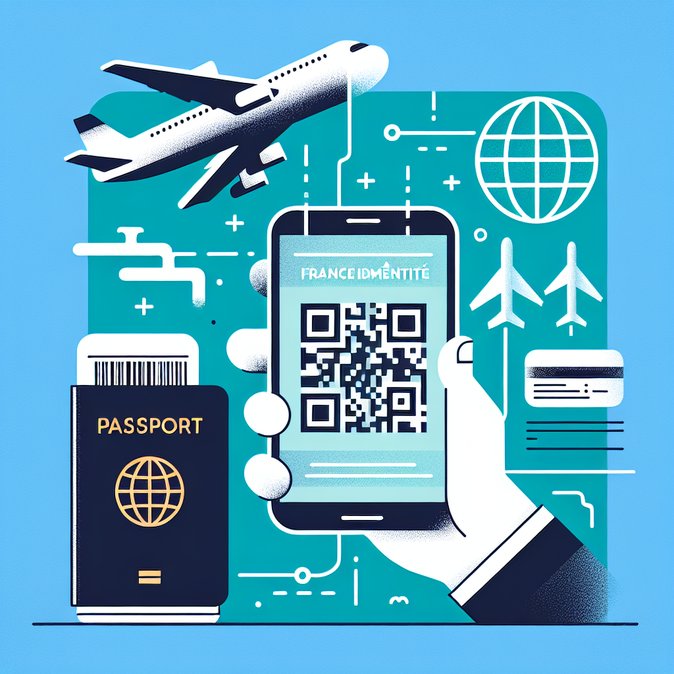
The French Civil Aviation Authority (DGAC) has confirmed that passengers will be able to board domestic and selected Schengen flights this summer using the France Identité smartphone app instead of a physical identity card.
The roll-out marks the first aviation use-case for the government-backed digital wallet, which already lets 3 million citizens prove their identity when collecting parcels, voting by proxy or showing a digital driving licence at roadside checks. From July, travellers holding the post-2021 biometric national ID card can generate a one-time QR code in the app that airline staff scan at security and the boarding gate. The scheme is initially limited to French citizens on flights within France and to Schengen destinations where an EU ID card is normally accepted, but the transport ministry says discussions are under way with Spain, Italy and Belgium to extend mutual recognition.
The development is part of Paris’s wider strategy to digitise travel documents ahead of the EU Entry/Exit System and the 2027 Digital Wallet Regulation. It should speed up processing at peak holiday periods and reduce the risk of passengers being turned away after forgetting a plastic card. However, two important caveats remain: a physical passport is still required for the inbound leg if the return airport cannot read the QR code, and non-French residents – including most expatriates – are excluded until at least late 2025 when the app may open to certain residence-permit holders.
![French Airports to Accept France Identité Digital ID From Summer 2026]()
Whether you’re a French national eager to try France Identité or an expatriate wondering which hard-copy documents you still need, VisaHQ can clarify the rules and assist with any complementary visas or travel authorisations you might require. Their platform (https://www.visahq.com/france/) offers up-to-date guidance, application management and real-time status tracking, taking the guesswork out of cross-border compliance.
For corporate travel managers the announcement is both an efficiency gain and a communications challenge. Firms with large numbers of French-national employees can encourage early adoption to cut dwell time at Orly, Roissy CDG, Nice and Lyon. Expatriate staff, posted workers and visiting clients, on the other hand, must be reminded that they still need hard-copy ID. Airlines are updating their check-in systems and will provide dedicated lanes for France Identité users; HR and mobility teams should circulate those details once published.
Longer term, acceptance of digital ID across transport modes – it already works on some SNCF high-speed routes – points to a future in which visas, residence permits and ETIAS travel authorisations sit in a single secure wallet. Mobility professionals should start mapping how those changes will affect duty-of-care procedures and document audits.
The roll-out marks the first aviation use-case for the government-backed digital wallet, which already lets 3 million citizens prove their identity when collecting parcels, voting by proxy or showing a digital driving licence at roadside checks. From July, travellers holding the post-2021 biometric national ID card can generate a one-time QR code in the app that airline staff scan at security and the boarding gate. The scheme is initially limited to French citizens on flights within France and to Schengen destinations where an EU ID card is normally accepted, but the transport ministry says discussions are under way with Spain, Italy and Belgium to extend mutual recognition.
The development is part of Paris’s wider strategy to digitise travel documents ahead of the EU Entry/Exit System and the 2027 Digital Wallet Regulation. It should speed up processing at peak holiday periods and reduce the risk of passengers being turned away after forgetting a plastic card. However, two important caveats remain: a physical passport is still required for the inbound leg if the return airport cannot read the QR code, and non-French residents – including most expatriates – are excluded until at least late 2025 when the app may open to certain residence-permit holders.
Whether you’re a French national eager to try France Identité or an expatriate wondering which hard-copy documents you still need, VisaHQ can clarify the rules and assist with any complementary visas or travel authorisations you might require. Their platform (https://www.visahq.com/france/) offers up-to-date guidance, application management and real-time status tracking, taking the guesswork out of cross-border compliance.
For corporate travel managers the announcement is both an efficiency gain and a communications challenge. Firms with large numbers of French-national employees can encourage early adoption to cut dwell time at Orly, Roissy CDG, Nice and Lyon. Expatriate staff, posted workers and visiting clients, on the other hand, must be reminded that they still need hard-copy ID. Airlines are updating their check-in systems and will provide dedicated lanes for France Identité users; HR and mobility teams should circulate those details once published.
Longer term, acceptance of digital ID across transport modes – it already works on some SNCF high-speed routes – points to a future in which visas, residence permits and ETIAS travel authorisations sit in a single secure wallet. Mobility professionals should start mapping how those changes will affect duty-of-care procedures and document audits.