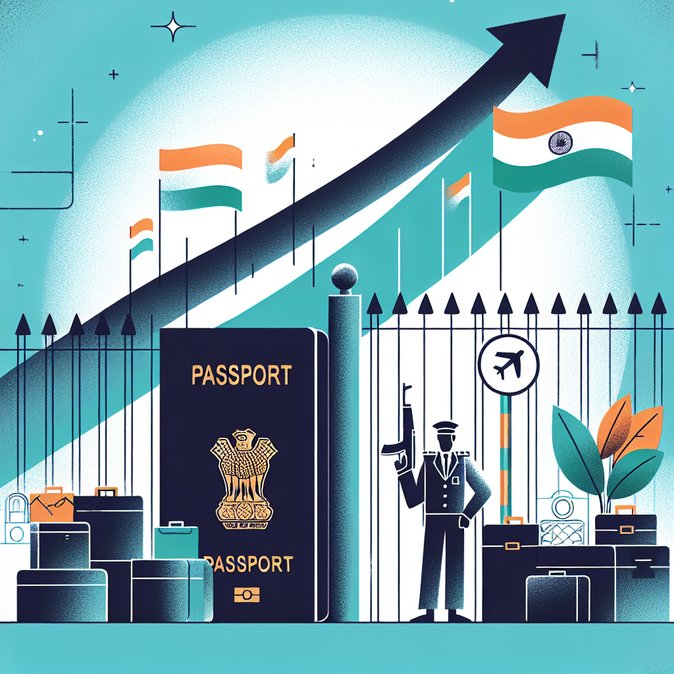
India’s travel document received an image boost on 15 February 2026 when the latest Henley Passport Index placed it 75th worldwide – a leap of ten places in just twelve months. The climb reflects incremental bilateral deals, the growing acceptance of India’s new e-passport and the reopening of many consular posts that had curtailed operations during the pandemic years. Government officials were quick to hail the ranking as evidence of India’s expanding ‘soft-power footprint’.
Yet beneath the headline, mobility experts point out that practical travel freedom for Indians has edged down, not up. The index confirms that ordinary passport-holders now enjoy visa-free, visa-on-arrival or electronic travel authorisation in 56 jurisdictions – two fewer than in 2025 after Iran suspended its waiver programme and Bolivia replaced visa-on-arrival with a paid e-visa. Tour operators say the change already influences itinerary design, noting that Gulf hubs such as Doha and Dubai are replacing Tehran as low-cost stop-overs for budget travellers.
![Indian passport rises 10 spots in Henley Index, but loses two visa-free destinations]()
In this climate, many travellers turn to digital aggregators for clarity. VisaHQ’s India portal (https://www.visahq.com/india/) lets users select a destination, view the latest visa requirements and, where needed, launch an online application or courier submission—saving multiple consulate visits while policies remain in flux.
For business mobility managers, the message is mixed. A higher ranking helps when negotiating corporate travel insurance and may reduce secondary screening at some airports, but the contraction of true visa-free access adds paperwork in the Middle East and South America. Companies routing assignees through Iran for offshore energy projects must now build in extra lead-time for filed visas, while travel buyers sending engineers to Bolivia’s lithium belt must budget for online fees and possible biometric capture on arrival.
Practically, Indian travellers should double-check entry rules even for destinations that were visa-free last season, maintain six-month passport validity and carry printed hotel and onward-ticket proof – requirements that consular officers say are being enforced more strictly since several cases of over-stay abuse came to light in late 2025.
Yet beneath the headline, mobility experts point out that practical travel freedom for Indians has edged down, not up. The index confirms that ordinary passport-holders now enjoy visa-free, visa-on-arrival or electronic travel authorisation in 56 jurisdictions – two fewer than in 2025 after Iran suspended its waiver programme and Bolivia replaced visa-on-arrival with a paid e-visa. Tour operators say the change already influences itinerary design, noting that Gulf hubs such as Doha and Dubai are replacing Tehran as low-cost stop-overs for budget travellers.

In this climate, many travellers turn to digital aggregators for clarity. VisaHQ’s India portal (https://www.visahq.com/india/) lets users select a destination, view the latest visa requirements and, where needed, launch an online application or courier submission—saving multiple consulate visits while policies remain in flux.
For business mobility managers, the message is mixed. A higher ranking helps when negotiating corporate travel insurance and may reduce secondary screening at some airports, but the contraction of true visa-free access adds paperwork in the Middle East and South America. Companies routing assignees through Iran for offshore energy projects must now build in extra lead-time for filed visas, while travel buyers sending engineers to Bolivia’s lithium belt must budget for online fees and possible biometric capture on arrival.
Practically, Indian travellers should double-check entry rules even for destinations that were visa-free last season, maintain six-month passport validity and carry printed hotel and onward-ticket proof – requirements that consular officers say are being enforced more strictly since several cases of over-stay abuse came to light in late 2025.