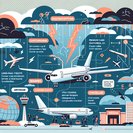
Travel plans for thousands of passengers leaving, entering or connecting through Brazil were up-ended on 15 February when São Paulo/Guarulhos, Brasília and Rio de Janeiro/Galeão struggled with a perfect storm of summer thunderstorms, crew shortages and cascading slot knock-ons. According to real-time data analysed by aviation tracker FlightAware, Guarulhos alone logged 20 cancellations and 80 delays in the first half of the day, while Congonhas, Brasília and Galeão added a further five cancellations and more than 60 delays. The bulk of the disruption hit LATAM Brasil and GOL Linhas Aéreas, but Azul, Copa and several regional carriers also reported schedule slippage. (travelandtourworld.com)
Operationally, the irregularities created a domino effect across Brazil’s domestic network and on long-haul departures to Miami, Lisbon and Buenos Aires, forcing aircraft rotations to be re-sequenced and fresh crews to be ferried from secondary bases. Guarulhos—responsible for more than half of Brazil’s international capacity—saw passengers miss onward connections to Asia and Europe, prompting airlines to invoke ANAC Resolution 400 protections that require re-routing, meal vouchers and, where necessary, hotel accommodation.
Amid the scramble, some travellers discovered that their onward itineraries suddenly required unexpected transit or entry visas—a headache that can be solved in minutes through VisaHQ’s digital service. Whether you need a Brazilian e-Visa reinstated for a longer layover or paperwork for a hastily rebooked connection to another country, the company’s step-by-step platform (https://www.visahq.com/brazil/) expedites applications and provides real-time status updates, sparing passengers yet another queue at the airport.
![Flight chaos at Brazil’s three busiest hubs as storms and staffing issues trigger 25 cancellations and 166 delays]()
For businesses, the timing could hardly be worse: the Monday–Wednesday Carnival bank holiday has already tightened hotel inventory and pushed rental-car prices up 30 percent. Corporate travel managers are advising employees to avoid same-day connections and to build in at least 24 hours of slack for time-sensitive meetings. In São Paulo, ride-share surge pricing briefly exceeded the regulated airport taxi fare as stranded travellers scrambled for last-minute city hotels.
From a policy standpoint, the episode has renewed calls for ANAC to fast-track its long-delayed slot-coordination reform, which would allow airlines to swap slots on the day of operation and reduce cascading delays. Consumer groups, meanwhile, are pressuring Congress to raise the automatic compensation ceiling beyond the current R$1,700, arguing that inflation has eroded its deterrent effect.
Practical tips for travellers: use airline apps rather than airport FIDS for the most current gate information; request written delay statements at the time of disruption to facilitate insurance claims; and, if travelling on separate tickets, proactively contact the second carrier once a delay exceeds two hours.
Operationally, the irregularities created a domino effect across Brazil’s domestic network and on long-haul departures to Miami, Lisbon and Buenos Aires, forcing aircraft rotations to be re-sequenced and fresh crews to be ferried from secondary bases. Guarulhos—responsible for more than half of Brazil’s international capacity—saw passengers miss onward connections to Asia and Europe, prompting airlines to invoke ANAC Resolution 400 protections that require re-routing, meal vouchers and, where necessary, hotel accommodation.
Amid the scramble, some travellers discovered that their onward itineraries suddenly required unexpected transit or entry visas—a headache that can be solved in minutes through VisaHQ’s digital service. Whether you need a Brazilian e-Visa reinstated for a longer layover or paperwork for a hastily rebooked connection to another country, the company’s step-by-step platform (https://www.visahq.com/brazil/) expedites applications and provides real-time status updates, sparing passengers yet another queue at the airport.

For businesses, the timing could hardly be worse: the Monday–Wednesday Carnival bank holiday has already tightened hotel inventory and pushed rental-car prices up 30 percent. Corporate travel managers are advising employees to avoid same-day connections and to build in at least 24 hours of slack for time-sensitive meetings. In São Paulo, ride-share surge pricing briefly exceeded the regulated airport taxi fare as stranded travellers scrambled for last-minute city hotels.
From a policy standpoint, the episode has renewed calls for ANAC to fast-track its long-delayed slot-coordination reform, which would allow airlines to swap slots on the day of operation and reduce cascading delays. Consumer groups, meanwhile, are pressuring Congress to raise the automatic compensation ceiling beyond the current R$1,700, arguing that inflation has eroded its deterrent effect.
Practical tips for travellers: use airline apps rather than airport FIDS for the most current gate information; request written delay statements at the time of disruption to facilitate insurance claims; and, if travelling on separate tickets, proactively contact the second carrier once a delay exceeds two hours.