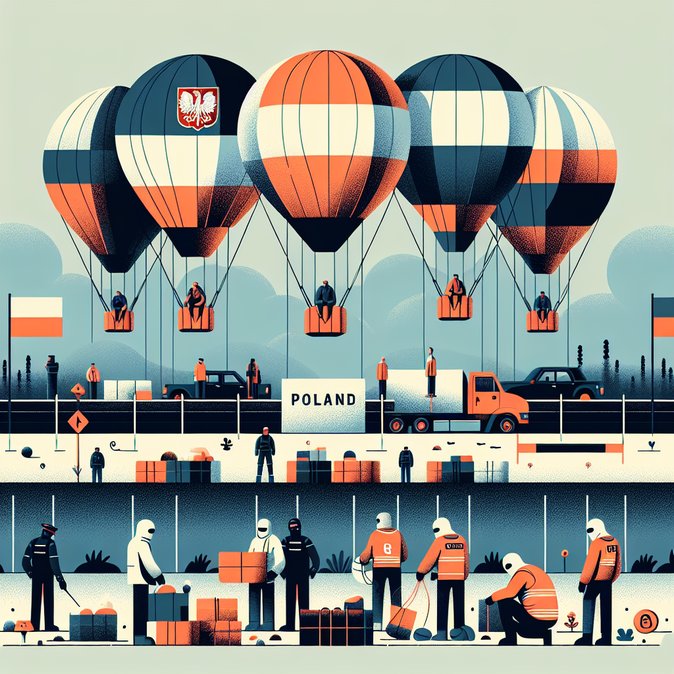
Polish border-security forces arrested eight suspects—four Poles and four Lithuanians—near Sokółka on 13 February after they retrieved bundles of Belarusian cigarettes floated across the frontier beneath meteorological balloons. Interior Minister Marcin Kierwiński said the gang is linked to a wider network that has cost the Treasury an estimated PLN 2.8 million (€800,000) in lost excise so far this year.
Radar operators had tracked multiple balloon incursions on 28 and 31 January and on 1, 4 and 9 February. Ground units mounted overnight surveillance of likely landing zones before moving in. The detainees, aged 20–44, will face fiscal-crime charges and potential expulsion orders under Poland’s 2023 law targeting economic activities that could finance Russia’s aggression.
The arrests highlight the increasingly creative methods smugglers adopt to sidestep the 186-km border barrier erected in 2022. Last December, authorities recorded 59 balloon overflights in a single night. Poland has now requested additional EU funding to deploy counter-UAV sensors along its eastern frontier.
![Border Guards Foil Balloon-Borne Cigarette Smuggling from Belarus]()
Amid this tightening of frontier controls, international staff and compliance officers who need to travel to or work in Poland may encounter more rigorous document checks at crossings and airports. VisaHQ can smooth the process by providing up-to-date visa requirements, online applications, and courier support for Polish travel documents—see https://www.visahq.com/poland/ for details.
For logistics and supply-chain compliance teams, the case is a cautionary tale: contraband routed through Poland can trigger downstream liability if intercepted further west. Transport operators should verify cargo origins and beware of seemingly innocuous consignments sourced near the Belarus border.
Lithuania, which has also reported balloon incursions, continues to close sections of its airspace and is lobbying to have such hybrid tactics labelled as state-sponsored terrorism, potentially opening the door to coordinated EU sanctions.
Radar operators had tracked multiple balloon incursions on 28 and 31 January and on 1, 4 and 9 February. Ground units mounted overnight surveillance of likely landing zones before moving in. The detainees, aged 20–44, will face fiscal-crime charges and potential expulsion orders under Poland’s 2023 law targeting economic activities that could finance Russia’s aggression.
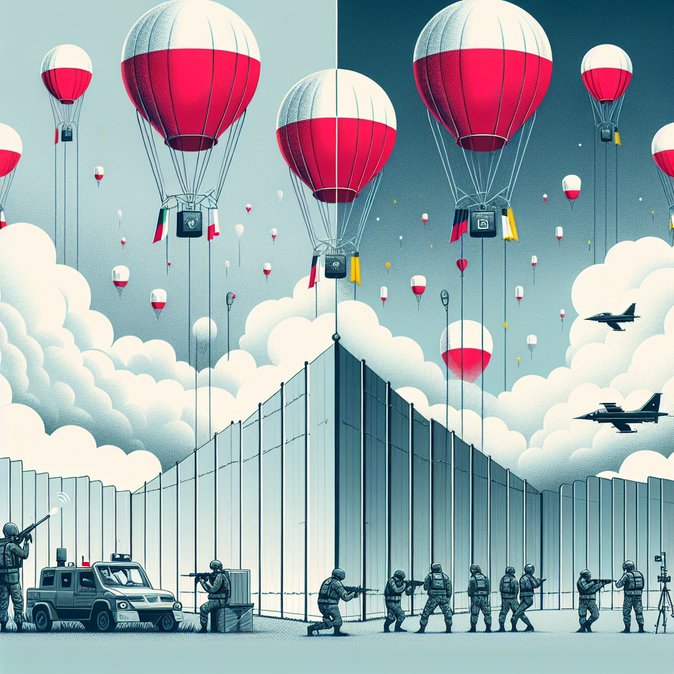
The arrests highlight the increasingly creative methods smugglers adopt to sidestep the 186-km border barrier erected in 2022. Last December, authorities recorded 59 balloon overflights in a single night. Poland has now requested additional EU funding to deploy counter-UAV sensors along its eastern frontier.
Amid this tightening of frontier controls, international staff and compliance officers who need to travel to or work in Poland may encounter more rigorous document checks at crossings and airports. VisaHQ can smooth the process by providing up-to-date visa requirements, online applications, and courier support for Polish travel documents—see https://www.visahq.com/poland/ for details.
For logistics and supply-chain compliance teams, the case is a cautionary tale: contraband routed through Poland can trigger downstream liability if intercepted further west. Transport operators should verify cargo origins and beware of seemingly innocuous consignments sourced near the Belarus border.
Lithuania, which has also reported balloon incursions, continues to close sections of its airspace and is lobbying to have such hybrid tactics labelled as state-sponsored terrorism, potentially opening the door to coordinated EU sanctions.