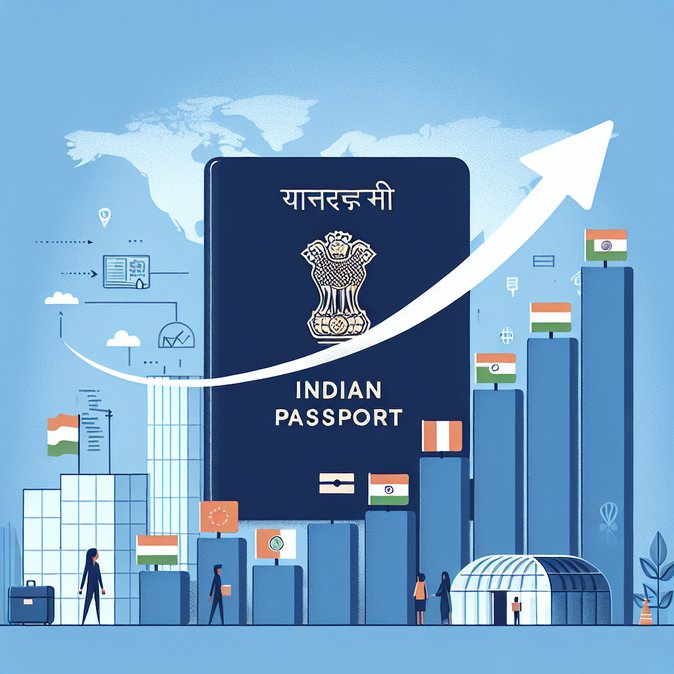
India’s passport has received a timely Valentine’s-Day gift. The February 2026 edition of the Henley Passport Index shows India climbing from 85th place last year to 75th, the country’s best showing since 2014. While the absolute number of destinations Indian citizens can enter without securing a visa in advance has inched up only marginally—from 55 in January to 56 this month after The Gambia restored visa-on-arrival facilities—the improved rank reflects sharper declines for several peer economies.
Context matters. In late-2025 Iran scrapped its visa-free entry for Indians following trafficking concerns, and Bolivia shifted Indians to an e-visa that requires prior approval. Those moves dented India’s tally, but they also coincided with reversals elsewhere (notably in Latin America and parts of Africa) that pushed other emerging-market passports down the table. The net effect: India’s comparative mobility strength rose.
For business travellers this incremental lift is more than symbolic. Henley data show that Indian executives today can reach roughly one quarter of the world’s economies visa-free or on arrival; a decade ago that share was closer to one fifth. Destinations such as Indonesia, Serbia and, as of this month, The Gambia are courting Indian investors and tourists with simplified entry, a trend consulates say is driven by India’s post-pandemic outbound boom, which crossed US$17 billion in 2025.
![Indian passport jumps 10 places to 75th in the Henley Index, unlocking 56 visa-free or VOA destinations]()
To navigate the still-fractured visa landscape, corporate travel desks can lean on VisaHQ’s concierge platform. Its India portal (https://www.visahq.com/india/) tracks changing entry rules in real time, secures embassy appointments, files e-visa applications and arranges courier pickups, freeing HR and mobility managers to focus on itineraries rather than paperwork.
Companies running regional hubs in Dubai or Singapore should update their travel-policy matrices, as staff holding Indian passports may now bypass pre-trip consular visits for an expanded list of meetings and site visits. HR teams should also note that the Index does not yet count India’s new chip-embedded e-passport, expected to roll out at all Passport Seva Kendras by July; officials say that upgrade could unlock additional fast-track e-gate agreements in the Gulf and ASEAN in the next 12 months.
Practically, travellers must still monitor bilateral quirks—e.g., Iran now requires advance clearance—but the upward trajectory sends an encouraging signal to multinational mobility managers: India’s negotiating weight is translating into fewer visa bottlenecks, helping shorten lead times for short-notice assignments and client calls.
Context matters. In late-2025 Iran scrapped its visa-free entry for Indians following trafficking concerns, and Bolivia shifted Indians to an e-visa that requires prior approval. Those moves dented India’s tally, but they also coincided with reversals elsewhere (notably in Latin America and parts of Africa) that pushed other emerging-market passports down the table. The net effect: India’s comparative mobility strength rose.
For business travellers this incremental lift is more than symbolic. Henley data show that Indian executives today can reach roughly one quarter of the world’s economies visa-free or on arrival; a decade ago that share was closer to one fifth. Destinations such as Indonesia, Serbia and, as of this month, The Gambia are courting Indian investors and tourists with simplified entry, a trend consulates say is driven by India’s post-pandemic outbound boom, which crossed US$17 billion in 2025.

To navigate the still-fractured visa landscape, corporate travel desks can lean on VisaHQ’s concierge platform. Its India portal (https://www.visahq.com/india/) tracks changing entry rules in real time, secures embassy appointments, files e-visa applications and arranges courier pickups, freeing HR and mobility managers to focus on itineraries rather than paperwork.
Companies running regional hubs in Dubai or Singapore should update their travel-policy matrices, as staff holding Indian passports may now bypass pre-trip consular visits for an expanded list of meetings and site visits. HR teams should also note that the Index does not yet count India’s new chip-embedded e-passport, expected to roll out at all Passport Seva Kendras by July; officials say that upgrade could unlock additional fast-track e-gate agreements in the Gulf and ASEAN in the next 12 months.
Practically, travellers must still monitor bilateral quirks—e.g., Iran now requires advance clearance—but the upward trajectory sends an encouraging signal to multinational mobility managers: India’s negotiating weight is translating into fewer visa bottlenecks, helping shorten lead times for short-notice assignments and client calls.