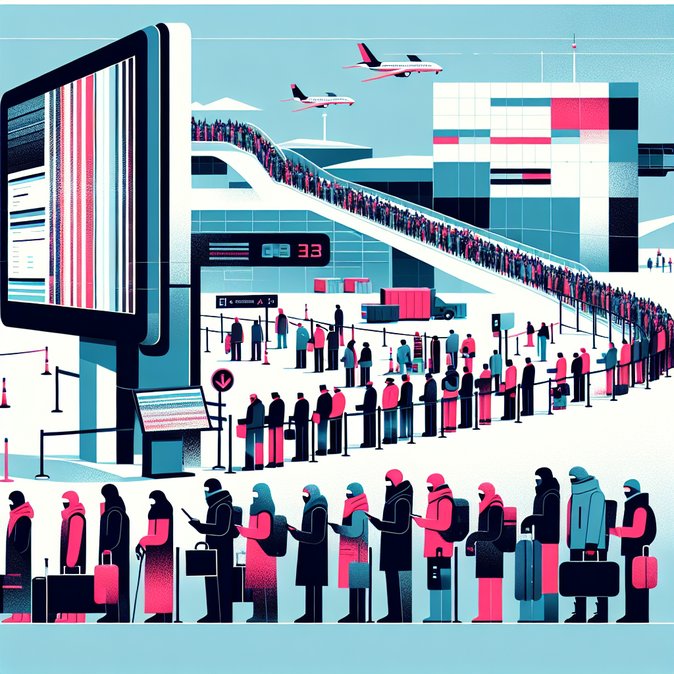
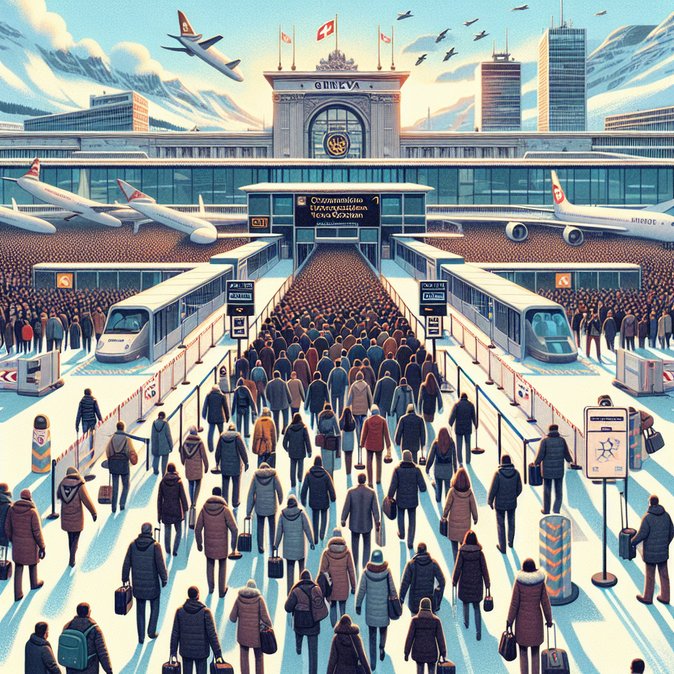
International arrivals at Geneva Airport faced up to two-and-a-half hours in passport-control lines on Friday evening as the European Entry/Exit System (EES) strained under peak ski-season traffic. Public broadcaster RTS described the scene as “interminable queues” stretching the length of the arrivals concourse, with some airlines reporting missed coach transfers to Alpine resorts.
The EES—rolled out in Switzerland between October and November 2025—replaces manual passport stamping with biometric registration for every non-EU and non-EFTA traveller. While designed to speed up border checks and calculate permissible stay time automatically, the system adds several steps: face-image capture, four-finger printing and an electronic declaration. Geneva Airport says it has doubled staffing at control booths and deployed a crisis team to clear luggage piled up because many passengers were still stuck in immigration when their bags hit the carousel.
Travellers anxious to avoid surprises at the border can streamline their preparation well before departure. VisaHQ’s Switzerland portal (https://www.visahq.com/switzerland/) offers step-by-step visa guidance, EES pre-registration resources and real-time alerts on entry-rule changes, helping passengers arrive with the right documents and realistic expectations about processing times.
![Geneva Airport Hit by 2-Hour Immigration Queues as EU Biometric System Bites]()
The bottleneck is not uniquely Swiss. In a joint letter to EU Home-Affairs Commissioner Magnus Brunner this week, Airports Council International (Europe), Airlines for Europe and IATA warned that chronic understaffing, software glitches and the low take-up of the Frontex pre-registration app are producing waits of “up to two hours” across the Schengen zone and could balloon to four hours by the summer rush.
For Switzerland, the reputational risk is acute. The country markets itself on efficiency and attracts hundreds of thousands of UK and US skiers every winter; negative social-media coverage of three-hour queues could redirect next season’s traffic to Austria or Italy. Travel-management companies are already advising corporate travellers to arrive at least three hours before departure and to build buffer time into meetings scheduled immediately after landing.
Looking ahead, Swiss border police say a software update due in March should shave 30 seconds off each transaction. Airlines are lobbying Bern to authorise dedicated fast-track lanes for premium passengers and global-entry style kiosks for frequent travellers. HR teams should brief mobile staff on likely delays, advise them to complete pre-registration where available and monitor airline contingency plans for connection protection.
The EES—rolled out in Switzerland between October and November 2025—replaces manual passport stamping with biometric registration for every non-EU and non-EFTA traveller. While designed to speed up border checks and calculate permissible stay time automatically, the system adds several steps: face-image capture, four-finger printing and an electronic declaration. Geneva Airport says it has doubled staffing at control booths and deployed a crisis team to clear luggage piled up because many passengers were still stuck in immigration when their bags hit the carousel.
Travellers anxious to avoid surprises at the border can streamline their preparation well before departure. VisaHQ’s Switzerland portal (https://www.visahq.com/switzerland/) offers step-by-step visa guidance, EES pre-registration resources and real-time alerts on entry-rule changes, helping passengers arrive with the right documents and realistic expectations about processing times.
The bottleneck is not uniquely Swiss. In a joint letter to EU Home-Affairs Commissioner Magnus Brunner this week, Airports Council International (Europe), Airlines for Europe and IATA warned that chronic understaffing, software glitches and the low take-up of the Frontex pre-registration app are producing waits of “up to two hours” across the Schengen zone and could balloon to four hours by the summer rush.
For Switzerland, the reputational risk is acute. The country markets itself on efficiency and attracts hundreds of thousands of UK and US skiers every winter; negative social-media coverage of three-hour queues could redirect next season’s traffic to Austria or Italy. Travel-management companies are already advising corporate travellers to arrive at least three hours before departure and to build buffer time into meetings scheduled immediately after landing.
Looking ahead, Swiss border police say a software update due in March should shave 30 seconds off each transaction. Airlines are lobbying Bern to authorise dedicated fast-track lanes for premium passengers and global-entry style kiosks for frequent travellers. HR teams should brief mobile staff on likely delays, advise them to complete pre-registration where available and monitor airline contingency plans for connection protection.