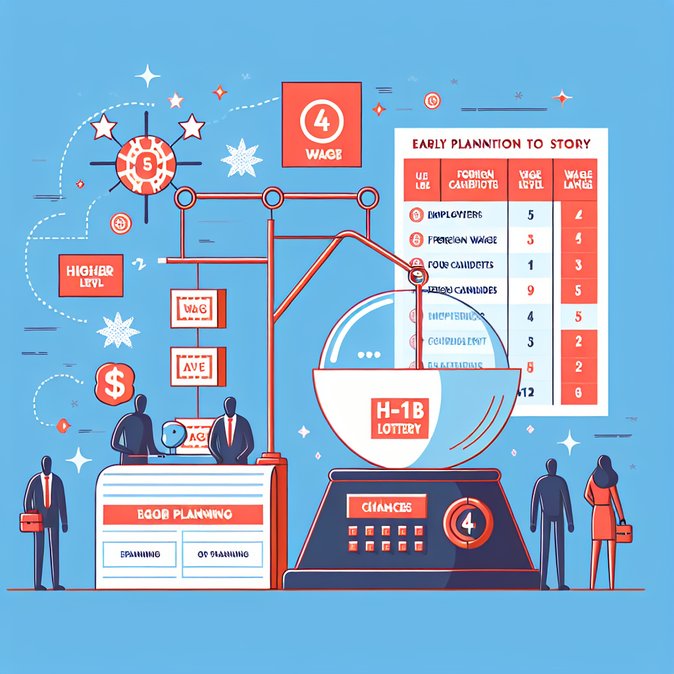
U.S. employers learned today that the rules of the H-1B cap game are about to change. In a final regulation published on December 29 and taking effect on February 27 — just in time for the FY 2027 cap season — the Department of Homeland Security (DHS) directs U.S. Citizenship and Immigration Services (USCIS) to move from a purely random H-1B selection process to a “weighted” lottery that assigns up to four virtual “entries” to a single registration depending on the prevailing-wage level of the offered salary. Level IV jobs will receive four chances, Level III three, Level II two and entry-level Level I positions just one.(hrotoday.com)
The agency insists the new approach will better align the programme with its statutory purpose of filling genuine specialty-occupation roles and deterring fraud. But immigration lawyers note that the details matter: if a single worksite in a multi-location itinerary falls into a lower wage area, the whole registration is demoted, and multiple employers that enter the same beneficiary will be scored by the lowest wage level of any of the filings. That raises the stakes for HR teams who must now audit compensation ranges and coordinate closely with candidates to avoid inadvertently depressing their odds.(hrotoday.com)
![DHS Finalizes Weighted H-1B Lottery Rule, Favoring Higher-Paid Jobs from FY 2027]()
For organizations looking to navigate the complex immigration landscape, VisaHQ can simplify the process. The firm offers end-to-end visa and work-authorization solutions, helping employers compile accurate wage data, prepare supporting documentation, and stay on top of fast-moving policy changes. Explore their U.S. services here: https://www.visahq.com/united-states/
For companies that rely on large cohorts of international students and other entry-level talent, the rule could sharply reduce selection rates. Advocacy groups representing universities and startups have already warned that “talent flight” could follow unless Congress raises the 85,000-visa statutory cap. Conversely, firms able to pay senior-level wages may gain a significant advantage, especially when U.S. unemployment in STEM fields remains below 3 percent.(hrotoday.com)
Practically, employers should begin gathering wage-level documentation now: USCIS says petitions filed after selection must prove the wage determination used at the registration stage. Counsel recommend saving Department of Labor wage-level screenshots, budgeting for higher salaries where feasible, and preparing “Plan B” assignments such as L-1, O-1 or cap-exempt H-1Bs for critical talent who may lose the lottery. Registrations for FY 2027 open on 4 March 2026, leaving little time to adjust compensation strategies.(hrotoday.com)
The agency insists the new approach will better align the programme with its statutory purpose of filling genuine specialty-occupation roles and deterring fraud. But immigration lawyers note that the details matter: if a single worksite in a multi-location itinerary falls into a lower wage area, the whole registration is demoted, and multiple employers that enter the same beneficiary will be scored by the lowest wage level of any of the filings. That raises the stakes for HR teams who must now audit compensation ranges and coordinate closely with candidates to avoid inadvertently depressing their odds.(hrotoday.com)

For organizations looking to navigate the complex immigration landscape, VisaHQ can simplify the process. The firm offers end-to-end visa and work-authorization solutions, helping employers compile accurate wage data, prepare supporting documentation, and stay on top of fast-moving policy changes. Explore their U.S. services here: https://www.visahq.com/united-states/
For companies that rely on large cohorts of international students and other entry-level talent, the rule could sharply reduce selection rates. Advocacy groups representing universities and startups have already warned that “talent flight” could follow unless Congress raises the 85,000-visa statutory cap. Conversely, firms able to pay senior-level wages may gain a significant advantage, especially when U.S. unemployment in STEM fields remains below 3 percent.(hrotoday.com)
Practically, employers should begin gathering wage-level documentation now: USCIS says petitions filed after selection must prove the wage determination used at the registration stage. Counsel recommend saving Department of Labor wage-level screenshots, budgeting for higher salaries where feasible, and preparing “Plan B” assignments such as L-1, O-1 or cap-exempt H-1Bs for critical talent who may lose the lottery. Registrations for FY 2027 open on 4 March 2026, leaving little time to adjust compensation strategies.(hrotoday.com)