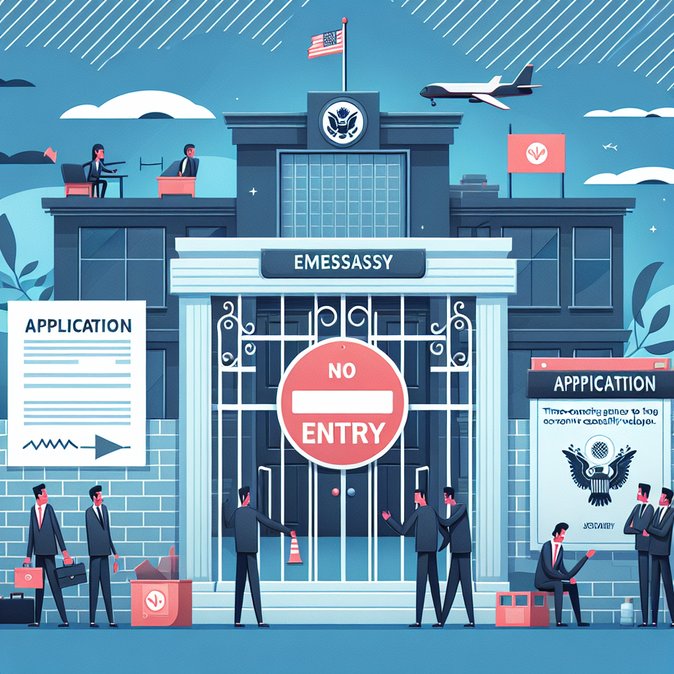
C-suite travellers bound for the United States are discovering that misdemeanours once waved through the consular process can now torpedo a trip. The Financial Times reports a surge in refusals at the U.S. Embassy in London, where consular officers are denying B-1/B-2 and E-1/E-2 visas over minor infractions such as university-era cannabis possession, decades-old police cautions and single-instance drink-driving arrests.
Immigration lawyers told the FT that denials under Section 214(b)—a broad provision requiring applicants to prove non-immigrant intent—have spiked since the start of President Donald Trump’s second term in January 2025. The clamp-down is tied to Secretary of State Marco Rubio’s “catch-and-revoke” directive, which instructs posts worldwide to re-examine any criminal history, however dated, when assessing admissibility. Crucially, officers may refuse without providing specific reasons, leaving applicants little recourse beyond a costly waiver process that can add months to timelines.
For executives caught in this tightening net, specialist assistance can be invaluable. VisaHQ, an online visa facilitation service, helps applicants assemble airtight B-1/B-2 and E-classification filings, flags potential inadmissibility issues early and shepherds clients through the waiver maze when required. C-suite teams can tap its U.K. portal at https://www.visahq.com/united-states/ to streamline paperwork and salvage critical travel timelines.
![U.S. embassy in London tightens visa screening—executives turned away for decades-old cautions]()
The business fallout is immediate. British and European firms say senior staff have missed board meetings, trade-show keynotes and investor roadshows in New York and San Francisco. One aerospace company had to reroute a product-launch team through Dublin only to see visas cancelled upon arrival for secondary screening. Attempts to apply at ‘easier’ posts such as Paris or Madrid have been thwarted by new inter-consular data sharing that flags previous refusals.
Consulates have also stopped publishing monthly issuance statistics, obscuring trends just as demand for U.S. travel begins to recover. Travel-industry groups fear a chilling effect akin to the post-9/11 slowdown, warning that London is a bell-wether for how other embassies may apply the policy.
Practical steps for mobility managers include deeper background checks on transferees, early contingency planning for waiver filings and renewed emphasis on remote-first alternatives for board and compliance meetings. Given that the visa bond pilot and $250 ‘integrity fee’ already inflate costs, companies must now add unpredictability to the calculus of sending staff stateside.
Immigration lawyers told the FT that denials under Section 214(b)—a broad provision requiring applicants to prove non-immigrant intent—have spiked since the start of President Donald Trump’s second term in January 2025. The clamp-down is tied to Secretary of State Marco Rubio’s “catch-and-revoke” directive, which instructs posts worldwide to re-examine any criminal history, however dated, when assessing admissibility. Crucially, officers may refuse without providing specific reasons, leaving applicants little recourse beyond a costly waiver process that can add months to timelines.
For executives caught in this tightening net, specialist assistance can be invaluable. VisaHQ, an online visa facilitation service, helps applicants assemble airtight B-1/B-2 and E-classification filings, flags potential inadmissibility issues early and shepherds clients through the waiver maze when required. C-suite teams can tap its U.K. portal at https://www.visahq.com/united-states/ to streamline paperwork and salvage critical travel timelines.

The business fallout is immediate. British and European firms say senior staff have missed board meetings, trade-show keynotes and investor roadshows in New York and San Francisco. One aerospace company had to reroute a product-launch team through Dublin only to see visas cancelled upon arrival for secondary screening. Attempts to apply at ‘easier’ posts such as Paris or Madrid have been thwarted by new inter-consular data sharing that flags previous refusals.
Consulates have also stopped publishing monthly issuance statistics, obscuring trends just as demand for U.S. travel begins to recover. Travel-industry groups fear a chilling effect akin to the post-9/11 slowdown, warning that London is a bell-wether for how other embassies may apply the policy.
Practical steps for mobility managers include deeper background checks on transferees, early contingency planning for waiver filings and renewed emphasis on remote-first alternatives for board and compliance meetings. Given that the visa bond pilot and $250 ‘integrity fee’ already inflate costs, companies must now add unpredictability to the calculus of sending staff stateside.