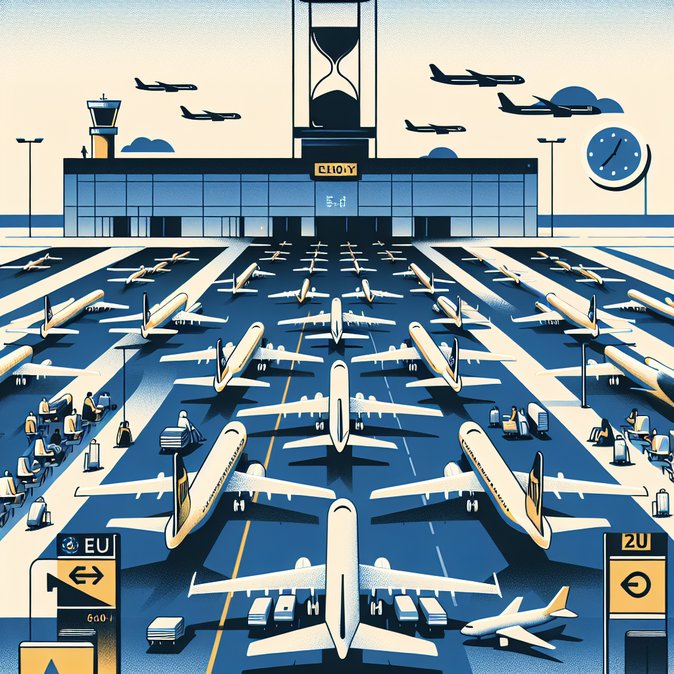
Dublin Airport experienced major knock-on disruptions on 7 February 2026, recording 211 delayed departures and arrivals alongside three outright cancellations, according to air-passenger-rights firm AirHelp. While the data were published on 9 February, they paint a detailed picture of mid-winter operational stress at Ireland’s largest hub.
Ryanair bore the brunt—102 delayed sectors and two cancellations—followed by Emerald Airlines (38 delays), Aer Lingus (26), and Buzz (17). Legacy carriers including British Airways, Air France, KLM, SAS, United Airlines and Air Canada also suffered scattered delays, indicating that the problem affected both short-haul and long-haul operations.
AirHelp links the disruption chiefly to brisk Atlantic weather fronts combined with saturated European air-traffic-control (ATC) flows. Routes to and from Manchester, Edinburgh, London Heathrow and Amsterdam Schiphol were repeatedly cited, and all three cancellations involved the Berlin Brandenburg sector. Long-haul services fared better, suggesting that slot restrictions and crew-duty limits on tight European rotations were the weak point.
![Heavy delays hit Dublin Airport, with 211 flights late and three cancelled]()
Travellers whose itineraries suddenly shift because of delays or cancellations often also need to adjust onward visa or transit documentation, and that's where VisaHQ can step in. The platform (https://www.visahq.com/ireland/) provides real-time visa requirements, expedited processing and live support, making it easier for Dublin-bound passengers to keep paperwork aligned with last-minute flight changes.
For corporate travel managers, the episode is another reminder that winter remains an unpredictable period despite post-pandemic traffic normalisation. Contingency buffers—longer connection windows, flexible tickets and real-time traveller-tracking—remain best practice when scheduling short business hops out of Dublin. Under EU Regulation 261/2004, affected passengers may be entitled to compensation or rerouting; mobility teams should encourage staff to file claims promptly and retain boarding passes and delay notifications.
Airport operator daa has highlighted ongoing investments in de-icing pads and stands, but industry analysts note that the airport is already operating well above the long-debated 32 million-passenger planning cap. Until a final decision is reached on lifting that cap, slot pressure during weather events is likely to continue.
Ryanair bore the brunt—102 delayed sectors and two cancellations—followed by Emerald Airlines (38 delays), Aer Lingus (26), and Buzz (17). Legacy carriers including British Airways, Air France, KLM, SAS, United Airlines and Air Canada also suffered scattered delays, indicating that the problem affected both short-haul and long-haul operations.
AirHelp links the disruption chiefly to brisk Atlantic weather fronts combined with saturated European air-traffic-control (ATC) flows. Routes to and from Manchester, Edinburgh, London Heathrow and Amsterdam Schiphol were repeatedly cited, and all three cancellations involved the Berlin Brandenburg sector. Long-haul services fared better, suggesting that slot restrictions and crew-duty limits on tight European rotations were the weak point.
Travellers whose itineraries suddenly shift because of delays or cancellations often also need to adjust onward visa or transit documentation, and that's where VisaHQ can step in. The platform (https://www.visahq.com/ireland/) provides real-time visa requirements, expedited processing and live support, making it easier for Dublin-bound passengers to keep paperwork aligned with last-minute flight changes.
For corporate travel managers, the episode is another reminder that winter remains an unpredictable period despite post-pandemic traffic normalisation. Contingency buffers—longer connection windows, flexible tickets and real-time traveller-tracking—remain best practice when scheduling short business hops out of Dublin. Under EU Regulation 261/2004, affected passengers may be entitled to compensation or rerouting; mobility teams should encourage staff to file claims promptly and retain boarding passes and delay notifications.
Airport operator daa has highlighted ongoing investments in de-icing pads and stands, but industry analysts note that the airport is already operating well above the long-debated 32 million-passenger planning cap. Until a final decision is reached on lifting that cap, slot pressure during weather events is likely to continue.