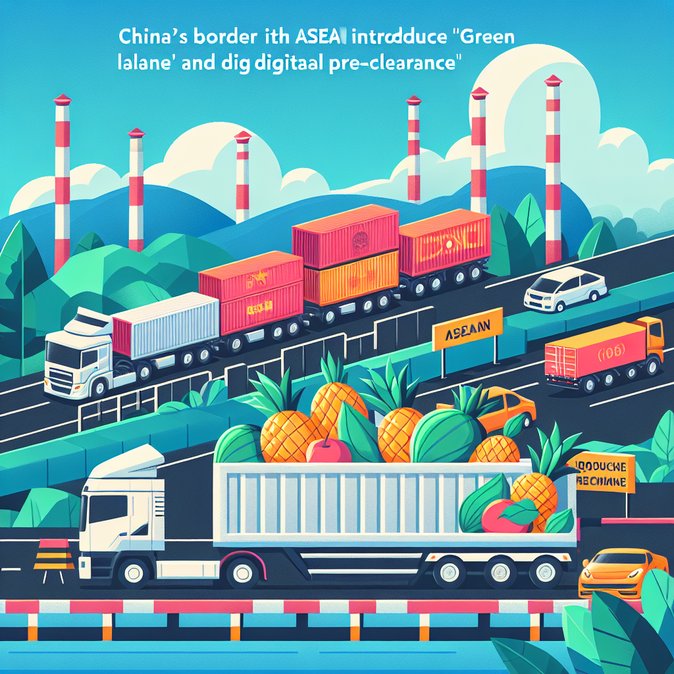
China’s appetite for festive produce is fuelling a sharp spike in fresh fruit movements across the Friendship Pass and other Sino-ASEAN checkpoints. At a wholesale bazaar in Pingxiang, Guangxi, traders reported Thai durians and pomelos selling out within hours, while customs officials said inspection teams are working round-the-clock to clear refrigerated trucks before perishable cargo spoils. (xinhuanet.com)
According to Nanning Customs, inbound consignments of Southeast Asian fruit have risen by double digits since mid-January. Customs has opened “green lanes” with simplified documentation, on-site phytosanitary scanning and electronic seals that allow sealed containers to proceed directly to inland cold-chain hubs.
For logistics providers, the acceleration reduces dwell times and improves truck-turn productivity during the most congested period of the year. Importers also benefit from a newly introduced pre-clearance system that lets brokers submit digital manifests 24 hours before trucks arrive, shaving an average of six hours off border processing.
![Border Customs Gear Up as Lunar-New-Year Demand Drives Surge in ASEAN Fruit Imports]()
Meanwhile, supply-chain planners juggling trans-border site visits and last-minute quality inspections may need rapid visa support for staff shuttling between China and ASEAN neighbours. VisaHQ’s online platform (https://www.visahq.com/china/) simplifies the application process for Chinese visas and other travel documents, allowing logistics coordinators to focus on temperature logs and delivery schedules rather than embassy queues.
Multinational retailers and caterers—many of whom rely on premium durian, longan and mangosteen for corporate gift hampers—are advised to lock in cold-chain slots early and factor in potential weather-related highway closures despite the customs efficiencies.
The surge highlights the continuing liberalisation of agri-trade corridors under the Regional Comprehensive Economic Partnership (RCEP) and is a bell-wether for how Chinese border agencies might handle other time-sensitive imports, from biotech reagents to temperature-controlled pharmaceuticals.
According to Nanning Customs, inbound consignments of Southeast Asian fruit have risen by double digits since mid-January. Customs has opened “green lanes” with simplified documentation, on-site phytosanitary scanning and electronic seals that allow sealed containers to proceed directly to inland cold-chain hubs.
For logistics providers, the acceleration reduces dwell times and improves truck-turn productivity during the most congested period of the year. Importers also benefit from a newly introduced pre-clearance system that lets brokers submit digital manifests 24 hours before trucks arrive, shaving an average of six hours off border processing.

Meanwhile, supply-chain planners juggling trans-border site visits and last-minute quality inspections may need rapid visa support for staff shuttling between China and ASEAN neighbours. VisaHQ’s online platform (https://www.visahq.com/china/) simplifies the application process for Chinese visas and other travel documents, allowing logistics coordinators to focus on temperature logs and delivery schedules rather than embassy queues.
Multinational retailers and caterers—many of whom rely on premium durian, longan and mangosteen for corporate gift hampers—are advised to lock in cold-chain slots early and factor in potential weather-related highway closures despite the customs efficiencies.
The surge highlights the continuing liberalisation of agri-trade corridors under the Regional Comprehensive Economic Partnership (RCEP) and is a bell-wether for how Chinese border agencies might handle other time-sensitive imports, from biotech reagents to temperature-controlled pharmaceuticals.