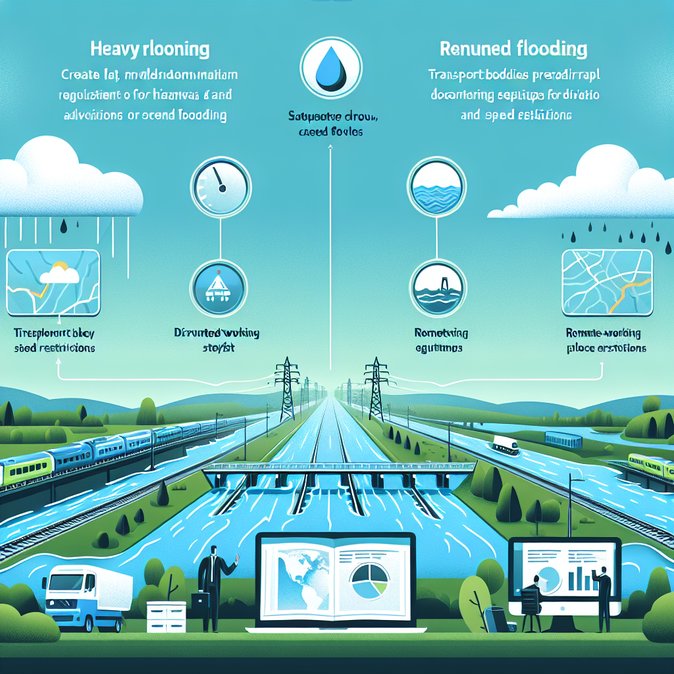
Ireland’s meteorological service Met Éireann has signalled that further Status Yellow and possibly Status Orange rainfall warnings are likely to be issued early in the week commencing 9 February, as saturated catchments struggle to absorb additional precipitation after Storm Chandra. Heavy downpours are forecast for the east and south-east, with forecasters flagging renewed risks to road and rail corridors already weakened by last week’s floods.
Meteorologist Cathal Nolan told national media on 8 February that ‘any extra rainfall now runs straight off into rivers’, raising the prospect of flash-flooding on the N11, M7 and Dublin–Wexford rail line. Transport Infrastructure Ireland (TII) has pre-positioned pumps and portable barriers at known blackspots, while Irish Rail is carrying out overnight ballast inspections to decide whether speed restrictions are required.
Travellers whose plans may pivot unexpectedly because of these weather alerts should also make sure their paperwork is weather-proof. VisaHQ’s Ireland portal (https://www.visahq.com/ireland/) provides instant visa requirement checks, embassy updates and expedited courier services, helping visitors, business travellers and assignees keep documentation in order even when itineraries shift at short notice.
![Met Éireann warns of fresh rain alerts as flood-damaged transport network remains fragile]()
Although drier, colder air is expected mid-week, the shift will introduce icy surfaces and wintry showers, especially in Ulster. Airport operations at Dublin and Cork remain normal, but the Irish Aviation Authority has advised carriers to anticipate de-icing delays on morning departures. Bus Éireann has published diversion plans for rural routes that cross at-risk bridges.
For mobility managers, the continuing instability means travellers should leave additional journey time, download real-time transport apps and keep accommodation options close to the workplace. Assignees living in rental properties near floodplains should photograph any new water ingress for insurance purposes and consult local authority helplines if sandbags are required.
The government’s National Emergency Co-ordination Group remains on standby; should new Orange warnings be issued, temporary remote-working tax reliefs introduced during Storm Babet in 2025 are likely to be reactivated, allowing employers to reimburse home-office costs tax-free for affected staff.
Meteorologist Cathal Nolan told national media on 8 February that ‘any extra rainfall now runs straight off into rivers’, raising the prospect of flash-flooding on the N11, M7 and Dublin–Wexford rail line. Transport Infrastructure Ireland (TII) has pre-positioned pumps and portable barriers at known blackspots, while Irish Rail is carrying out overnight ballast inspections to decide whether speed restrictions are required.
Travellers whose plans may pivot unexpectedly because of these weather alerts should also make sure their paperwork is weather-proof. VisaHQ’s Ireland portal (https://www.visahq.com/ireland/) provides instant visa requirement checks, embassy updates and expedited courier services, helping visitors, business travellers and assignees keep documentation in order even when itineraries shift at short notice.

Although drier, colder air is expected mid-week, the shift will introduce icy surfaces and wintry showers, especially in Ulster. Airport operations at Dublin and Cork remain normal, but the Irish Aviation Authority has advised carriers to anticipate de-icing delays on morning departures. Bus Éireann has published diversion plans for rural routes that cross at-risk bridges.
For mobility managers, the continuing instability means travellers should leave additional journey time, download real-time transport apps and keep accommodation options close to the workplace. Assignees living in rental properties near floodplains should photograph any new water ingress for insurance purposes and consult local authority helplines if sandbags are required.
The government’s National Emergency Co-ordination Group remains on standby; should new Orange warnings be issued, temporary remote-working tax reliefs introduced during Storm Babet in 2025 are likely to be reactivated, allowing employers to reimburse home-office costs tax-free for affected staff.