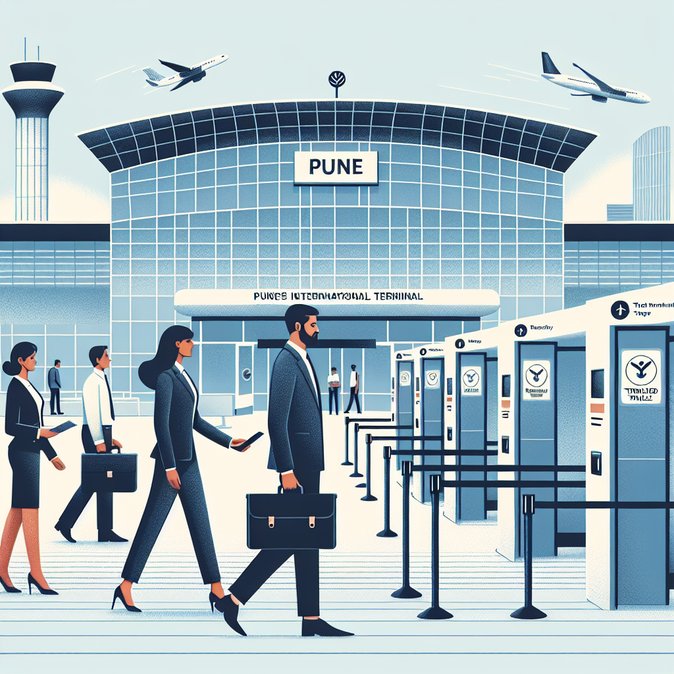
Pune’s Lohegaon International Airport is on track to become the 14th Indian gateway to offer automated e-gates under the Fast-Track Immigration–Trusted Traveller Programme (FTI-TTP). Minister of State for Civil Aviation Murlidhar Mohol told reporters on 7 February that he will formally request the Ministry of Home Affairs to extend the scheme to Pune, a move long demanded by frequent flyers and export-oriented companies in Maharashtra’s second-largest city.
FTI-TTP, first rolled out at Delhi and Bengaluru in 2023, allows pre-verified Indian citizens and eligible foreign residents to breeze through immigration in under 30 seconds by scanning a biometric-enabled passport or national ID at an automated gate. The traveller’s data are checked in real time against immigration and security watch-lists before the glass doors slide open. Industry studies suggest that one e-gate can process 10–12 passengers per minute—three times the manual desk throughput—freeing officers to focus on higher-risk travellers.
If you need assistance gathering the right paperwork for FTI-TTP enrolment—or for any visas that connect to your international travel plans—VisaHQ’s India team can help. Their portal (https://www.visahq.com/india/) provides step-by-step instructions, document checks and live application tracking so that Pune-based executives can prepare everything in one sitting and avoid last-minute surprises at the airport.
![Pune airport seeks green light for ‘Fast-Track Immigration’ e-gate system]()
For Pune, the upgrade is more than a convenience feature. International traffic at the single-runway airport jumped 65 percent between 2024 and 2025 as multinationals such as Mercedes-Benz, Bharat Forge and Infosys increased cross-border project travel. Yet the terminal still has only four manual immigration counters, and peak-hour queues routinely spill into the concourse. Business chambers argue that predictable processing times are essential if Pune hopes to secure the nonstop links to Singapore and Frankfurt that are currently being negotiated.
Once approved, the airport authority will install up to six e-gates—three each for departures and arrivals—along with a dedicated enrolment kiosk where travellers submit biometrics and a ₹4,000 five-year membership fee. The same FTI-TTP card will work at 13 other Indian airports, including Delhi, Mumbai and Hyderabad, creating a budding trusted-traveller network similar to the U.S. Global Entry programme. Mohol said the target is to commission the system before the festival travel rush that begins in October.
Corporate mobility managers should alert frequent travellers to pre-enrol online at ftittp.mha.gov.in; once activated, the card eliminates the need to fill out embarkation forms and shaves 15–20 minutes off door-to-door journey time. While security screening rules remain unchanged, the e-gates are expected to ease overall congestion, indirectly benefiting non-enrolled passengers as well.
FTI-TTP, first rolled out at Delhi and Bengaluru in 2023, allows pre-verified Indian citizens and eligible foreign residents to breeze through immigration in under 30 seconds by scanning a biometric-enabled passport or national ID at an automated gate. The traveller’s data are checked in real time against immigration and security watch-lists before the glass doors slide open. Industry studies suggest that one e-gate can process 10–12 passengers per minute—three times the manual desk throughput—freeing officers to focus on higher-risk travellers.
If you need assistance gathering the right paperwork for FTI-TTP enrolment—or for any visas that connect to your international travel plans—VisaHQ’s India team can help. Their portal (https://www.visahq.com/india/) provides step-by-step instructions, document checks and live application tracking so that Pune-based executives can prepare everything in one sitting and avoid last-minute surprises at the airport.

For Pune, the upgrade is more than a convenience feature. International traffic at the single-runway airport jumped 65 percent between 2024 and 2025 as multinationals such as Mercedes-Benz, Bharat Forge and Infosys increased cross-border project travel. Yet the terminal still has only four manual immigration counters, and peak-hour queues routinely spill into the concourse. Business chambers argue that predictable processing times are essential if Pune hopes to secure the nonstop links to Singapore and Frankfurt that are currently being negotiated.
Once approved, the airport authority will install up to six e-gates—three each for departures and arrivals—along with a dedicated enrolment kiosk where travellers submit biometrics and a ₹4,000 five-year membership fee. The same FTI-TTP card will work at 13 other Indian airports, including Delhi, Mumbai and Hyderabad, creating a budding trusted-traveller network similar to the U.S. Global Entry programme. Mohol said the target is to commission the system before the festival travel rush that begins in October.
Corporate mobility managers should alert frequent travellers to pre-enrol online at ftittp.mha.gov.in; once activated, the card eliminates the need to fill out embarkation forms and shaves 15–20 minutes off door-to-door journey time. While security screening rules remain unchanged, the e-gates are expected to ease overall congestion, indirectly benefiting non-enrolled passengers as well.