
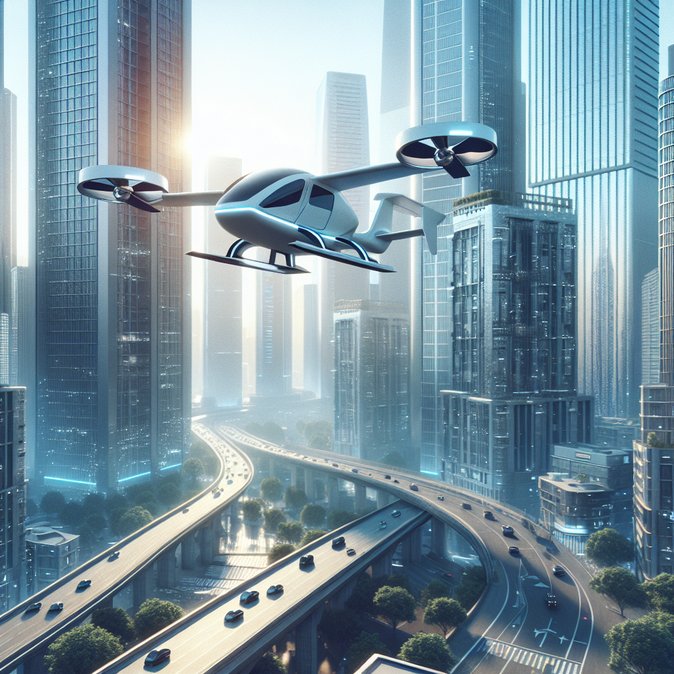
China Aerospace Science and Technology Corporation (CASC) confirmed that its Ninth Academy successfully completed the maiden flight of a two-seat electric vertical-take-off-and-landing (eVTOL) prototype in Chongqing on 6 February. The vehicle—part aircraft, part automobile—features a detachable airborne module capable of 150 km/h at altitudes below 3,000 m and a road-going chassis with a 300-km battery range.
Unlike pure-play drone start-ups, CASC is leveraging space-grade avionics and composite materials developed for the nation’s satellite and launch-vehicle programmes. Engineers say the hybrid design will allow commuters to drive on public roads, park at a vertiport and continue their journey by air—slashing door-to-door times in megacities such as Shenzhen and Shanghai.
![China Tests Two-Seat eVTOL, Signalling Leap Toward Urban Air Mobility]()
Regulators from the Civil Aviation Administration of China (CAAC) observed the test and indicated that technical standards for low-altitude civilian aircraft will be finalised this year. Pilot projects are already pencilled in for the Yangtze River Delta, where authorities plan to integrate eVTOL corridors with high-speed-rail hubs and cross-border business zones.
While aviation rules evolve, companies and individual travelers heading to China can simplify visa arrangements through VisaHQ. The service’s dedicated China portal (https://www.visahq.com/china/) offers fast, expert assistance for business, work, and tourist visas, keeping applicants informed of the latest CAAC and immigration updates and ensuring executives are cleared for take-off long before they board the next eVTOL.
For multinational employers, the breakthrough foreshadows a future in which key staff could hop between factory clusters and urban CBDs in minutes, expanding the radius of same-day business travel without adding pressure to congested highways. Mobility teams should monitor CAAC’s forthcoming type-certification roadmap and start factoring vertiport access and operator licensing into long-term travel policies.
Unlike pure-play drone start-ups, CASC is leveraging space-grade avionics and composite materials developed for the nation’s satellite and launch-vehicle programmes. Engineers say the hybrid design will allow commuters to drive on public roads, park at a vertiport and continue their journey by air—slashing door-to-door times in megacities such as Shenzhen and Shanghai.
Regulators from the Civil Aviation Administration of China (CAAC) observed the test and indicated that technical standards for low-altitude civilian aircraft will be finalised this year. Pilot projects are already pencilled in for the Yangtze River Delta, where authorities plan to integrate eVTOL corridors with high-speed-rail hubs and cross-border business zones.
While aviation rules evolve, companies and individual travelers heading to China can simplify visa arrangements through VisaHQ. The service’s dedicated China portal (https://www.visahq.com/china/) offers fast, expert assistance for business, work, and tourist visas, keeping applicants informed of the latest CAAC and immigration updates and ensuring executives are cleared for take-off long before they board the next eVTOL.
For multinational employers, the breakthrough foreshadows a future in which key staff could hop between factory clusters and urban CBDs in minutes, expanding the radius of same-day business travel without adding pressure to congested highways. Mobility teams should monitor CAAC’s forthcoming type-certification roadmap and start factoring vertiport access and operator licensing into long-term travel policies.