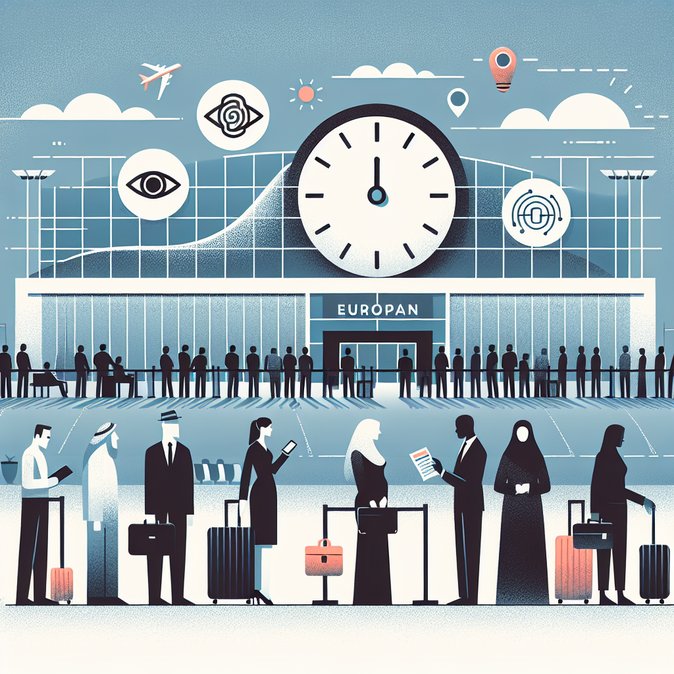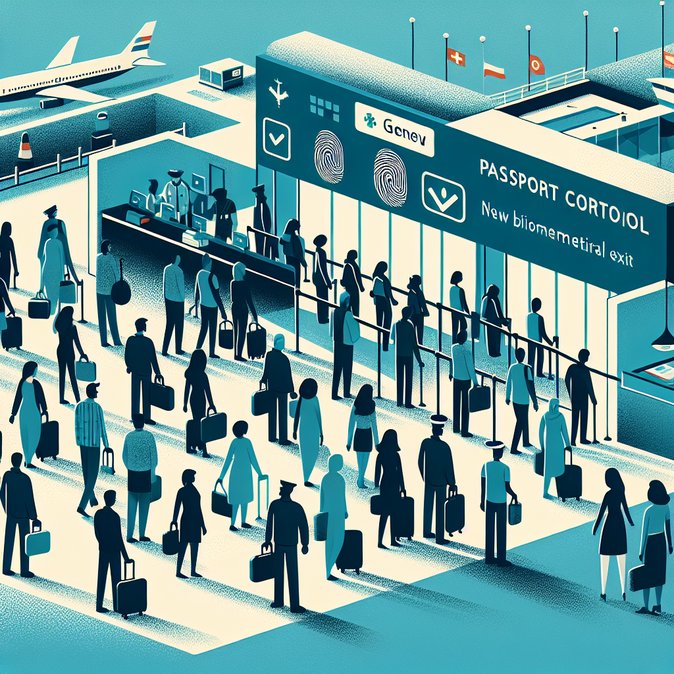
Swiss ski-season travellers got an unpleasant surprise this week when social-media images showed passport-control lines snaking for hundreds of metres inside Geneva Airport. The bottlenecks are the most visible Swiss example of the Schengen area’s new Entry-Exit System (EES), which requires every third-country visitor to provide a facial image, four fingerprints and a full passport scan on first arrival. According to biometrics trade journal Identity Week, only about 35 % of Europe’s external-border posts have activated the technology so far, yet peak-time waits have already reached three hours in Geneva and other hubs.(identityweek.net)
Understaffing is a major culprit. Federal Office for Customs and Border Security (FOCBS) officers have had to redeploy from routine customs checks to EES kiosks, while Geneva Airport has hired 40 temporary agents just to manage passenger flows. Airlines complain that mis-sequenced boarding means entire flights sometimes arrive at the kiosks simultaneously. The European Commission has now told member states and Schengen associates such as Switzerland that they may suspend compulsory enrolment during the February–March ski rush and again in July–August if queues exceed acceptable limits.
Meanwhile, travellers who would rather not navigate these shifting rules alone can turn to VisaHQ for up-to-date guidance and hands-on assistance. The platform tracks Schengen entry requirements and biometric procedures in real time, streamlines document submission for both short-term visitors and long-term assignees, and offers live support if airport delays force last-minute itinerary changes. Full details on Swiss visa categories, EES updates and related services are available at https://www.visahq.com/switzerland/
![Geneva Airport queues highlight Entry-Exit System growing pains]()
For Swiss business travellers the advice is clear: allow at least an extra hour for outbound flights and plan meetings accordingly. Companies moving assignees to Switzerland should brief non-EU staff that biometric enrolment is unavoidable and permanent; once registered, future entries will be faster, but the first trip can easily derail tight relocation schedules. Mobility managers should also factor in the 9 April 2026 deadline, when manual passport-stamping at Swiss airports will cease entirely and 100 % EES compliance becomes law.(ar.admin.ch)
From a policy perspective, the episode illustrates Switzerland’s delicate position: it has no vote in Brussels yet must implement Schengen border rules on the same timetable as the EU-27. If the Commission ultimately postpones full EES enforcement until after the summer, Bern will almost certainly follow suit—but the Federal Council has little room to negotiate. Trade bodies are therefore urging Swiss authorities to keep contingency staff on the payroll at least through the first post-implementation winter season of 2026-27.
In the medium term, airports expect EES to speed up flows by replacing manual stamps with automated kiosks and by giving migration authorities real-time over-stay data. Geneva Airport is already tendering for 20 additional self-service gates designed to read the EES token in less than 20 seconds. Until that future arrives, however, travellers—and the businesses that depend on their punctuality—will need patience and flexible itineraries.
Understaffing is a major culprit. Federal Office for Customs and Border Security (FOCBS) officers have had to redeploy from routine customs checks to EES kiosks, while Geneva Airport has hired 40 temporary agents just to manage passenger flows. Airlines complain that mis-sequenced boarding means entire flights sometimes arrive at the kiosks simultaneously. The European Commission has now told member states and Schengen associates such as Switzerland that they may suspend compulsory enrolment during the February–March ski rush and again in July–August if queues exceed acceptable limits.
Meanwhile, travellers who would rather not navigate these shifting rules alone can turn to VisaHQ for up-to-date guidance and hands-on assistance. The platform tracks Schengen entry requirements and biometric procedures in real time, streamlines document submission for both short-term visitors and long-term assignees, and offers live support if airport delays force last-minute itinerary changes. Full details on Swiss visa categories, EES updates and related services are available at https://www.visahq.com/switzerland/

For Swiss business travellers the advice is clear: allow at least an extra hour for outbound flights and plan meetings accordingly. Companies moving assignees to Switzerland should brief non-EU staff that biometric enrolment is unavoidable and permanent; once registered, future entries will be faster, but the first trip can easily derail tight relocation schedules. Mobility managers should also factor in the 9 April 2026 deadline, when manual passport-stamping at Swiss airports will cease entirely and 100 % EES compliance becomes law.(ar.admin.ch)
From a policy perspective, the episode illustrates Switzerland’s delicate position: it has no vote in Brussels yet must implement Schengen border rules on the same timetable as the EU-27. If the Commission ultimately postpones full EES enforcement until after the summer, Bern will almost certainly follow suit—but the Federal Council has little room to negotiate. Trade bodies are therefore urging Swiss authorities to keep contingency staff on the payroll at least through the first post-implementation winter season of 2026-27.
In the medium term, airports expect EES to speed up flows by replacing manual stamps with automated kiosks and by giving migration authorities real-time over-stay data. Geneva Airport is already tendering for 20 additional self-service gates designed to read the EES token in less than 20 seconds. Until that future arrives, however, travellers—and the businesses that depend on their punctuality—will need patience and flexible itineraries.