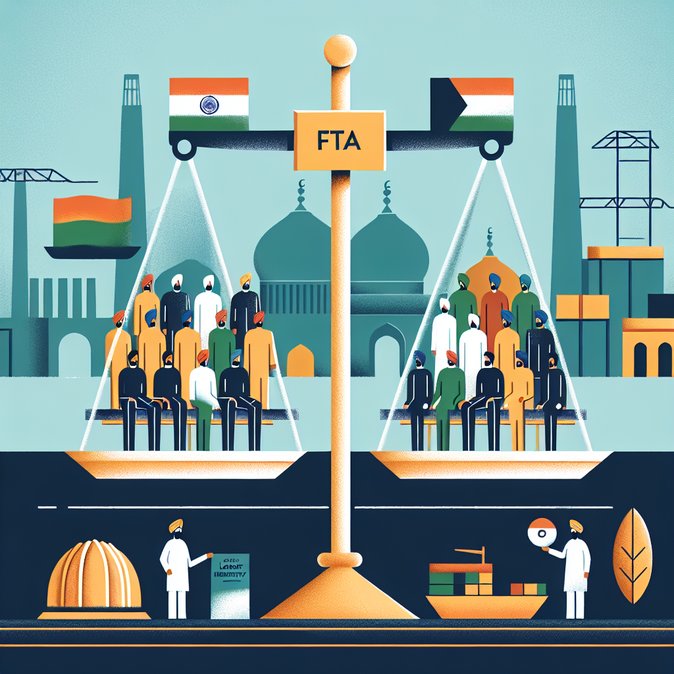
India will resume free-trade-agreement (FTA) talks with the six-member Gulf Cooperation Council (GCC) after a 15-year hiatus, with terms of reference signed in New Delhi on 5 February 2026. Commerce Minister Piyush Goyal said the revived negotiations will build on India’s existing Comprehensive Economic Partnership Agreement with the UAE and a recently initialled pact with Oman, with a view to covering goods, services and—critically—labour mobility. (timesofindia.indiatimes.com)
The GCC collectively hosts more than eight million Indian expatriate workers, and remittances from the bloc exceed USD 45 billion annually. Current visa and work-permit rules differ by country, making intra-GCC transfers difficult for Indian contractors handling pan-regional infrastructure or IT projects. Officials indicated that India will seek mutual-recognition arrangements for professional qualifications, a common e-visa verification interface and more liberal short-term business-visitor quotas. (timesofindia.indiatimes.com)
![India and Gulf Cooperation Council restart FTA negotiations, aim to ease labour mobility]()
Businesses and individuals already grappling with multiple Gulf visa regimes can streamline much of the paperwork through VisaHQ’s India portal (https://www.visahq.com/india/), which offers up-to-date application checklists, online form completion and concierge services for the UAE, Saudi Arabia, Qatar and other GCC states. As the FTA discussions progress and rules converge, VisaHQ can help applicants adapt quickly to any new requirements, ensuring compliance while saving time and administrative costs.
For Indian companies, a modernised FTA could reduce project-mobilisation times by up to 40 %, according to industry body FICCI. HR teams currently juggle six separate immigration regimes; a harmonised template would simplify compliance and cut legal spend. Mobility experts caution that negotiations are likely to be complex, especially around wage-protection rules and social-security contributions. (timesofindia.indiatimes.com)
Nevertheless, the restart signals political will. Businesses should begin mapping critical skill categories—engineers, nurses, chefs—that could benefit from streamlined work visas and prepare evidence-based submissions when stakeholder consultations open later this year. (timesofindia.indiatimes.com)
The GCC collectively hosts more than eight million Indian expatriate workers, and remittances from the bloc exceed USD 45 billion annually. Current visa and work-permit rules differ by country, making intra-GCC transfers difficult for Indian contractors handling pan-regional infrastructure or IT projects. Officials indicated that India will seek mutual-recognition arrangements for professional qualifications, a common e-visa verification interface and more liberal short-term business-visitor quotas. (timesofindia.indiatimes.com)

Businesses and individuals already grappling with multiple Gulf visa regimes can streamline much of the paperwork through VisaHQ’s India portal (https://www.visahq.com/india/), which offers up-to-date application checklists, online form completion and concierge services for the UAE, Saudi Arabia, Qatar and other GCC states. As the FTA discussions progress and rules converge, VisaHQ can help applicants adapt quickly to any new requirements, ensuring compliance while saving time and administrative costs.
For Indian companies, a modernised FTA could reduce project-mobilisation times by up to 40 %, according to industry body FICCI. HR teams currently juggle six separate immigration regimes; a harmonised template would simplify compliance and cut legal spend. Mobility experts caution that negotiations are likely to be complex, especially around wage-protection rules and social-security contributions. (timesofindia.indiatimes.com)
Nevertheless, the restart signals political will. Businesses should begin mapping critical skill categories—engineers, nurses, chefs—that could benefit from streamlined work visas and prepare evidence-based submissions when stakeholder consultations open later this year. (timesofindia.indiatimes.com)