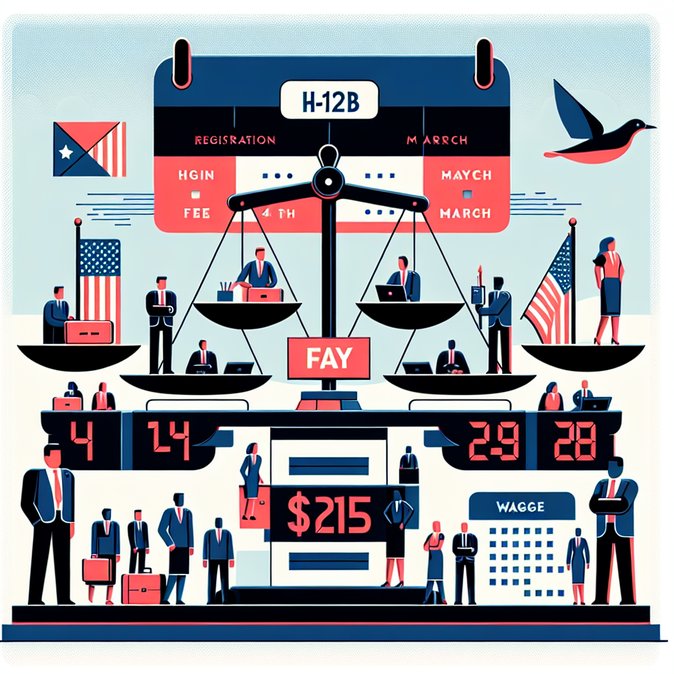
U.S. Citizenship and Immigration Services (USCIS) confirmed late Tuesday, February 3 (ET) that the initial electronic registration window for FY 2027 cap-subject H-1B petitions will open at noon Eastern on March 4 and close at noon on March 19. Employers must now pay a non-refundable $215 registration fee—more than twenty-one times the $10 charge in place from 2020-2025—and submit additional job-specific data (SOC code, work-site, prevailing-wage level) for every beneficiary.
The most consequential change is the formal launch of a wage-level–based weighted selection process. Under a final DHS rule published December 29 2025, Level IV wage offers will be entered into the selection pool four times, Level III three times, Level II twice and Level I once, giving higher-paid roles a statistically greater chance of selection while preserving the beneficiary-centric system. USCIS says lottery results will be released by March 31 and cap petitions may be filed April 1-June 30.
For employers, the new framework reshapes cap-season strategy. HR and mobility teams must confirm SOC codes, validate wage levels against updated Occupational Employment and Wage Statistics (OEWS) tables, and finalise work-site locations well before March 4. Budgeting should also account for the downstream filing-fee surge expected once the agency’s broader fee schedule takes effect on April 1.
![USCIS Sets March 4 Opening for FY 2027 H-1B Cap Registration, Introduces Weighted Lottery and $215 Fee]()
Large technology and consulting firms that rely on multiple Level I and Level II entries will see their odds drop, while start-ups willing to pay above-market wages may gain a competitive edge. Immigration counsel recommend that companies revisit salary bands, anticipate employee questions about wage-based chances, and ensure organisational USCIS accounts are linked to outside counsel ahead of the portal’s opening.
Businesses looking for hands-on assistance can also turn to VisaHQ, which offers end-to-end support with H-1B registration, petition preparation and broader U.S. work-visa strategies. Its dedicated corporate team helps verify SOC codes, calculate compliant wage levels and manage filing timelines through an easy online dashboard—learn more at https://www.visahq.com/united-states/
USCIS is expected to host “Tech Talk” webinars in mid-February to walk filers through portal changes. Employers should monitor the agency’s alerts for troubleshooting guidance and be prepared to upload bulk CSV files if registering high volumes of beneficiaries. Missing the March 19 cut-off—or submitting incomplete wage data—will disqualify a registration.
Although the weighted lottery does not take effect until FY 2027, the policy signals the administration’s broader effort to align business immigration with its “high-wage, high-skill” agenda. Companies should begin forecasting talent needs for FY 2028 and beyond under the assumption that future selection rounds will continue to privilege higher pay levels.
The most consequential change is the formal launch of a wage-level–based weighted selection process. Under a final DHS rule published December 29 2025, Level IV wage offers will be entered into the selection pool four times, Level III three times, Level II twice and Level I once, giving higher-paid roles a statistically greater chance of selection while preserving the beneficiary-centric system. USCIS says lottery results will be released by March 31 and cap petitions may be filed April 1-June 30.
For employers, the new framework reshapes cap-season strategy. HR and mobility teams must confirm SOC codes, validate wage levels against updated Occupational Employment and Wage Statistics (OEWS) tables, and finalise work-site locations well before March 4. Budgeting should also account for the downstream filing-fee surge expected once the agency’s broader fee schedule takes effect on April 1.

Large technology and consulting firms that rely on multiple Level I and Level II entries will see their odds drop, while start-ups willing to pay above-market wages may gain a competitive edge. Immigration counsel recommend that companies revisit salary bands, anticipate employee questions about wage-based chances, and ensure organisational USCIS accounts are linked to outside counsel ahead of the portal’s opening.
Businesses looking for hands-on assistance can also turn to VisaHQ, which offers end-to-end support with H-1B registration, petition preparation and broader U.S. work-visa strategies. Its dedicated corporate team helps verify SOC codes, calculate compliant wage levels and manage filing timelines through an easy online dashboard—learn more at https://www.visahq.com/united-states/
USCIS is expected to host “Tech Talk” webinars in mid-February to walk filers through portal changes. Employers should monitor the agency’s alerts for troubleshooting guidance and be prepared to upload bulk CSV files if registering high volumes of beneficiaries. Missing the March 19 cut-off—or submitting incomplete wage data—will disqualify a registration.
Although the weighted lottery does not take effect until FY 2027, the policy signals the administration’s broader effort to align business immigration with its “high-wage, high-skill” agenda. Companies should begin forecasting talent needs for FY 2028 and beyond under the assumption that future selection rounds will continue to privilege higher pay levels.