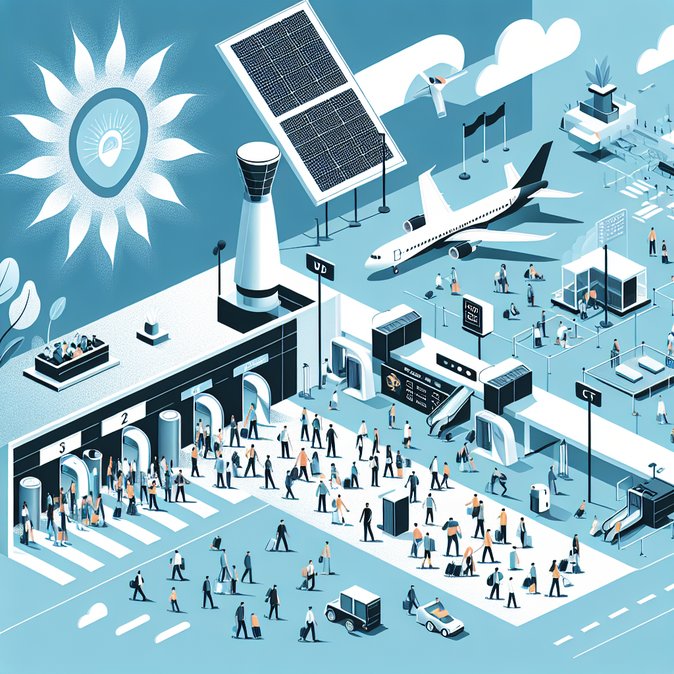
Fresh traffic data and an independent industry ranking released on 4 February confirm that Dublin Airport has climbed to 24th place among Europe’s 50 best airports—its highest position to date. The accolade follows a blockbuster 2025 in which the gateway handled 36.43 million passengers, up 5 % year-on-year and well above its long-debated 32 million planning cap.
Behind the numbers lies a multi-pronged modernisation drive. State-of-the-art CT scanners are now installed across both terminals, letting travellers keep liquids and laptops inside hand-luggage and slashing security queues; 97 % of passengers cleared screening in under 20 minutes last year. A new Airport Operations Centre powered by real-time AI modelling optimises gate allocation and weather-related diversions, while pilot trials of “single-token” biometrics promise frictionless movement from check-in to boarding during the peak summer season.
Infrastructure isn’t the only upgrade. Sustainability features prominently in daa’s ‘Better DUB’ roadmap. An 8.5 MWp solar farm already supplies 13 % of campus electricity, EV-charging bays are being rolled out for staff and passengers alike, and exploratory boreholes suggest geothermal heating could follow. The airport has publicly committed to net-zero emissions by 2050—an increasingly important credential for multinationals measuring Scope-3 travel footprints.
![Dublin Airport Cracks Europe’s Top-25 List After Record 36.4 Million Passengers and Tech Overhaul]()
Whether employees are hopping over to London or connecting onward to the United States, the paperwork can be as daunting as the journey itself. VisaHQ’s online platform (https://www.visahq.com/ireland/) streamlines visa and passport services for more than 200 destinations, giving Dublin-based travel managers a single dashboard to track requirements, submit applications and receive status alerts—features that dovetail neatly with the airport’s push for friction-free passenger flows.
For corporate mobility teams the improvements translate into shorter connection times, reduced laptop-removal hassles for frequent flyers and more resilient flight schedules. Dublin’s full US Pre-clearance facility remains a competitive edge for trans-Atlantic assignments, enabling travellers to land stateside as domestic passengers. However, capacity growth continues to test physical limits: on 215 days last year the airport processed more than 100,000 people. The Government is considering legislation to scrap the passenger cap entirely, but community opposition over noise and carbon impact is mounting.
Travel managers should monitor slot allocations for summer ’26—especially on North-American and short-haul European routes—while advising staff to arrive three hours before US-bound departures. Tech firms in Silicon Docks will welcome the improved Auracast audio system, which beams gate announcements directly to Bluetooth hearing aids and earbuds, a small but meaningful step towards inclusive travel.
Behind the numbers lies a multi-pronged modernisation drive. State-of-the-art CT scanners are now installed across both terminals, letting travellers keep liquids and laptops inside hand-luggage and slashing security queues; 97 % of passengers cleared screening in under 20 minutes last year. A new Airport Operations Centre powered by real-time AI modelling optimises gate allocation and weather-related diversions, while pilot trials of “single-token” biometrics promise frictionless movement from check-in to boarding during the peak summer season.
Infrastructure isn’t the only upgrade. Sustainability features prominently in daa’s ‘Better DUB’ roadmap. An 8.5 MWp solar farm already supplies 13 % of campus electricity, EV-charging bays are being rolled out for staff and passengers alike, and exploratory boreholes suggest geothermal heating could follow. The airport has publicly committed to net-zero emissions by 2050—an increasingly important credential for multinationals measuring Scope-3 travel footprints.

Whether employees are hopping over to London or connecting onward to the United States, the paperwork can be as daunting as the journey itself. VisaHQ’s online platform (https://www.visahq.com/ireland/) streamlines visa and passport services for more than 200 destinations, giving Dublin-based travel managers a single dashboard to track requirements, submit applications and receive status alerts—features that dovetail neatly with the airport’s push for friction-free passenger flows.
For corporate mobility teams the improvements translate into shorter connection times, reduced laptop-removal hassles for frequent flyers and more resilient flight schedules. Dublin’s full US Pre-clearance facility remains a competitive edge for trans-Atlantic assignments, enabling travellers to land stateside as domestic passengers. However, capacity growth continues to test physical limits: on 215 days last year the airport processed more than 100,000 people. The Government is considering legislation to scrap the passenger cap entirely, but community opposition over noise and carbon impact is mounting.
Travel managers should monitor slot allocations for summer ’26—especially on North-American and short-haul European routes—while advising staff to arrive three hours before US-bound departures. Tech firms in Silicon Docks will welcome the improved Auracast audio system, which beams gate announcements directly to Bluetooth hearing aids and earbuds, a small but meaningful step towards inclusive travel.
More From Ireland
View all
Ireland Extends Travel Confirmation Notice, Letting Non-EEA Residents Fly on Recently-Expired IRP Cards Until 28 February
UK Reminds British-Irish Dual Nationals to Carry Proof of Citizenship as ETA Scheme Goes Fully Live on 25 February