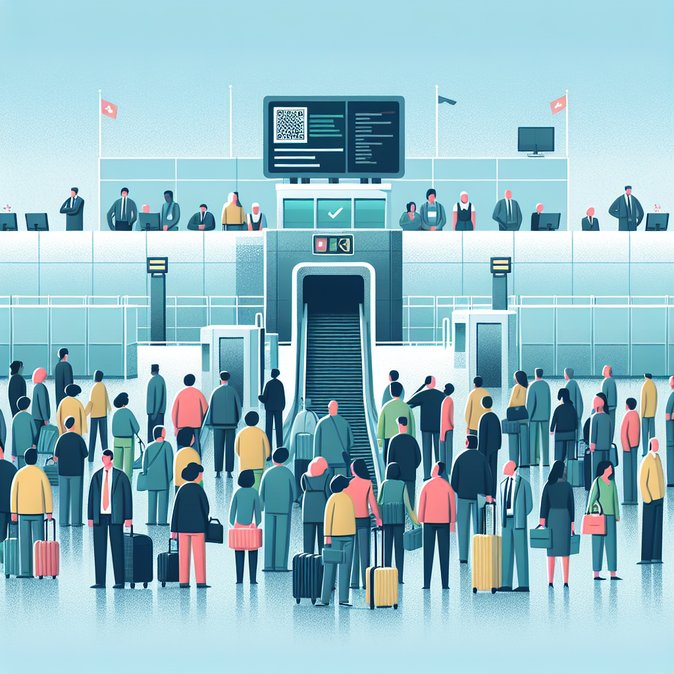
Geneva Airport—Switzerland’s second-busiest international gateway—spent most of Monday morning coping with snaking queues that stretched the length of its arrivals hall. Non-EU passengers found themselves funneled into a brand-new bank of self-service kiosks collecting facial images and four fingerprints under the European Union’s Entry/Exit System (EES). The system, which Switzerland is obliged to deploy under the Schengen acquis, has been gradually activated since last October but reached full operational testing at Geneva on 2 February.
While Zurich Airport reported wait times of 30-40 minutes thanks to larger e-gate capacity, bottlenecks at Geneva quickly climbed past three hours, peaking at roughly four. Border guards told local media that many travelers arrived without knowing they would be asked to remove gloves, hats or masks for biometric capture, slowing the line further. Airlines were forced to hold several departures to London, Dubai and Istanbul while awaiting connecting passengers from immigration.
The congestion provides an early stress test ahead of the continent-wide “big-bang” switch on 10 April 2026, after which manual passport stamping will cease.
![Four-hour queues hit Geneva Airport as EU biometric Entry/Exit System goes live]()
For travelers still clarifying entry requirements, a quick pre-trip consultation with VisaHQ can remove much of the guesswork. Its Switzerland page (https://www.visahq.com/switzerland/) consolidates the latest visa rules, EES enrollment tips and documentation checklists, helping both leisure and corporate passengers avoid surprises at the border.
Business-travel managers are already rewriting Swiss travel policies: most now recommend a minimum three-hour buffer between scheduled arrival and onward rail meetings, and are alerting frequent flyers that subsequent trips should move faster once fingerprints are on file for three years.
For mobility teams, the episode underlines two practical points. First, carrier communications remain patchy—several long-haul airlines failed to warn premium passengers of the new checks. Second, companies relocating non-EU assignees to Switzerland this spring should add EES enrollment guidance to welcome packs and factor longer transfer windows into duty-of-care calculations. Swiss authorities insist performance will improve as travelers and officers climb the learning curve, but advise arriving at least two hours earlier than usual during the first weeks of rollout.
While Zurich Airport reported wait times of 30-40 minutes thanks to larger e-gate capacity, bottlenecks at Geneva quickly climbed past three hours, peaking at roughly four. Border guards told local media that many travelers arrived without knowing they would be asked to remove gloves, hats or masks for biometric capture, slowing the line further. Airlines were forced to hold several departures to London, Dubai and Istanbul while awaiting connecting passengers from immigration.
The congestion provides an early stress test ahead of the continent-wide “big-bang” switch on 10 April 2026, after which manual passport stamping will cease.

For travelers still clarifying entry requirements, a quick pre-trip consultation with VisaHQ can remove much of the guesswork. Its Switzerland page (https://www.visahq.com/switzerland/) consolidates the latest visa rules, EES enrollment tips and documentation checklists, helping both leisure and corporate passengers avoid surprises at the border.
Business-travel managers are already rewriting Swiss travel policies: most now recommend a minimum three-hour buffer between scheduled arrival and onward rail meetings, and are alerting frequent flyers that subsequent trips should move faster once fingerprints are on file for three years.
For mobility teams, the episode underlines two practical points. First, carrier communications remain patchy—several long-haul airlines failed to warn premium passengers of the new checks. Second, companies relocating non-EU assignees to Switzerland this spring should add EES enrollment guidance to welcome packs and factor longer transfer windows into duty-of-care calculations. Swiss authorities insist performance will improve as travelers and officers climb the learning curve, but advise arriving at least two hours earlier than usual during the first weeks of rollout.