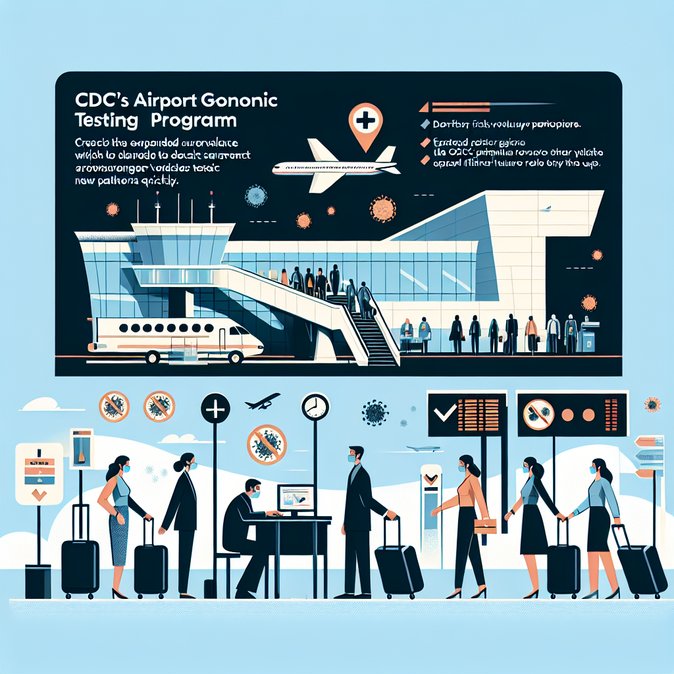
The Centers for Disease Control and Prevention (CDC) announced on January 30 that its Traveler-Based Genomic Surveillance (TGS) program has surpassed one million travelers who have voluntarily provided nasal swabs or wastewater samples at U.S. airports. Launched during the COVID-19 pandemic, TGS now operates at 16 major gateways—including JFK, ATL, SFO and DFW—and has expanded beyond SARS-CoV-2 to monitor influenza, RSV and emerging pathogens.
For business-travel stakeholders, the milestone carries two main implications. First, early detection of novel variants can shape border policies such as testing mandates or targeted travel advisories—rules that directly influence trip approvals and duty-of-care protocols. Second, the CDC signaled plans to increase airport coverage ahead of the 2026 World Cup, meaning more executives may be asked to participate (the process adds about 90 seconds after deplaning).
Participation remains voluntary and anonymous; no personal identifiers are attached to samples. However, privacy advocates have raised concerns that expanded biosurveillance could create de facto health passports. CDC stressed that all specimens are destroyed after sequencing and that data is shared only in aggregate with international health bodies.
![CDC Traveler-Based Genomic Surveillance Program Tops One Million Voluntary Participants]()
While public-health measures evolve, the basics of cross-border paperwork still matter. VisaHQ’s online platform helps corporate travel teams and individual flyers secure visas, passports and electronic travel authorizations quickly, keeping attention free for new variables like TGS. Check country-specific requirements or start an application at https://www.visahq.com/united-states/
Companies with large travel programs should brief employees on the purpose and mechanics of TGS to avoid confusion at arrival halls. Travel managers may also wish to track CDC variant alerts, which could influence corporate policies on masking, vaccination and trip routing.
In the broader context, TGS exemplifies how public-health surveillance is becoming a permanent layer of cross-border mobility infrastructure—on par with biometrics and advance passenger information. Understanding these systems will be as critical for global-mobility professionals as mastering visa rules.
For business-travel stakeholders, the milestone carries two main implications. First, early detection of novel variants can shape border policies such as testing mandates or targeted travel advisories—rules that directly influence trip approvals and duty-of-care protocols. Second, the CDC signaled plans to increase airport coverage ahead of the 2026 World Cup, meaning more executives may be asked to participate (the process adds about 90 seconds after deplaning).
Participation remains voluntary and anonymous; no personal identifiers are attached to samples. However, privacy advocates have raised concerns that expanded biosurveillance could create de facto health passports. CDC stressed that all specimens are destroyed after sequencing and that data is shared only in aggregate with international health bodies.

While public-health measures evolve, the basics of cross-border paperwork still matter. VisaHQ’s online platform helps corporate travel teams and individual flyers secure visas, passports and electronic travel authorizations quickly, keeping attention free for new variables like TGS. Check country-specific requirements or start an application at https://www.visahq.com/united-states/
Companies with large travel programs should brief employees on the purpose and mechanics of TGS to avoid confusion at arrival halls. Travel managers may also wish to track CDC variant alerts, which could influence corporate policies on masking, vaccination and trip routing.
In the broader context, TGS exemplifies how public-health surveillance is becoming a permanent layer of cross-border mobility infrastructure—on par with biometrics and advance passenger information. Understanding these systems will be as critical for global-mobility professionals as mastering visa rules.