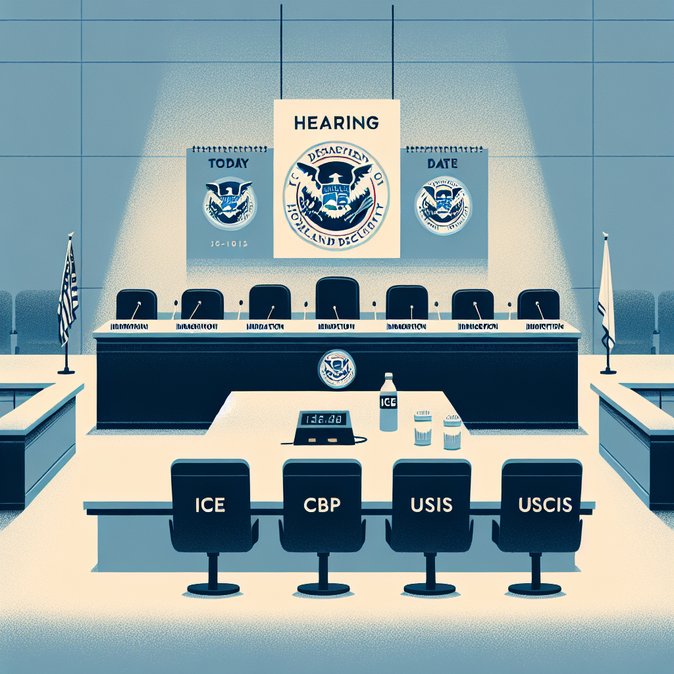
House Homeland Security Committee Chairman Andrew Garbarino (R-NY) announced on 27 January that the heads of ICE, CBP and USCIS will testify at a full committee hearing on 10 February. The session will examine agency performance amid record border encounters, visa-processing backlogs and the rollout of the new wage-weighted H-1B cap system.(homeland.house.gov)
The trio of witnesses—ICE Acting Director Todd Lyons, CBP Commissioner Rodney Scott and USCIS Director Joseph Edlow—will face bipartisan scrutiny over operational transparency. Democrats are expected to press ICE on detention conditions and CBP on human-rights compliance, while Republicans plan to spotlight employment-visa fraud and perceived gaps in vetting.
![Congress Schedules High-Profile Hearing with ICE, CBP and USCIS Leaders]()
Business-immigration advocates welcome the hearing as a rare chance to obtain public timelines for critical initiatives, including the FY 2027 H-1B registration portal (set to open in March) and long-delayed digitization of Form I-485 adjustment filings. The committee has requested that USCIS provide metrics on premium-processing turnaround times and plans to reduce the current 150-day average for EAD adjudications.
Meanwhile, global mobility managers navigating these evolving requirements can turn to VisaHQ for end-to-end support with U.S. travel and employment-visa filings; the platform offers document validation, expedited submission and status alerts in one dashboard—see https://www.visahq.com/united-states/ for details.
Mobility programs should monitor the hearing for policy signals. Legislative aides say new fee legislation aimed at funding asylum adjudicators could surface in conjunction with the proceedings, potentially reshaping employer cost structures in late 2026.
The trio of witnesses—ICE Acting Director Todd Lyons, CBP Commissioner Rodney Scott and USCIS Director Joseph Edlow—will face bipartisan scrutiny over operational transparency. Democrats are expected to press ICE on detention conditions and CBP on human-rights compliance, while Republicans plan to spotlight employment-visa fraud and perceived gaps in vetting.

Business-immigration advocates welcome the hearing as a rare chance to obtain public timelines for critical initiatives, including the FY 2027 H-1B registration portal (set to open in March) and long-delayed digitization of Form I-485 adjustment filings. The committee has requested that USCIS provide metrics on premium-processing turnaround times and plans to reduce the current 150-day average for EAD adjudications.
Meanwhile, global mobility managers navigating these evolving requirements can turn to VisaHQ for end-to-end support with U.S. travel and employment-visa filings; the platform offers document validation, expedited submission and status alerts in one dashboard—see https://www.visahq.com/united-states/ for details.
Mobility programs should monitor the hearing for policy signals. Legislative aides say new fee legislation aimed at funding asylum adjudicators could surface in conjunction with the proceedings, potentially reshaping employer cost structures in late 2026.