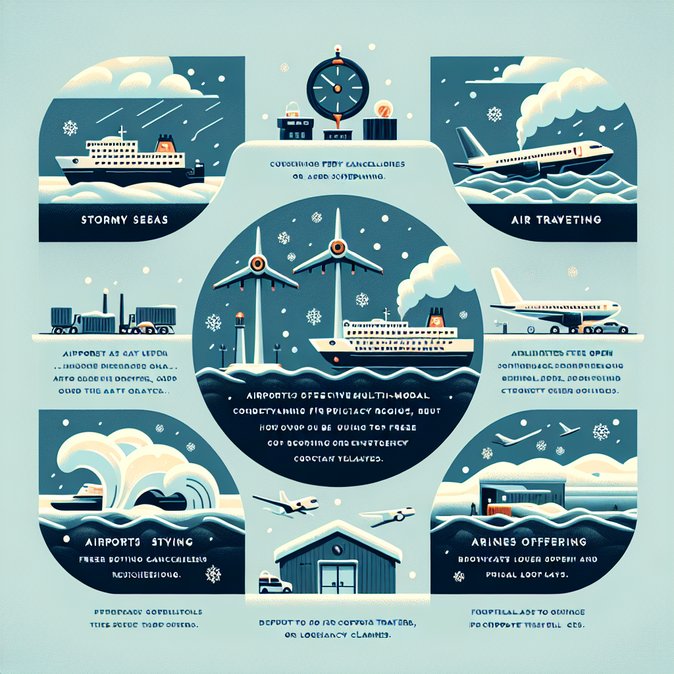
Atlantic storm ‘Goretti’ barrelled into the Irish Sea on 9 January, delivering gusts above 120 km/h and forcing operators to tear up sailing timetables. Irish Ferries advanced its first Holyhead–Dublin departure, while Brittany Ferries cancelled Rosslare–Cherbourg and Rosslare–Bilbao crossings; Stena Line issued rolling alerts for the Fishguard–Rosslare route. Travellers received SMS re-routing offers or refunds, but tourism bodies estimate more than 8,000 passengers had to rearrange land connections and accommodation. (euronews.com)
Met Éireann maintained Status-Yellow snow-and-rain warnings for Cork, Kerry, Waterford and Wexford, cautioning motorists about icy patches and “difficult or impossible” mountain passes. Although Dublin Airport remained operational, airlines invoked flexible-change policies and advised passengers to arrive three hours early in case de-icing or flow-control measures were imposed by Eurocontrol. Road hauliers rerouted high-sided trucks away from the M8 corridor after Garda checkpoints flagged the risk of overturns. (thesun.ie)
![Storm Goretti Triggers Ferry Rescheduling and Travel Warnings Across Ireland]()
If rerouting leads travellers to swap ferry tickets for last-minute flights or rail journeys through other countries, VisaHQ’s Ireland portal (https://www.visahq.com/ireland/) can quickly clarify whether additional visas or transit authorisations are needed and even process urgent applications online. Having that backup can spare passengers another layer of disruption when storms already upend carefully planned itineraries.
For mobility managers, the disruption underscores the need for weather-contingency clauses in assignment policies. Companies shifting equipment between Ireland and mainland Europe have been urged to consider cargo ferries out of Belfast or Cork, which experienced fewer cancellations. Meanwhile, accommodation platforms in Dublin reported a brief spike in same-day bookings from stranded ferry passengers, illustrating how weather events can ripple into urban lodging markets.
Climate analysts note that Goretti is the third severe winter storm to hit the island since November, adding momentum to calls for a national ‘Travel Resilience Plan’ that would integrate ferry, rail and aviation emergency protocols. The Department of Transport confirmed it will convene operators next week to review response times and passenger-notification standards.
Met Éireann maintained Status-Yellow snow-and-rain warnings for Cork, Kerry, Waterford and Wexford, cautioning motorists about icy patches and “difficult or impossible” mountain passes. Although Dublin Airport remained operational, airlines invoked flexible-change policies and advised passengers to arrive three hours early in case de-icing or flow-control measures were imposed by Eurocontrol. Road hauliers rerouted high-sided trucks away from the M8 corridor after Garda checkpoints flagged the risk of overturns. (thesun.ie)

If rerouting leads travellers to swap ferry tickets for last-minute flights or rail journeys through other countries, VisaHQ’s Ireland portal (https://www.visahq.com/ireland/) can quickly clarify whether additional visas or transit authorisations are needed and even process urgent applications online. Having that backup can spare passengers another layer of disruption when storms already upend carefully planned itineraries.
For mobility managers, the disruption underscores the need for weather-contingency clauses in assignment policies. Companies shifting equipment between Ireland and mainland Europe have been urged to consider cargo ferries out of Belfast or Cork, which experienced fewer cancellations. Meanwhile, accommodation platforms in Dublin reported a brief spike in same-day bookings from stranded ferry passengers, illustrating how weather events can ripple into urban lodging markets.
Climate analysts note that Goretti is the third severe winter storm to hit the island since November, adding momentum to calls for a national ‘Travel Resilience Plan’ that would integrate ferry, rail and aviation emergency protocols. The Department of Transport confirmed it will convene operators next week to review response times and passenger-notification standards.