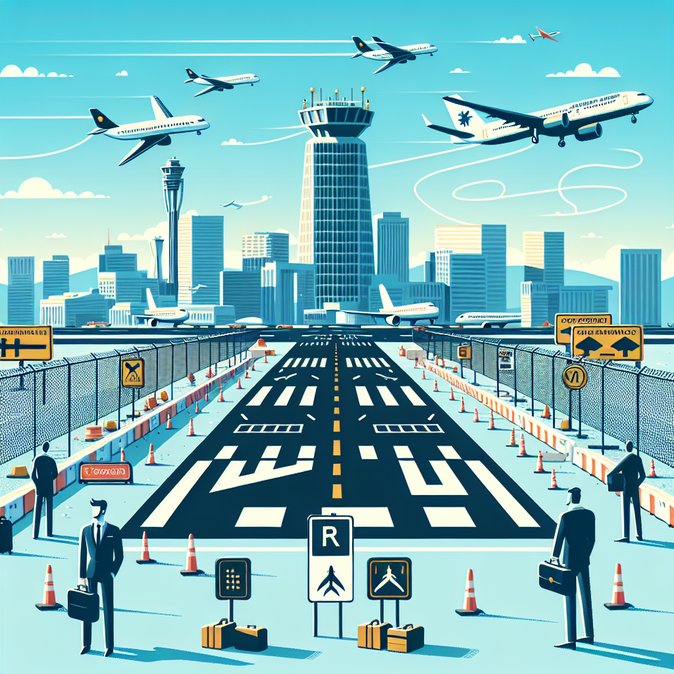
The San Francisco International Airport (SFO) has confirmed that Runway 1R will shut from March 30 to October 2, 2026, for a US$180 million resurfacing and taxiway-upgrade project. The closure was announced on December 30 but widely circulated to travelers and airlines on December 31. SFO pledges that less than 10 percent of flights should face delays, typically under 30 minutes during peak departure banks.
During work periods, all arrivals and departures will funnel to the parallel 28 Left / 28 Right pair—a configuration familiar to carriers but one that concentrates departure noise over parts of South San Francisco, Millbrae and Foster City. Runway 1L will serve as an auxiliary taxiway to cut ground congestion.
The rehabilitation includes new asphalt equivalent to paving four interstate lanes for 10 miles, LED centerline lights and two taxiway re-alignments to boost throughput once the runway reopens. Granite Construction holds the contract; US$92 million comes from FAA Airport Improvement Program grants.
![San Francisco International Airport to Close Runway 1R for Six-Month Overhaul]()
International passengers forced to tweak flight plans—perhaps connecting through different countries or extending layovers—should also double-check entry requirements. VisaHQ’s digital platform (https://www.visahq.com/united-states/) can expedite any supplementary visas you may suddenly need, offering quick online applications and live support so schedule shifts triggered by the runway closure don’t morph into documentation headaches.
For corporate travel managers, the project coincides with peak summer-travel season and the OracleWorld and Dreamforce conferences. Companies should build buffer time into itineraries, consider Oakland or San Jose routings and monitor carrier schedule updates—some international long-hauls may receive minor time-of-day shifts.
Forward-looking assignees relocating to Silicon Valley can expect sporadic noise-pattern changes and should verify lease clauses regarding aircraft noise. Program managers should also update mobility cost projections if premium fares spike during weekend runway closures.
During work periods, all arrivals and departures will funnel to the parallel 28 Left / 28 Right pair—a configuration familiar to carriers but one that concentrates departure noise over parts of South San Francisco, Millbrae and Foster City. Runway 1L will serve as an auxiliary taxiway to cut ground congestion.
The rehabilitation includes new asphalt equivalent to paving four interstate lanes for 10 miles, LED centerline lights and two taxiway re-alignments to boost throughput once the runway reopens. Granite Construction holds the contract; US$92 million comes from FAA Airport Improvement Program grants.

International passengers forced to tweak flight plans—perhaps connecting through different countries or extending layovers—should also double-check entry requirements. VisaHQ’s digital platform (https://www.visahq.com/united-states/) can expedite any supplementary visas you may suddenly need, offering quick online applications and live support so schedule shifts triggered by the runway closure don’t morph into documentation headaches.
For corporate travel managers, the project coincides with peak summer-travel season and the OracleWorld and Dreamforce conferences. Companies should build buffer time into itineraries, consider Oakland or San Jose routings and monitor carrier schedule updates—some international long-hauls may receive minor time-of-day shifts.
Forward-looking assignees relocating to Silicon Valley can expect sporadic noise-pattern changes and should verify lease clauses regarding aircraft noise. Program managers should also update mobility cost projections if premium fares spike during weekend runway closures.