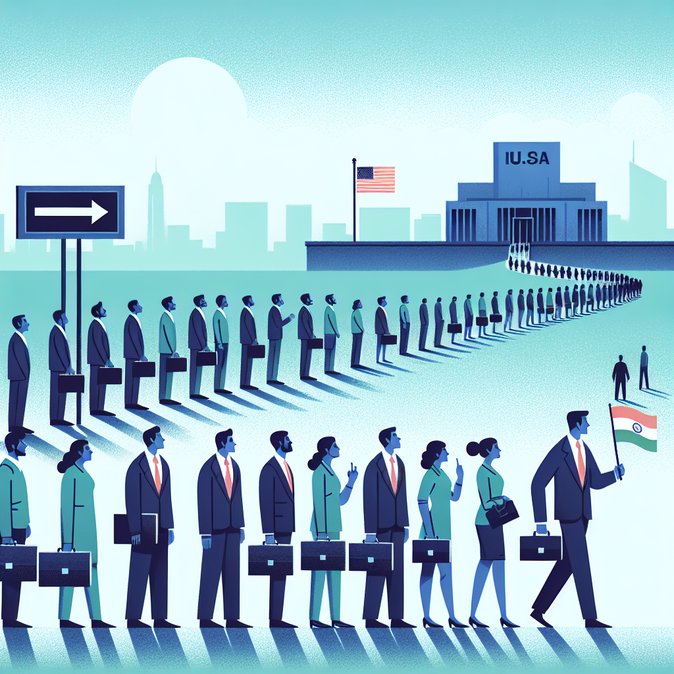
In a blunt New Year’s Eve post on X, the U.S. Embassy in India reminded visa applicants that “violating U.S. immigration law has consequences,” even as tens of thousands of Indian H-1B and H-4 hopefuls remain stranded by interview backlogs stretching to March 2026. The gridlock began on 15 December when Washington expanded mandatory social-media screening to employment-based visas, adding about 30 minutes of officer time per case and slashing daily appointment capacity by nearly half.
Immigration lawyers say passports are now routinely retained for “administrative processing” that can run to six weeks, disrupting project timelines for India’s US-facing IT and engineering majors. One Bengaluru outsourcer told Global Mobility News it has already redeployed 12 % of affected staff to Mexico-based near-shore centres to avoid client penalties. Family reunification is also hit: dependants on H-4 visas cannot travel until the principal applicant clears security vetting.
The Embassy’s advisory sparked backlash from applicants who accuse Washington of poor capacity planning. They warn that the public reminder that “turning up on the original interview date after rescheduling will result in denial of entry” is tone-deaf when many cannot secure any appointment at all.
![U.S. Embassy warns Indians after H-1B/H-4 interview slots pushed to March 2026]()
VisaHQ’s India portal (https://www.visahq.com/india/) can lighten the load for both corporates and individual travelers by tracking real-time appointment availability, pre-screening documents, and arranging nationwide passport couriers—services that collectively trim valuable days off each stage of the U.S. visa process. Its specialists can also map out contingency routes to Canada, Europe, or Mexico when American timelines prove unworkable, giving mobility planners a practical insurance policy while the backlog persists.
Mobility teams are being urged to build 12-to-16-week buffers for U.S. assignments, monitor CEAC status daily and ensure employees’ social-media accounts are set to public to avoid 221(g) holds. Some corporates are pivoting to Canada or Europe for time-critical work, while others explore remote-first engagement models until the backlog eases.
Consular officials privately concede the backlog will persist until at least Q2 2026 unless temporary officers are flown in from other missions—an option reportedly under review in Washington.
Immigration lawyers say passports are now routinely retained for “administrative processing” that can run to six weeks, disrupting project timelines for India’s US-facing IT and engineering majors. One Bengaluru outsourcer told Global Mobility News it has already redeployed 12 % of affected staff to Mexico-based near-shore centres to avoid client penalties. Family reunification is also hit: dependants on H-4 visas cannot travel until the principal applicant clears security vetting.
The Embassy’s advisory sparked backlash from applicants who accuse Washington of poor capacity planning. They warn that the public reminder that “turning up on the original interview date after rescheduling will result in denial of entry” is tone-deaf when many cannot secure any appointment at all.

VisaHQ’s India portal (https://www.visahq.com/india/) can lighten the load for both corporates and individual travelers by tracking real-time appointment availability, pre-screening documents, and arranging nationwide passport couriers—services that collectively trim valuable days off each stage of the U.S. visa process. Its specialists can also map out contingency routes to Canada, Europe, or Mexico when American timelines prove unworkable, giving mobility planners a practical insurance policy while the backlog persists.
Mobility teams are being urged to build 12-to-16-week buffers for U.S. assignments, monitor CEAC status daily and ensure employees’ social-media accounts are set to public to avoid 221(g) holds. Some corporates are pivoting to Canada or Europe for time-critical work, while others explore remote-first engagement models until the backlog eases.
Consular officials privately concede the backlog will persist until at least Q2 2026 unless temporary officers are flown in from other missions—an option reportedly under review in Washington.