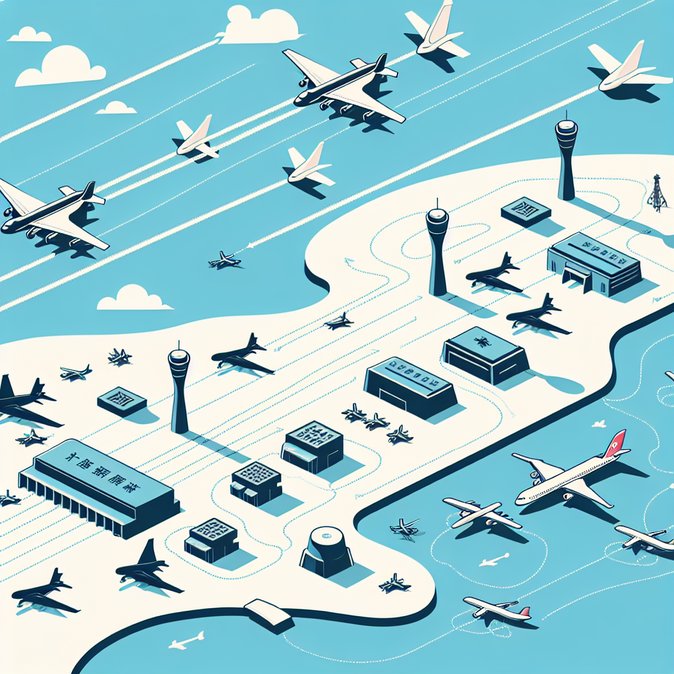
China’s two-day “Justice Mission 2025” military exercise encircling Taiwan, which concluded on 30 December, had an immediate spill-over into civil aviation. Taiwan’s Civil Aeronautics Administration reported 857 international flight delays and 84 domestic cancellations as carriers were forced to reroute around live-fire zones declared by the People’s Liberation Army. The disruptions affected services not only to Taipei Taoyuan but also to Shanghai Pudong and Xiamen Gaoqi, where air-traffic controllers implemented flow-control measures to keep aircraft clear of restricted airspace.
Flight-tracking data show average east-Asia sector times extended by 18-35 minutes on 29 December, translating into extra fuel and crew-duty costs estimated at US$4.8 million. Cathay Pacific, China Airlines and EVA all activated contingency schedules, while FedEx re-timed its Asian hub arrivals into Guangzhou to avoid curfews triggered by the drills. Private-jet operators reported slot denials for missions into Shenzhen and Xiamen, complicating executive travel plans ahead of year-end board meetings.
Travel-risk consultants note that the PLA issued six NOTAMs (Notice to Airmen) with as little as 12 hours’ warning—far shorter than the 3-day notice typical of past exercises—leaving airlines scrambling to re-file flight plans and secure overflight approvals. Mobility teams should therefore review crisis-management protocols for assignees in Taiwan and coastal Fujian, ensuring they have alternative routings via Hong Kong or Seoul.
![PLA drills around Taiwan snarl air routes and delay 900+ flights across Greater China]()
Beyond immediate logistics, the exercise underscores a broader vulnerability: about 30 percent of flights from mainland China to Southeast Asia cross the Taipei FIR (Flight Information Region). Continued geopolitical tension could push carriers to adopt longer southern corridors via Hainan, adding costs that may ultimately be passed on to passengers and corporate travel budgets.
For organizations needing to reroute personnel quickly or shift itineraries between mainland China, Hong Kong and Taiwan, VisaHQ can streamline the paperwork. Its dedicated China portal (https://www.visahq.com/china/) offers expedited visa processing, document couriering and real-time regulatory updates, helping travel managers keep crews and executives compliant even as flight paths change with little warning.
The Taiwanese government lodged protests and said it would seek ICAO discussion on minimizing civilian impact. Beijing blamed “external interference” and reiterated that the drills were routine defensive measures—language unlikely to reassure travel planners who faced similar upheaval during the August 2024 “Joint Sword” exercise.
Flight-tracking data show average east-Asia sector times extended by 18-35 minutes on 29 December, translating into extra fuel and crew-duty costs estimated at US$4.8 million. Cathay Pacific, China Airlines and EVA all activated contingency schedules, while FedEx re-timed its Asian hub arrivals into Guangzhou to avoid curfews triggered by the drills. Private-jet operators reported slot denials for missions into Shenzhen and Xiamen, complicating executive travel plans ahead of year-end board meetings.
Travel-risk consultants note that the PLA issued six NOTAMs (Notice to Airmen) with as little as 12 hours’ warning—far shorter than the 3-day notice typical of past exercises—leaving airlines scrambling to re-file flight plans and secure overflight approvals. Mobility teams should therefore review crisis-management protocols for assignees in Taiwan and coastal Fujian, ensuring they have alternative routings via Hong Kong or Seoul.

Beyond immediate logistics, the exercise underscores a broader vulnerability: about 30 percent of flights from mainland China to Southeast Asia cross the Taipei FIR (Flight Information Region). Continued geopolitical tension could push carriers to adopt longer southern corridors via Hainan, adding costs that may ultimately be passed on to passengers and corporate travel budgets.
For organizations needing to reroute personnel quickly or shift itineraries between mainland China, Hong Kong and Taiwan, VisaHQ can streamline the paperwork. Its dedicated China portal (https://www.visahq.com/china/) offers expedited visa processing, document couriering and real-time regulatory updates, helping travel managers keep crews and executives compliant even as flight paths change with little warning.
The Taiwanese government lodged protests and said it would seek ICAO discussion on minimizing civilian impact. Beijing blamed “external interference” and reiterated that the drills were routine defensive measures—language unlikely to reassure travel planners who faced similar upheaval during the August 2024 “Joint Sword” exercise.