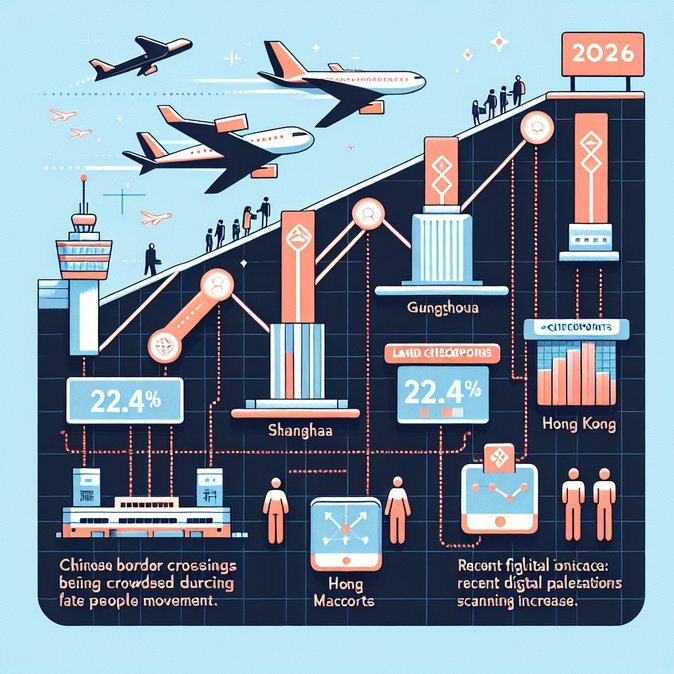
China’s National Immigration Administration (NIA) is bracing for its busiest New Year’s Day break since the pandemic, forecasting more than 2.1 million inbound and outbound passenger movements per day between Thursday and Saturday (January 1 – 3, 2026). That would be 22.4 percent higher than the same three-day period a year ago and roughly 85 percent of pre-Covid volumes.
According to the NIA notice published on 30 December, Shanghai Pudong International Airport alone is expected to process nearly 100,000 international travellers a day, followed by Guangzhou Baiyun (≈53,000) and Beijing Capital (≈40,000). Land-border ports will be just as busy: Gongbei in Zhuhai is projected to exceed 400,000 daily crossings, while Shenzhen’s Luohu and Futian checkpoints may each top 200,000.
Officials attribute the rebound to a raft of immigration-facilitation measures rolled out since mid-2024, including the extension of China’s 240-hour visa-free transit scheme to 65 ports and the expansion of unilateral 30-day visa-free entry to 45 countries. Digitalisation is also helping: foreigners can now complete arrival-card formalities online via the NIA 12367 app, and most land ports are equipped with e-channels that cut clearance time to under 25 seconds.
![China projects 22% surge in cross-border travel over New Year’s holiday]()
To navigate these evolving entry rules, travellers and mobility managers can lean on VisaHQ, which offers up-to-date guidance on China’s visa-free transit allowances as well as tourist and business visa categories, and can process applications entirely online (https://www.visahq.com/china/). Real-time tracking, document checks and dedicated support help clients avoid last-minute snags and breeze through increasingly busy ports.
For corporate mobility managers, the figures signal tightening capacity at major gateways. Airlines have already announced peak-period seat-caps and surcharges, while hotel rates in the Greater Bay Area are trending 15-20 percent higher than last December. Companies moving assignees in the first week of January should therefore factor in longer queues, limited award-seat availability and higher ground-transfer costs.
Looking ahead, analysts see the holiday as a bellwether for 2026. If the predicted numbers materialise, China could surpass 100 million international visitor trips next year—nearly double 2025’s total—and inbound spending could reach 1 percent of GDP for the first time since 2019. The NIA says it will keep “dynamic real-time monitoring” at all ports and publish hourly traffic alerts to help travellers plan routes and avoid peaks.
According to the NIA notice published on 30 December, Shanghai Pudong International Airport alone is expected to process nearly 100,000 international travellers a day, followed by Guangzhou Baiyun (≈53,000) and Beijing Capital (≈40,000). Land-border ports will be just as busy: Gongbei in Zhuhai is projected to exceed 400,000 daily crossings, while Shenzhen’s Luohu and Futian checkpoints may each top 200,000.
Officials attribute the rebound to a raft of immigration-facilitation measures rolled out since mid-2024, including the extension of China’s 240-hour visa-free transit scheme to 65 ports and the expansion of unilateral 30-day visa-free entry to 45 countries. Digitalisation is also helping: foreigners can now complete arrival-card formalities online via the NIA 12367 app, and most land ports are equipped with e-channels that cut clearance time to under 25 seconds.

To navigate these evolving entry rules, travellers and mobility managers can lean on VisaHQ, which offers up-to-date guidance on China’s visa-free transit allowances as well as tourist and business visa categories, and can process applications entirely online (https://www.visahq.com/china/). Real-time tracking, document checks and dedicated support help clients avoid last-minute snags and breeze through increasingly busy ports.
For corporate mobility managers, the figures signal tightening capacity at major gateways. Airlines have already announced peak-period seat-caps and surcharges, while hotel rates in the Greater Bay Area are trending 15-20 percent higher than last December. Companies moving assignees in the first week of January should therefore factor in longer queues, limited award-seat availability and higher ground-transfer costs.
Looking ahead, analysts see the holiday as a bellwether for 2026. If the predicted numbers materialise, China could surpass 100 million international visitor trips next year—nearly double 2025’s total—and inbound spending could reach 1 percent of GDP for the first time since 2019. The NIA says it will keep “dynamic real-time monitoring” at all ports and publish hourly traffic alerts to help travellers plan routes and avoid peaks.