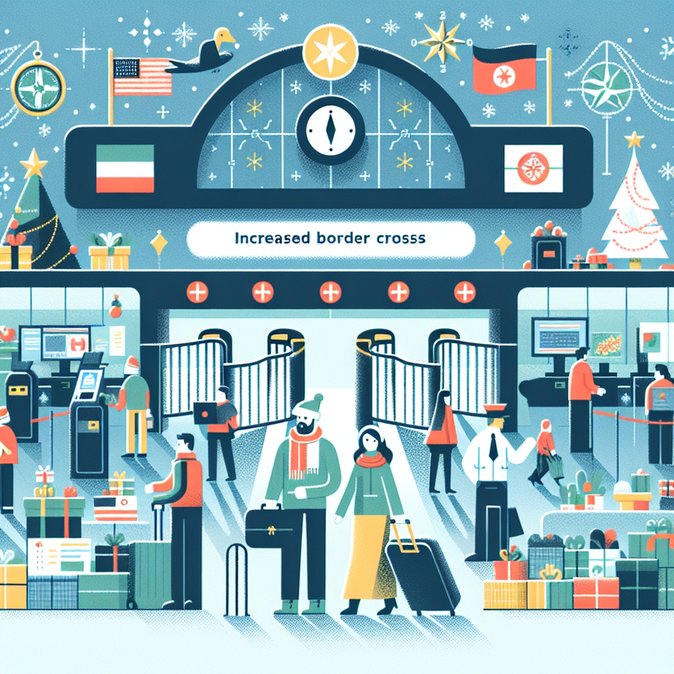
Hong Kong’s Immigration Department reported that its land, sea and air checkpoints handled almost six million entries and exits between 24 and 28 December – a robust 11 percent year-on-year increase and the SAR’s busiest Christmas period since the border fully reopened last year. Departures peaked on Christmas Day at more than 795,000, while arrivals topped 457,000, pushing total daily traffic above 1.25 million.
Outbound Hong Kong residents accounted for 2.73 million of the movements, many heading to neighbouring Guangdong for shopping and entertainment, or onwards via Shenzhen and Guangzhou airports to longer-haul destinations. Conversely, inbound visitor numbers from Europe and the United States jumped by high single digits as airline capacity on trans-Pacific and trans-Eurasian routes continued to recover. Bar and nightlife operators said takings were up roughly 10 percent, underscoring the ripple effect of improved connectivity on local SMEs.
Travellers planning side trips into mainland China can simplify visa formalities through VisaHQ’s online concierge service, which assembles and pre-screens the required documents, books consular submissions and tracks progress in real time. The platform’s China page (https://www.visahq.com/china/) outlines the latest requirements and processing speeds, helping passengers avoid last-minute border headaches.
![Hong Kong clocks nearly six million cross-boundary trips over Christmas long-weekend]()
Front-line agencies said the West Kowloon High-Speed Rail Station, Lo Wu and Shenzhen Bay were again the three busiest land crossings, together processing two-thirds of all travellers. Authorities deployed extra e-gates and mobile passport counters to keep average wait times under 25 minutes even at peak surges. Meanwhile, ferry terminals reported a 20 percent spike in Macau-bound passengers, illustrating the growing popularity of the Hong Kong–Zhuhai–Macau Bridge as a multimodal corridor.
For corporates, the figures confirm that Hong Kong’s role as a regional mobility hub is firmly back. Mobility managers should expect tighter hotel availability and higher room rates around major Western holidays, and consider booking cross-boundary car services or rail tickets well in advance for assignees shuttling between Hong Kong and mainland offices.
Looking ahead, an inter-departmental working group projects 11.5 million passenger movements across the SAR’s control points in the combined Christmas–New Year window that ends 4 January. Additional e-passport channels will be brought online at the Airport and Shenzhen Bay to cope with the next wave.
Outbound Hong Kong residents accounted for 2.73 million of the movements, many heading to neighbouring Guangdong for shopping and entertainment, or onwards via Shenzhen and Guangzhou airports to longer-haul destinations. Conversely, inbound visitor numbers from Europe and the United States jumped by high single digits as airline capacity on trans-Pacific and trans-Eurasian routes continued to recover. Bar and nightlife operators said takings were up roughly 10 percent, underscoring the ripple effect of improved connectivity on local SMEs.
Travellers planning side trips into mainland China can simplify visa formalities through VisaHQ’s online concierge service, which assembles and pre-screens the required documents, books consular submissions and tracks progress in real time. The platform’s China page (https://www.visahq.com/china/) outlines the latest requirements and processing speeds, helping passengers avoid last-minute border headaches.

Front-line agencies said the West Kowloon High-Speed Rail Station, Lo Wu and Shenzhen Bay were again the three busiest land crossings, together processing two-thirds of all travellers. Authorities deployed extra e-gates and mobile passport counters to keep average wait times under 25 minutes even at peak surges. Meanwhile, ferry terminals reported a 20 percent spike in Macau-bound passengers, illustrating the growing popularity of the Hong Kong–Zhuhai–Macau Bridge as a multimodal corridor.
For corporates, the figures confirm that Hong Kong’s role as a regional mobility hub is firmly back. Mobility managers should expect tighter hotel availability and higher room rates around major Western holidays, and consider booking cross-boundary car services or rail tickets well in advance for assignees shuttling between Hong Kong and mainland offices.
Looking ahead, an inter-departmental working group projects 11.5 million passenger movements across the SAR’s control points in the combined Christmas–New Year window that ends 4 January. Additional e-passport channels will be brought online at the Airport and Shenzhen Bay to cope with the next wave.
More From China
View all
China braces for record 2.1 million daily border crossings over 2026 New Year break

Macau greets 1.14 million visitors during SAR anniversary-cum-Christmas week; Hengqin port tops 30 million annual crossings