Brazil has spent most of 2025 rebuilding the visitor-visa regime it dismantled just before the pandemic, and officials are now taking the next leap: a fully digital, biometric border that will eventually link four South-American countries.
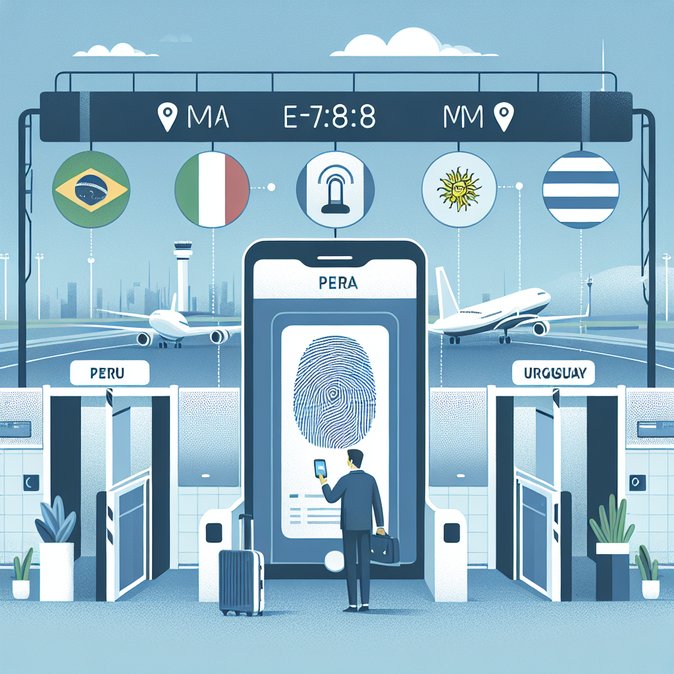
In an interview released late on 26 December and confirmed on 29 December, senior executives at the Ministry of Tourism and the Ministry of Justice said that the electronic visitor visa (e-Visa) relaunched in April for U.S., Canadian and Australian travellers will serve as the ‘reference implementation’ for a broader, multi-country ecosystem. Peru, Colombia and Uruguay have signed on to a joint working group that is standardising APIs for e-Visa issuance, selfie-biometric capture and real-time exchange of Advance Passenger Information (API). The first deliverable—a mobile “cross-border wallet” storing a Brazil e-Visa QR code backed by a facial match against the Federal-Police database—will enter closed beta with selected corporate travellers in Q2 2026.
The project matters because today even the fastest Brazilian visitor visa takes three to five business days; each additional South-American visa adds a week. Under the new scheme, a traveller heading to a three-country road-show could apply once, submit biometrics once and move through e-gates in seconds. Airlines at São Paulo/Guarulhos and Rio/Galeão have already begun installing compatible e-gates, and the airports’ operator group ABEAR says boarding times in Terminal 3 at GRU have dropped 10 percent in preliminary tests.
![Brazil Fast-Tracks Regional e-Visa & Biometric Wallet; Full Roll-Out by 2026]()
Travellers and corporate mobility teams seeking a streamlined path through these changes can turn to VisaHQ, whose Brazil desk (https://www.visahq.com/brazil/) already handles the revived e-Visa process and offers hands-on support for biometric enrolment and multi-country itineraries. By consolidating embassy requirements and real-time policy updates in one place, VisaHQ helps applicants avoid delays and ensures companies stay compliant as the regional digital-border initiative expands.
For multinationals the business case is obvious: shorter lead times for assignments, lower document courier costs and earlier visibility into travel data. Visa and privacy lawyers, however, warn that HR teams will have to update consent language because biometric templates will be shared among multiple sovereign databases. Data localisation rules differ sharply between Brazil (which follows the LGPD) and Colombia, for example. Mobility managers should start mapping those discrepancies now, especially for U.S. travellers whose facial images could end up stored abroad.
Although participation will remain voluntary—paper passports will still be accepted—the Ministry of Justice is drafting a portaria that would make acceptance of the credential mandatory at all Brazilian international airports by December 2026. Companies that rely on frequent short-notice travel into Brazil should therefore plan to enrol key staff in the e-Visa wallet during the pilot phase, both to iron out procedural kinks and to demonstrate compliance with Brazil’s tightening duty-of-care requirements.
In an interview released late on 26 December and confirmed on 29 December, senior executives at the Ministry of Tourism and the Ministry of Justice said that the electronic visitor visa (e-Visa) relaunched in April for U.S., Canadian and Australian travellers will serve as the ‘reference implementation’ for a broader, multi-country ecosystem. Peru, Colombia and Uruguay have signed on to a joint working group that is standardising APIs for e-Visa issuance, selfie-biometric capture and real-time exchange of Advance Passenger Information (API). The first deliverable—a mobile “cross-border wallet” storing a Brazil e-Visa QR code backed by a facial match against the Federal-Police database—will enter closed beta with selected corporate travellers in Q2 2026.
The project matters because today even the fastest Brazilian visitor visa takes three to five business days; each additional South-American visa adds a week. Under the new scheme, a traveller heading to a three-country road-show could apply once, submit biometrics once and move through e-gates in seconds. Airlines at São Paulo/Guarulhos and Rio/Galeão have already begun installing compatible e-gates, and the airports’ operator group ABEAR says boarding times in Terminal 3 at GRU have dropped 10 percent in preliminary tests.

Travellers and corporate mobility teams seeking a streamlined path through these changes can turn to VisaHQ, whose Brazil desk (https://www.visahq.com/brazil/) already handles the revived e-Visa process and offers hands-on support for biometric enrolment and multi-country itineraries. By consolidating embassy requirements and real-time policy updates in one place, VisaHQ helps applicants avoid delays and ensures companies stay compliant as the regional digital-border initiative expands.
For multinationals the business case is obvious: shorter lead times for assignments, lower document courier costs and earlier visibility into travel data. Visa and privacy lawyers, however, warn that HR teams will have to update consent language because biometric templates will be shared among multiple sovereign databases. Data localisation rules differ sharply between Brazil (which follows the LGPD) and Colombia, for example. Mobility managers should start mapping those discrepancies now, especially for U.S. travellers whose facial images could end up stored abroad.
Although participation will remain voluntary—paper passports will still be accepted—the Ministry of Justice is drafting a portaria that would make acceptance of the credential mandatory at all Brazilian international airports by December 2026. Companies that rely on frequent short-notice travel into Brazil should therefore plan to enrol key staff in the e-Visa wallet during the pilot phase, both to iron out procedural kinks and to demonstrate compliance with Brazil’s tightening duty-of-care requirements.