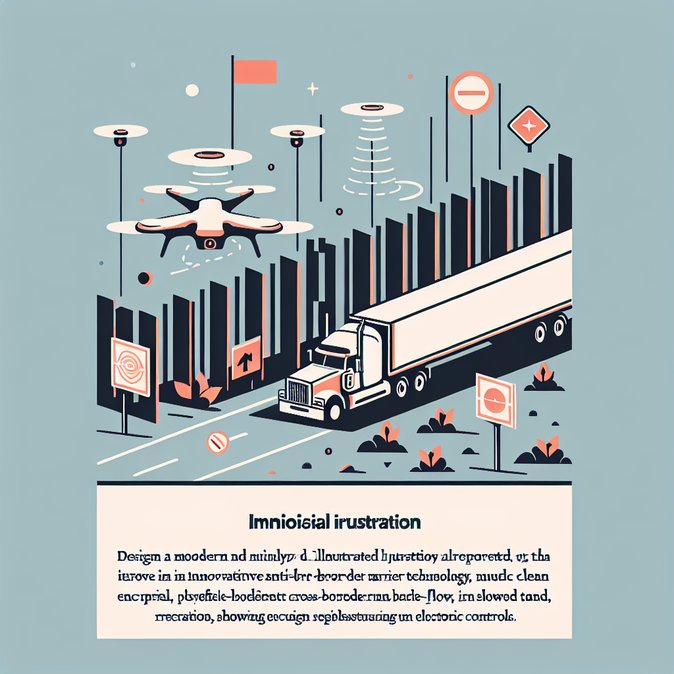
Poland’s government has confirmed plans to spend €2 billion on an integrated anti-drone defence wall stretching more than 400 km along its borders with Belarus and the Russian exclave of Kaliningrad. Deputy Defence Minister Cezary Tomczyk told reporters on 27 December that the first batteries of jammers, rapid-fire cannon and surface-to-air missiles would be operational “within six months,” with full deployment targeted for late-2027 .
Context and drivers – why now? 2025 has been the most turbulent year for Polish air-space since the Cold War. More than 30 Russian reconnaissance drones have violated Polish airspace this year, while the Zapad-2025 exercises staged jointly by Russia and Belarus in September forced Warsaw to close its land frontier for a month. The new shield—co-funded by the EU’s SAFE Defence Facility—aims to deter low-cost unmanned incursions that threaten both civilian aviation corridors and the rail-and-road lifeline feeding NATO logistics into Ukraine.
What will be built? The project combines hardened “drone-proof” fencing, radar-linked acoustic sensors, electronic-warfare (EW) towers able to jam GPS and Starlink frequencies, and mobile firing units equipped with 35 mm cannon and short-range missiles. A new logistics hub at Białystok will store spares and host rapid-response EW teams capable of reaching any border sector within two hours.
![Poland to Build €2 Billion Anti-Drone Shield Along Eastern Border]()
Practical impact for mobility managers.
• Border wait-times: Construction will involve heavy machinery operating inside existing lanes at the Kuźnica, Bobrowniki and Terespol crossings. Transport ministry planners expect a 30 % reduction in truck throughput on the S-8 and DK-2 corridors between March and September 2026.
• Airspace restrictions: NOTAMs similar to those issued after the September drone incursions are likely whenever live-fire tests are scheduled, resulting in short-notice rerouting of LOT and Ryanair services into Warsaw and Rzeszów.
• Work-site permits: Non-EU security contractors installing sensors will need expedited “protected zone” work passes from the Podlaskie Voivode; vetting can take up to 50 days, so corporate security integrators should factor this into deployment timelines.
Travel teams grappling with these new permit layers can simplify the paperwork by using VisaHQ’s Poland portal (https://www.visahq.com/poland/), which delivers step-by-step guidance on Schengen visas, local work passes and the forthcoming protected-zone clearances, along with courier pickup and real-time application tracking.
Broader implications. For multinational manufacturers operating “near-shoring” plants in eastern Poland, the shield offers welcome insurance against supply-chain disruption but also signals a more militarised frontier. Mobility teams should update crisis-response plans and ensure employees’ personal data are enrolled in Poland’s new Civil Security Alert app, launched in October. From an EU-wide perspective, the project is an early test of the bloc’s first common border-air-defence fund and could become a template for Latvia and Lithuania, both of which have reported similar drone intrusions.
Context and drivers – why now? 2025 has been the most turbulent year for Polish air-space since the Cold War. More than 30 Russian reconnaissance drones have violated Polish airspace this year, while the Zapad-2025 exercises staged jointly by Russia and Belarus in September forced Warsaw to close its land frontier for a month. The new shield—co-funded by the EU’s SAFE Defence Facility—aims to deter low-cost unmanned incursions that threaten both civilian aviation corridors and the rail-and-road lifeline feeding NATO logistics into Ukraine.
What will be built? The project combines hardened “drone-proof” fencing, radar-linked acoustic sensors, electronic-warfare (EW) towers able to jam GPS and Starlink frequencies, and mobile firing units equipped with 35 mm cannon and short-range missiles. A new logistics hub at Białystok will store spares and host rapid-response EW teams capable of reaching any border sector within two hours.

Practical impact for mobility managers.
• Border wait-times: Construction will involve heavy machinery operating inside existing lanes at the Kuźnica, Bobrowniki and Terespol crossings. Transport ministry planners expect a 30 % reduction in truck throughput on the S-8 and DK-2 corridors between March and September 2026.
• Airspace restrictions: NOTAMs similar to those issued after the September drone incursions are likely whenever live-fire tests are scheduled, resulting in short-notice rerouting of LOT and Ryanair services into Warsaw and Rzeszów.
• Work-site permits: Non-EU security contractors installing sensors will need expedited “protected zone” work passes from the Podlaskie Voivode; vetting can take up to 50 days, so corporate security integrators should factor this into deployment timelines.
Travel teams grappling with these new permit layers can simplify the paperwork by using VisaHQ’s Poland portal (https://www.visahq.com/poland/), which delivers step-by-step guidance on Schengen visas, local work passes and the forthcoming protected-zone clearances, along with courier pickup and real-time application tracking.
Broader implications. For multinational manufacturers operating “near-shoring” plants in eastern Poland, the shield offers welcome insurance against supply-chain disruption but also signals a more militarised frontier. Mobility teams should update crisis-response plans and ensure employees’ personal data are enrolled in Poland’s new Civil Security Alert app, launched in October. From an EU-wide perspective, the project is an early test of the bloc’s first common border-air-defence fund and could become a template for Latvia and Lithuania, both of which have reported similar drone intrusions.