Brazil is closing out 2025 by putting itself at the center of Latin America’s push toward fully digital borders. In an interview released late on 26 December, senior officials from the Ministry of Tourism confirmed that the experience gained since reinstating the electronic visitor visa (e-Visa) for U.S., Canadian and Australian travelers in April will now serve as the springboard for a broader roll-out.
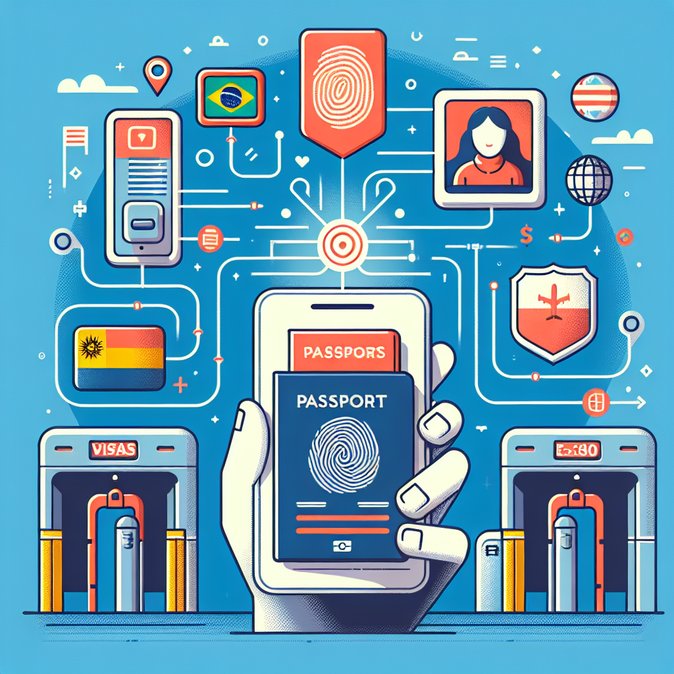
Under the plan, Brazil, Peru, Colombia and Uruguay have created a working group piloting a shared application-programming-interface (API) standard for issuing e-visas, capturing biometrics and sharing advance passenger information. The first tangible deliverable will be a mobile “cross-border wallet” that stores a traveler’s Brazil e-Visa QR code plus a selfie biometric validated against the federal-police database. Beta testing with selected corporate travelers is slated for Q2 2026—just ahead of the COP30 climate summit in Belém—while airlines at São Paulo/Guarulhos and Rio/Galeão are already installing e-gates that can read the credential.
Officials say the objective is to let passengers reuse the same digital credential across participating countries, dramatically shortening queues and giving governments earlier data for risk assessment. From a corporate-mobility perspective, a region-wide e-visa platform could slash assignment lead times, reduce document-handling costs and give compliance teams real-time visibility of employee travel.
![Brazil leads regional shift to e-visas and biometrics, sets 2026 deadline for digital borders]()
Travelers and mobility managers who want a turnkey way to navigate these new requirements can tap VisaHQ’s expertise: the company’s Brazil portal (https://www.visahq.com/brazil/) already streamlines e-Visa processing and will incorporate the forthcoming cross-border wallet as soon as APIs go live, supplying step-by-step guidance, document validation and status alerts to keep trips on schedule and compliant.
Data-privacy lawyers, however, warn that HR departments will need to revisit consent language in assignment letters because biometric templates will be shared with multiple governments. Participation will remain optional—paper passports will still be accepted—and the Ministry of Justice is drafting a portaria that will make acceptance of the credential mandatory at all Brazilian international airports by December 2026.
With Brazil positioning itself as South America’s digital-border trend-setter, multinationals are advised to engage early with travel-management providers to ensure booking tools and duty-of-care platforms can ingest the new QR- and biometric data fields once they go live.
Under the plan, Brazil, Peru, Colombia and Uruguay have created a working group piloting a shared application-programming-interface (API) standard for issuing e-visas, capturing biometrics and sharing advance passenger information. The first tangible deliverable will be a mobile “cross-border wallet” that stores a traveler’s Brazil e-Visa QR code plus a selfie biometric validated against the federal-police database. Beta testing with selected corporate travelers is slated for Q2 2026—just ahead of the COP30 climate summit in Belém—while airlines at São Paulo/Guarulhos and Rio/Galeão are already installing e-gates that can read the credential.
Officials say the objective is to let passengers reuse the same digital credential across participating countries, dramatically shortening queues and giving governments earlier data for risk assessment. From a corporate-mobility perspective, a region-wide e-visa platform could slash assignment lead times, reduce document-handling costs and give compliance teams real-time visibility of employee travel.

Travelers and mobility managers who want a turnkey way to navigate these new requirements can tap VisaHQ’s expertise: the company’s Brazil portal (https://www.visahq.com/brazil/) already streamlines e-Visa processing and will incorporate the forthcoming cross-border wallet as soon as APIs go live, supplying step-by-step guidance, document validation and status alerts to keep trips on schedule and compliant.
Data-privacy lawyers, however, warn that HR departments will need to revisit consent language in assignment letters because biometric templates will be shared with multiple governments. Participation will remain optional—paper passports will still be accepted—and the Ministry of Justice is drafting a portaria that will make acceptance of the credential mandatory at all Brazilian international airports by December 2026.
With Brazil positioning itself as South America’s digital-border trend-setter, multinationals are advised to engage early with travel-management providers to ensure booking tools and duty-of-care platforms can ingest the new QR- and biometric data fields once they go live.