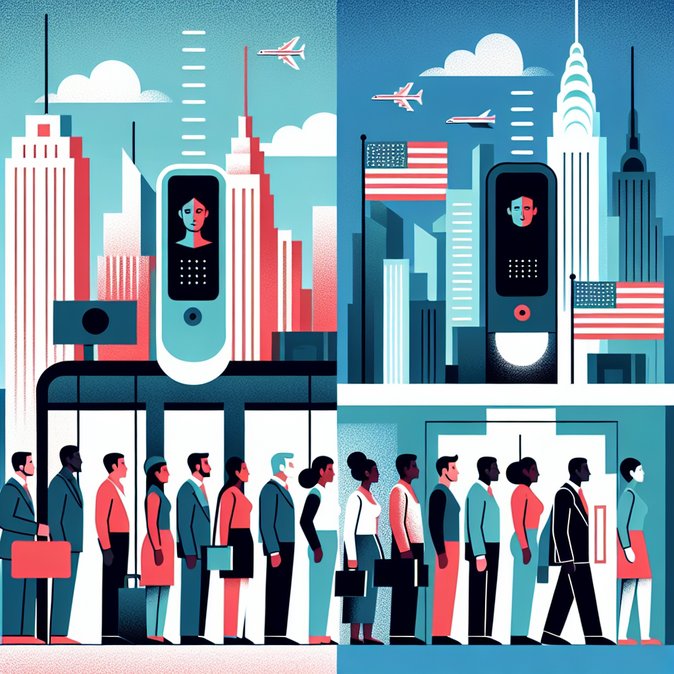
A long-planned expansion of America’s biometric entry-exit system quietly went live at 12:01 a.m. ET on December 26, 2025. The Department of Homeland Security’s final rule authorises U.S. Customs and Border Protection (CBP) officers to photograph—and, where operationally feasible, fingerprint or otherwise collect biometrics from—every non-U.S. citizen each time they enter or depart the United States, whether by air, land or sea. Exemptions for diplomats, most Canadian travellers, children under 14 and adults over 79 have been removed, making the programme truly universal for foreign nationals for the first time .
CBP argues that the new regime will strengthen border security, help detect impostors and visa overstays, and speed inspections by allowing automated facial-comparison gates at major airports. According to agency estimates, 98 percent of air passengers will clear in under 15 seconds once the system is fully deployed. Civil-liberty advocates, however, warn that the rule amounts to “perpetual line-up” photography and expands government surveillance of millions of lawful travellers .
For travellers and programme managers who need hands-on assistance interpreting these changes, VisaHQ’s U.S. portal (https://www.visahq.com/united-states/) offers real-time regulatory updates, step-by-step guidance and application support, helping ensure that employees’ documents and travel plans remain compliant even as biometric requirements evolve.
![DHS Biometric Entry-Exit Rule Takes Effect Across All U.S. Ports]()
For global mobility managers the timing is critical. The holiday peak combines record passenger volumes with the first day of mandatory scans; companies moving foreign staff should plan for longer arrivals queues and advise travellers of their right to request manual inspection if they object to facial recognition. Permanent residents must also comply, a change that may surprise green-card holders accustomed to lighter scrutiny.
Airports have raced to install additional e-gates, while land ports along the Canadian and Mexican borders are phasing in mobile biometric kiosks. Carriers have been instructed to remind passengers that refusal to provide biometrics can trigger civil fines of up to $5,000 and, in some cases, denial of boarding. CBP insists the images will be retained for no more than 75 years and shared only for law-enforcement purposes, but privacy groups are already preparing litigation.
In the short term, companies should update travel policies, brief employees about the new requirements, and ensure that vendor systems used for travel booking capture the added processing time. Longer-term, mobility teams will need to monitor data-protection developments and evaluate whether Trusted-Traveler enrolment remains worthwhile when biometrics are effectively universal.
CBP argues that the new regime will strengthen border security, help detect impostors and visa overstays, and speed inspections by allowing automated facial-comparison gates at major airports. According to agency estimates, 98 percent of air passengers will clear in under 15 seconds once the system is fully deployed. Civil-liberty advocates, however, warn that the rule amounts to “perpetual line-up” photography and expands government surveillance of millions of lawful travellers .
For travellers and programme managers who need hands-on assistance interpreting these changes, VisaHQ’s U.S. portal (https://www.visahq.com/united-states/) offers real-time regulatory updates, step-by-step guidance and application support, helping ensure that employees’ documents and travel plans remain compliant even as biometric requirements evolve.

For global mobility managers the timing is critical. The holiday peak combines record passenger volumes with the first day of mandatory scans; companies moving foreign staff should plan for longer arrivals queues and advise travellers of their right to request manual inspection if they object to facial recognition. Permanent residents must also comply, a change that may surprise green-card holders accustomed to lighter scrutiny.
Airports have raced to install additional e-gates, while land ports along the Canadian and Mexican borders are phasing in mobile biometric kiosks. Carriers have been instructed to remind passengers that refusal to provide biometrics can trigger civil fines of up to $5,000 and, in some cases, denial of boarding. CBP insists the images will be retained for no more than 75 years and shared only for law-enforcement purposes, but privacy groups are already preparing litigation.
In the short term, companies should update travel policies, brief employees about the new requirements, and ensure that vendor systems used for travel booking capture the added processing time. Longer-term, mobility teams will need to monitor data-protection developments and evaluate whether Trusted-Traveler enrolment remains worthwhile when biometrics are effectively universal.