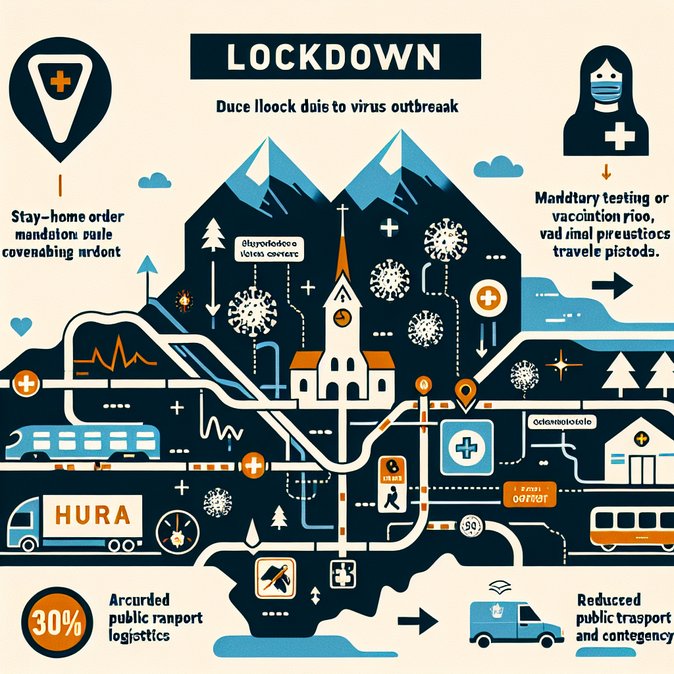
Switzerland’s traditionally tranquil Jura canton awoke on Christmas morning to sweeping public-health and mobility restrictions. Late on 24 December the Federal Office of Public Health (FOPH) confirmed 12 laboratory-verified cases of a novel respiratory virus—dubbed Jura-21—in Porrentruy, Delémont and Moutier. At 06:00 CET on 25 December the canton activated a stay-at-home order, closed non-essential businesses and, crucially for mobility planners, imposed testing or vaccination requirements on anyone entering or leaving the canton.
Under the decree, inter-canton travellers must present a negative PCR test taken within 24 hours or an up-to-date vaccination certificate. Federal Border Control units have been redeployed to key highway checkpoints and railway nodes to enforce compliance, effectively slowing domestic holiday traffic on the A16 Trans-Jura motorway and on cross-border regional trains to France and Basel-Land.
For travellers who still need to reach Switzerland or reposition staff across its cantonal borders, VisaHQ can streamline the paperwork. Its dedicated Switzerland page (https://www.visahq.com/switzerland/) aggregates the latest visa, vaccination and testing rules in real time and offers digital tools for securing the necessary certificates, giving mobility managers a single window as requirements shift from canton to canton.
![Jura-21 Outbreak Triggers Inter-Canton Travel Restrictions and Stay-at-Home Orders]()
Public transport within Jura has been cut back by 30 percent, while cross-border trains now require pre-travel test verification. Schools shift to remote learning until at least 8 January, and event permits are suspended. For firms running year-end production in the watch-making communes of the Franches-Montagnes, the restrictions mean re-routing staff via Neuchâtel and arranging on-site rapid tests to keep assembly lines moving.
Health authorities stress that Jura-21 is not yet classified as a variant of international concern, but they are racing to sequence its genome and trace contacts. A mobile testing surge, the mandatory “JuraTrack” tracing app and daily FOPH dashboards aim to break chains of transmission within two weeks. If case numbers stabilise, officials may lift travel limits in mid-January; failure could see neighbouring cantons replicate the controls.
For global-mobility managers the episode is a reminder that intra-Swiss moves can still be disrupted by public-health events. Employers should update domestic travel policies, verify that essential staff carry digital vaccination certificates and build redundancy into supply chains that transit the affected region.
Under the decree, inter-canton travellers must present a negative PCR test taken within 24 hours or an up-to-date vaccination certificate. Federal Border Control units have been redeployed to key highway checkpoints and railway nodes to enforce compliance, effectively slowing domestic holiday traffic on the A16 Trans-Jura motorway and on cross-border regional trains to France and Basel-Land.
For travellers who still need to reach Switzerland or reposition staff across its cantonal borders, VisaHQ can streamline the paperwork. Its dedicated Switzerland page (https://www.visahq.com/switzerland/) aggregates the latest visa, vaccination and testing rules in real time and offers digital tools for securing the necessary certificates, giving mobility managers a single window as requirements shift from canton to canton.

Public transport within Jura has been cut back by 30 percent, while cross-border trains now require pre-travel test verification. Schools shift to remote learning until at least 8 January, and event permits are suspended. For firms running year-end production in the watch-making communes of the Franches-Montagnes, the restrictions mean re-routing staff via Neuchâtel and arranging on-site rapid tests to keep assembly lines moving.
Health authorities stress that Jura-21 is not yet classified as a variant of international concern, but they are racing to sequence its genome and trace contacts. A mobile testing surge, the mandatory “JuraTrack” tracing app and daily FOPH dashboards aim to break chains of transmission within two weeks. If case numbers stabilise, officials may lift travel limits in mid-January; failure could see neighbouring cantons replicate the controls.
For global-mobility managers the episode is a reminder that intra-Swiss moves can still be disrupted by public-health events. Employers should update domestic travel policies, verify that essential staff carry digital vaccination certificates and build redundancy into supply chains that transit the affected region.