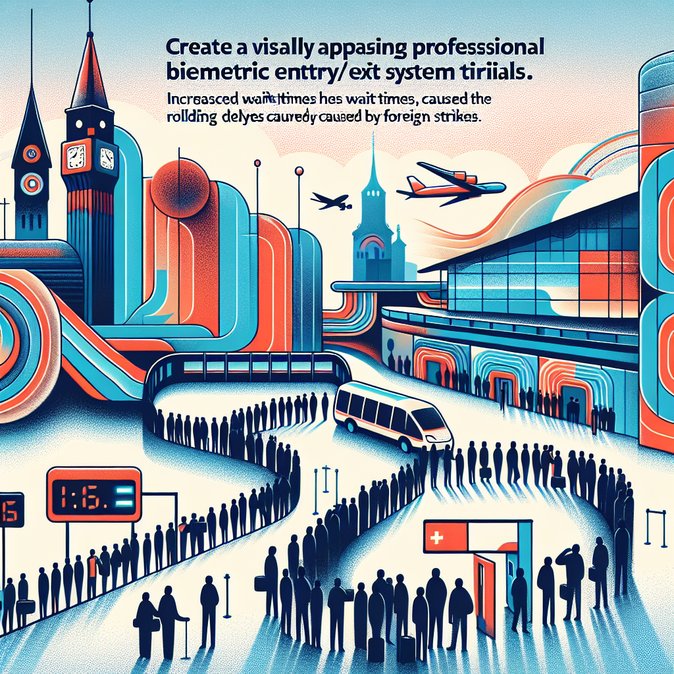
Corporate travel managers received an unwelcome Christmas present this week. An advisory circulated by VisaHQ on 24 December warns that passengers departing Switzerland between 24 and 31 December should prepare for security queues of up to three hours at Zurich, Geneva and Basel airports. Two factors are driving the crunch: spill-over industrial action abroad and the European Union’s pilot roll-out of its biometric Entry/Exit System (EES).
Ground-handling staff at London-Luton (easyJet) and cabin crews at several Spanish Ryanair bases have announced staggered strikes through 29 December. Because many Swiss holidaymakers route through these hubs, delays there compress aircraft turn-arounds in Switzerland’s arrival banks, creating a squeeze on immigration counters just as volumes peak. Zurich expects its busiest fortnight since 2019, while Geneva has redeployed administrative staff to front-line security posts and Basel has opened an overflow tent for baggage-drop.
The second stress-point is technology. Although the EES does not become mandatory until mid-2026, Swiss airports are among those testing live biometric capture for third-country nationals. VisaHQ estimates that each manual passport-stamp transaction takes 45 seconds, whereas a full facial-image and fingerprint scan under EES can take up to 80 seconds—an increase of roughly 70 percent. Non-EU nationals on short-haul business trips thus face the longest waits.
![Holiday Travel Alert: Swiss Travellers Told to Arrive Three Hours Early as Strikes and Biometric Checks Bite]()
For travel teams that want to stay one step ahead of these disruptions, VisaHQ’s Switzerland portal (https://www.visahq.com/switzerland/) provides real-time airport alerts, automated document checks and bulk Schengen visa processing, enabling companies to confirm EES readiness and compliance for every traveller before they leave the office.
VisaHQ recommends a three-pronged mitigation plan for employers: 1) push real-time strike calendars and delay trackers to travelling staff; 2) encourage hand-luggage-only travel to simplify re-routing; and 3) pre-verify that passports are machine-readable and valid for at least six months so travellers can access automated e-gates where available. The advisory also flags stepped-up spot checks on the southern road border with Italy, adding up to 45 minutes to daily commutes for Ticino-based cross-border workers.
While the queues are expected to ease in early January, mobility specialists warn that every subsequent EES trial will create similar bottlenecks until the system stabilises. Companies with high-frequency travellers should therefore review their Schengen-area visa matrices and consider enrolling key staff in trusted-traveller programmes where possible.
Ground-handling staff at London-Luton (easyJet) and cabin crews at several Spanish Ryanair bases have announced staggered strikes through 29 December. Because many Swiss holidaymakers route through these hubs, delays there compress aircraft turn-arounds in Switzerland’s arrival banks, creating a squeeze on immigration counters just as volumes peak. Zurich expects its busiest fortnight since 2019, while Geneva has redeployed administrative staff to front-line security posts and Basel has opened an overflow tent for baggage-drop.
The second stress-point is technology. Although the EES does not become mandatory until mid-2026, Swiss airports are among those testing live biometric capture for third-country nationals. VisaHQ estimates that each manual passport-stamp transaction takes 45 seconds, whereas a full facial-image and fingerprint scan under EES can take up to 80 seconds—an increase of roughly 70 percent. Non-EU nationals on short-haul business trips thus face the longest waits.
For travel teams that want to stay one step ahead of these disruptions, VisaHQ’s Switzerland portal (https://www.visahq.com/switzerland/) provides real-time airport alerts, automated document checks and bulk Schengen visa processing, enabling companies to confirm EES readiness and compliance for every traveller before they leave the office.
VisaHQ recommends a three-pronged mitigation plan for employers: 1) push real-time strike calendars and delay trackers to travelling staff; 2) encourage hand-luggage-only travel to simplify re-routing; and 3) pre-verify that passports are machine-readable and valid for at least six months so travellers can access automated e-gates where available. The advisory also flags stepped-up spot checks on the southern road border with Italy, adding up to 45 minutes to daily commutes for Ticino-based cross-border workers.
While the queues are expected to ease in early January, mobility specialists warn that every subsequent EES trial will create similar bottlenecks until the system stabilises. Companies with high-frequency travellers should therefore review their Schengen-area visa matrices and consider enrolling key staff in trusted-traveller programmes where possible.