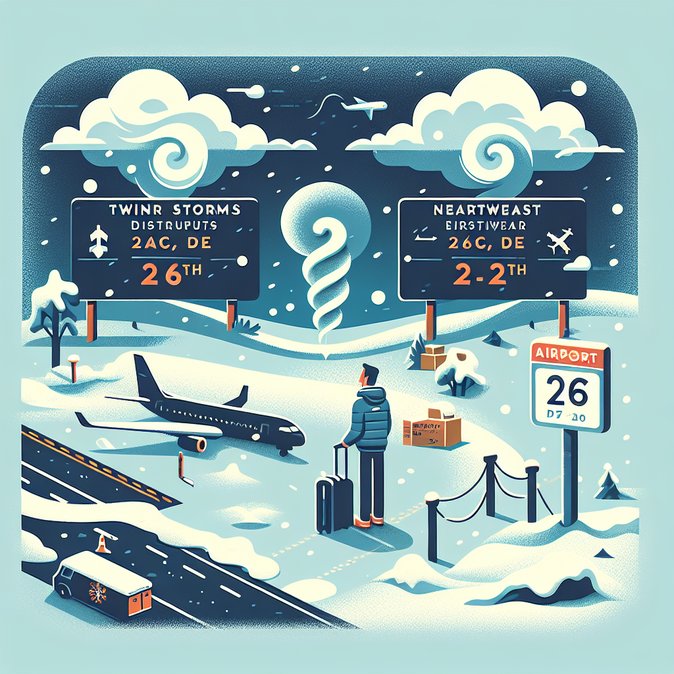
A potent one-two punch of Pacific atmospheric rivers and Northeast snowstorms disrupted holiday travel on Tuesday, delaying more than 2,000 U.S. flights and cancelling at least 100, according to FlightAware data cited in Newsweek’s live “Holiday Travel Tracker.” The Federal Aviation Administration issued ground-delay programs for San Francisco and San Diego, with average holds of 40–60 minutes, while high winds threatened the New York metro airports.
The National Weather Service warns that flooding rains in California and icing in New England will persist through Christmas Day, raising the risk of rolling cancellations as aircraft and crews fall out of position. AAA projects a record 8 million Americans will fly during the 13-day holiday window, and the first stress-test is proving rough: Bay-Area corporate headquarters reported difficulty repositioning international assignees, while tech firms are advising staff to pad itineraries by 24 hours.
![Winter storms snarl US holiday travel with 2,000+ flight delays and dozens of cancellations]()
If altered itineraries suddenly require new transit or destination visas, VisaHQ can streamline the process in minutes. Its digital platform lets travelers and mobility teams submit applications, track status in real time, and access emergency expediting services for the United States and 200+ other countries—visit https://www.visahq.com/united-states/ to keep documentation from becoming another cause of delay.
Road travel is no better. INRIX analytics show Boston-area routes could take 126% longer than normal, and Georgia State Patrol has launched statewide DUI checkpoints. Logistics managers moving critical parts between West-Coast ports and Midwest factories are advancing departure times to avoid expected Interstate-80 closures over Donner Pass.
For global-mobility and travel-risk teams, the takeaway is to anticipate cascading delays: encourage travellers to book morning flights (statistically less likely to cancel), monitor FAA OPSNET advisories, and ensure that remote-work contingencies are in place if employees are stranded.
The National Weather Service warns that flooding rains in California and icing in New England will persist through Christmas Day, raising the risk of rolling cancellations as aircraft and crews fall out of position. AAA projects a record 8 million Americans will fly during the 13-day holiday window, and the first stress-test is proving rough: Bay-Area corporate headquarters reported difficulty repositioning international assignees, while tech firms are advising staff to pad itineraries by 24 hours.

If altered itineraries suddenly require new transit or destination visas, VisaHQ can streamline the process in minutes. Its digital platform lets travelers and mobility teams submit applications, track status in real time, and access emergency expediting services for the United States and 200+ other countries—visit https://www.visahq.com/united-states/ to keep documentation from becoming another cause of delay.
Road travel is no better. INRIX analytics show Boston-area routes could take 126% longer than normal, and Georgia State Patrol has launched statewide DUI checkpoints. Logistics managers moving critical parts between West-Coast ports and Midwest factories are advancing departure times to avoid expected Interstate-80 closures over Donner Pass.
For global-mobility and travel-risk teams, the takeaway is to anticipate cascading delays: encourage travellers to book morning flights (statistically less likely to cancel), monitor FAA OPSNET advisories, and ensure that remote-work contingencies are in place if employees are stranded.