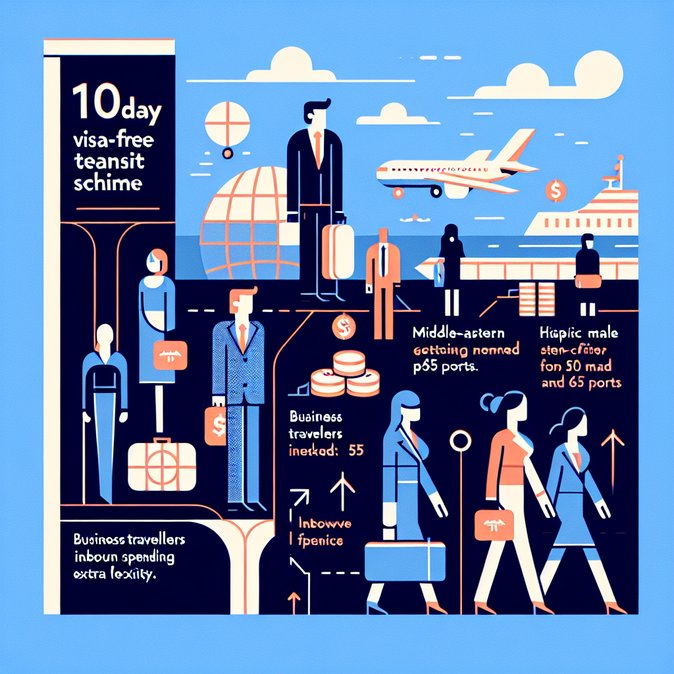
China’s year-old decision to merge its 72-hour and 144-hour transit waivers into a single 240-hour (10-day) visa-free transit programme is delivering measurable results. According to National Immigration Administration (NIA) figures released on 21 December, the mainland processed 40.6 million foreign-passport entries over the past 12 months, a 27.2 % jump on 2024. More than half of that increase was credited to heavier uptake of the longer transit waiver, which now covers 55 countries and 65 ports of entry.
Shanghai alone welcomed 5.35 million visitors under the scheme, while Beijing and Guangzhou each reported that a majority of inbound foreign travellers opted for the visa-free channel. Officials say the expansion to secondary airports—most recently Taiyuan, Hefei and Wenzhou—has spread the economic benefits beyond China’s tier-one cities.
To help corporate travel planners and individual passengers make the most of the 240-hour waiver—or obtain the appropriate visa when an itinerary falls outside the scheme—VisaHQ offers real-time guidance, document checks and application processing through its dedicated China portal (https://www.visahq.com/china/). The service consolidates up-to-date port lists, regional restrictions and transit rules, allowing travellers to upload itineraries for rapid compliance review and avoid costly delays.
![10-Day Visa-Free Transit Spurs 27 % Surge in Foreign Arrivals, NIA Data Show]()
For multinationals the change is more than a tourism story. Regional managers can now schedule week-long China itineraries at short notice, squeezing in factory visits, supplier audits and client meetings in several provinces without applying for an M-class business visa. Logistics providers report that the quicker processing has shortened cargo-owner inspections at ports, and conference organisers have seen stronger foreign attendance at trade fairs such as the Canton Fair and the China International Import Expo.
Nevertheless, companies must brief travellers carefully. The waiver is valid only for genuine transit to a third country, and overstays incur fines of RMB 500 per day. Executives should carry confirmed onward tickets and remain within the permitted regions. The NIA recommends preregistration via its “Smart Border” mini-programme to generate a QR code that speeds clearance at automated gates.
With China targeting 80 million foreign arrivals by 2027, officials hint that the transit policy could be expanded further—potentially to 15 days—and linked to digital travel credentials now being piloted at select airports.
Shanghai alone welcomed 5.35 million visitors under the scheme, while Beijing and Guangzhou each reported that a majority of inbound foreign travellers opted for the visa-free channel. Officials say the expansion to secondary airports—most recently Taiyuan, Hefei and Wenzhou—has spread the economic benefits beyond China’s tier-one cities.
To help corporate travel planners and individual passengers make the most of the 240-hour waiver—or obtain the appropriate visa when an itinerary falls outside the scheme—VisaHQ offers real-time guidance, document checks and application processing through its dedicated China portal (https://www.visahq.com/china/). The service consolidates up-to-date port lists, regional restrictions and transit rules, allowing travellers to upload itineraries for rapid compliance review and avoid costly delays.

For multinationals the change is more than a tourism story. Regional managers can now schedule week-long China itineraries at short notice, squeezing in factory visits, supplier audits and client meetings in several provinces without applying for an M-class business visa. Logistics providers report that the quicker processing has shortened cargo-owner inspections at ports, and conference organisers have seen stronger foreign attendance at trade fairs such as the Canton Fair and the China International Import Expo.
Nevertheless, companies must brief travellers carefully. The waiver is valid only for genuine transit to a third country, and overstays incur fines of RMB 500 per day. Executives should carry confirmed onward tickets and remain within the permitted regions. The NIA recommends preregistration via its “Smart Border” mini-programme to generate a QR code that speeds clearance at automated gates.
With China targeting 80 million foreign arrivals by 2027, officials hint that the transit policy could be expanded further—potentially to 15 days—and linked to digital travel credentials now being piloted at select airports.