The United Arab Emirates has moved the goalposts for aviation capacity again.
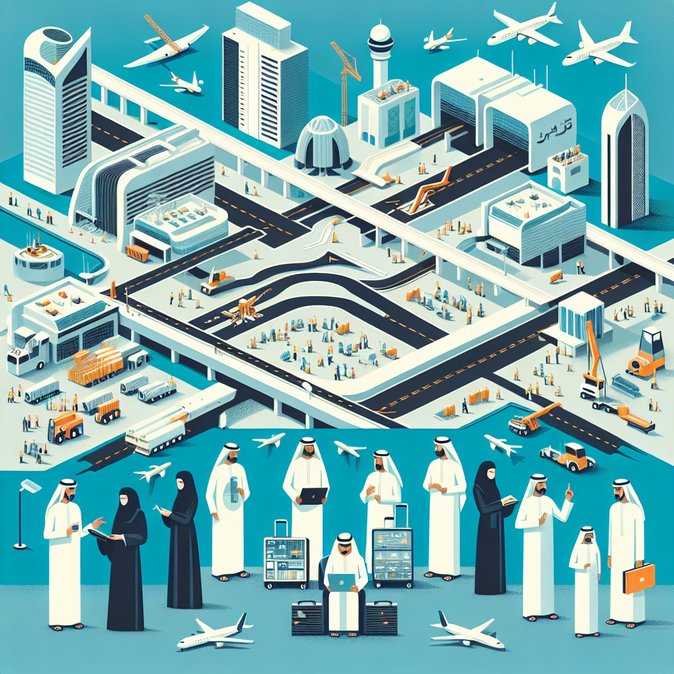
On 22 December the General Civil Aviation Authority and Dubai Airports jointly released the country’s 2026 master-plan, confirming that three major projects will enter full construction next year: the AED 128 billion (US $34.8 billion) rebuild of Al Maktoum International (DWC), a doubling of Sharjah International’s passenger terminal, and a phased expansion of Ras Al Khaimah International to 2028.
At DWC, five parallel runways, 400 remote and contact gates, and an integrated multimodal logistics zone will push theoretical capacity to 260 million travellers and 12 million tonnes of cargo—effectively future-proofing Dubai’s role as a super-hub when DXB reaches practical saturation later this decade. Sustainability and automation sit at the heart of the design: an all-electric ground-service fleet, hydrogen-ready auxiliary power, biometric “one-ID” passenger journeys, and a terminal cooled by a 100-MW solar park.
![UAE fast-tracks its next-generation airports: DWC, Sharjah and RAK unveil 2026 expansion blueprint]()
For corporate mobility managers the implications are immediate. Recruitment for specialist skills—air-traffic engineers, baggage-handling technologists, sustainability officers—will open in Q1 2026. Multinationals should review assignment allowances for staff relocating to Dubai South, Sharjah, or RAK as housing demand is expected to spike around construction corridors. Expansion also means additional airline slots; network planners can already file preliminary requests for the winter 2026/27 season.
Whether you’re rotating technical teams onto these mega-projects or scheduling executive site visits, VisaHQ can cut the red tape. Our digital visa management service streamlines UAE entry approvals, tracks application progress in real time, and offers tailored support for single or multiple-entry permits—ideal for companies with fluid travel needs. Get started at https://www.visahq.com/united-arab-emirates/
Sharjah International will add 85,000 m² of floor space, raising capacity to 20 million passengers and giving Air Arabia—its home carrier—room to grow its low-cost long-haul ambitions. Ras Al Khaimah, aiming for 5 million passengers by 2028, is positioning itself as a specialised leisure gateway with direct charter connections to Europe and India. Together the three projects reinforce the UAE’s strategy of distributing traffic across multiple hubs while keeping the entire ecosystem—airports, free-zones, and duty-free revenues—under an Emirati umbrella.
Businesses that rely on frequent executive travel to the Gulf should start mapping how the new geography will affect ground-transport times, preferred hotel locations, and immigration processing (each airport has its own General Directorate of Residency & Foreigners Affairs office). The message from regulators is clear: the UAE is betting big on aviation to underpin its post-oil economy, and the window to secure operating advantages is opening now.
On 22 December the General Civil Aviation Authority and Dubai Airports jointly released the country’s 2026 master-plan, confirming that three major projects will enter full construction next year: the AED 128 billion (US $34.8 billion) rebuild of Al Maktoum International (DWC), a doubling of Sharjah International’s passenger terminal, and a phased expansion of Ras Al Khaimah International to 2028.
At DWC, five parallel runways, 400 remote and contact gates, and an integrated multimodal logistics zone will push theoretical capacity to 260 million travellers and 12 million tonnes of cargo—effectively future-proofing Dubai’s role as a super-hub when DXB reaches practical saturation later this decade. Sustainability and automation sit at the heart of the design: an all-electric ground-service fleet, hydrogen-ready auxiliary power, biometric “one-ID” passenger journeys, and a terminal cooled by a 100-MW solar park.

For corporate mobility managers the implications are immediate. Recruitment for specialist skills—air-traffic engineers, baggage-handling technologists, sustainability officers—will open in Q1 2026. Multinationals should review assignment allowances for staff relocating to Dubai South, Sharjah, or RAK as housing demand is expected to spike around construction corridors. Expansion also means additional airline slots; network planners can already file preliminary requests for the winter 2026/27 season.
Whether you’re rotating technical teams onto these mega-projects or scheduling executive site visits, VisaHQ can cut the red tape. Our digital visa management service streamlines UAE entry approvals, tracks application progress in real time, and offers tailored support for single or multiple-entry permits—ideal for companies with fluid travel needs. Get started at https://www.visahq.com/united-arab-emirates/
Sharjah International will add 85,000 m² of floor space, raising capacity to 20 million passengers and giving Air Arabia—its home carrier—room to grow its low-cost long-haul ambitions. Ras Al Khaimah, aiming for 5 million passengers by 2028, is positioning itself as a specialised leisure gateway with direct charter connections to Europe and India. Together the three projects reinforce the UAE’s strategy of distributing traffic across multiple hubs while keeping the entire ecosystem—airports, free-zones, and duty-free revenues—under an Emirati umbrella.
Businesses that rely on frequent executive travel to the Gulf should start mapping how the new geography will affect ground-transport times, preferred hotel locations, and immigration processing (each airport has its own General Directorate of Residency & Foreigners Affairs office). The message from regulators is clear: the UAE is betting big on aviation to underpin its post-oil economy, and the window to secure operating advantages is opening now.