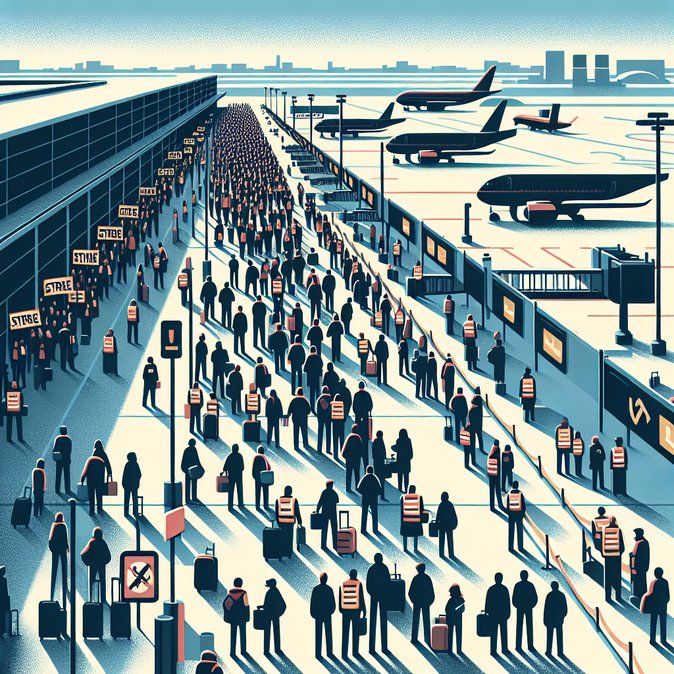
Less than 48 hours before Spain’s peak holiday travel rush, unions USO and CGT confirmed a series of walk-outs at South Europe Ground Services (South), the newly created low-cost handling arm of International Airlines Group (IAG). The strike schedule—23, 26 and 30 December 2025 plus 2 and 7 January 2026 in two four-hour blocks each day—threatens hundreds of departures at Madrid-Barajas (MAD), Iberia’s main hub and the country’s largest business-aviation gateway.
South was spun off from Iberia Airport Services only a year ago and already handles roughly 35 % of ground operations across 38 Spanish airports. Unions accuse the company of “low-costisation”: rapid hiring on sub-€18,000 salaries, high staff turnover, payroll errors, under-maintained equipment and abbreviated training they say is fuelling a rise in ramp incidents. Management counters that the model brings efficiency and competitiveness in line with EU market-opening rules.
The dispute places IAG—and indirectly Iberia, Vueling and LEVEL—under intense scrutiny just as Spain braces for record passenger numbers over the Christmas-New-Year period. Barajas alone expects 4.2 million passengers between 22 December and 8 January, according to Aena forecasts. Public-works ministry officials have set minimum-service requirements, but past actions show that baggage delivery, aircraft push-back and refuelling can suffer significant delays even when skeleton crews are in place.
![Ground-handling strike at Madrid-Barajas set to hit Christmas and New-Year flights as unions target IAG’s low-cost subsidiary]()
For multinational employers moving staff through MAD or relying on tight flight connections to Latin America, the strike could trigger missed meetings, visa-run complications and extra hotel costs. Mobility managers should advise travellers to build in additional layover time, use carry-on only where possible, and monitor re-routing options via Barcelona, Lisbon or Paris-Orly. Companies with posted workers on A1 social-security certificates should also remember that strike-related delays can push stays beyond 90/180-day limits in Schengen; proactive status checks are advisable.
Meanwhile, should those disruptions turn a routine transit into an unexpected stay or require a fresh visa, VisaHQ can pick up the slack. Through its Spain portal (https://www.visahq.com/spain/), the platform lets both corporate travel managers and individual flyers verify entry rules, file urgent visa applications and arrange document couriers—helping mitigate administrative headaches when ground operations grind to a halt.
Strategically, the confrontation exposes a broader labour fault-line in Europe’s aviation sector: airlines seeking cost relief via subsidiary handlers versus unions insisting on legacy-carrier wage and safety standards. Any precedent set in Spain could ripple across IAG bases in the UK and Ireland, affecting intra-company transfers and flight-reliability assumptions built into global mobility policies.
South was spun off from Iberia Airport Services only a year ago and already handles roughly 35 % of ground operations across 38 Spanish airports. Unions accuse the company of “low-costisation”: rapid hiring on sub-€18,000 salaries, high staff turnover, payroll errors, under-maintained equipment and abbreviated training they say is fuelling a rise in ramp incidents. Management counters that the model brings efficiency and competitiveness in line with EU market-opening rules.
The dispute places IAG—and indirectly Iberia, Vueling and LEVEL—under intense scrutiny just as Spain braces for record passenger numbers over the Christmas-New-Year period. Barajas alone expects 4.2 million passengers between 22 December and 8 January, according to Aena forecasts. Public-works ministry officials have set minimum-service requirements, but past actions show that baggage delivery, aircraft push-back and refuelling can suffer significant delays even when skeleton crews are in place.

For multinational employers moving staff through MAD or relying on tight flight connections to Latin America, the strike could trigger missed meetings, visa-run complications and extra hotel costs. Mobility managers should advise travellers to build in additional layover time, use carry-on only where possible, and monitor re-routing options via Barcelona, Lisbon or Paris-Orly. Companies with posted workers on A1 social-security certificates should also remember that strike-related delays can push stays beyond 90/180-day limits in Schengen; proactive status checks are advisable.
Meanwhile, should those disruptions turn a routine transit into an unexpected stay or require a fresh visa, VisaHQ can pick up the slack. Through its Spain portal (https://www.visahq.com/spain/), the platform lets both corporate travel managers and individual flyers verify entry rules, file urgent visa applications and arrange document couriers—helping mitigate administrative headaches when ground operations grind to a halt.
Strategically, the confrontation exposes a broader labour fault-line in Europe’s aviation sector: airlines seeking cost relief via subsidiary handlers versus unions insisting on legacy-carrier wage and safety standards. Any precedent set in Spain could ripple across IAG bases in the UK and Ireland, affecting intra-company transfers and flight-reliability assumptions built into global mobility policies.
More From Spain
View all
Amnesty International urges immediate mainland transfers for vulnerable migrants held in Spain’s Ceuta and Melilla reception centres

UN Experts Condemn Mass Eviction of 400 Migrants from Badalona School