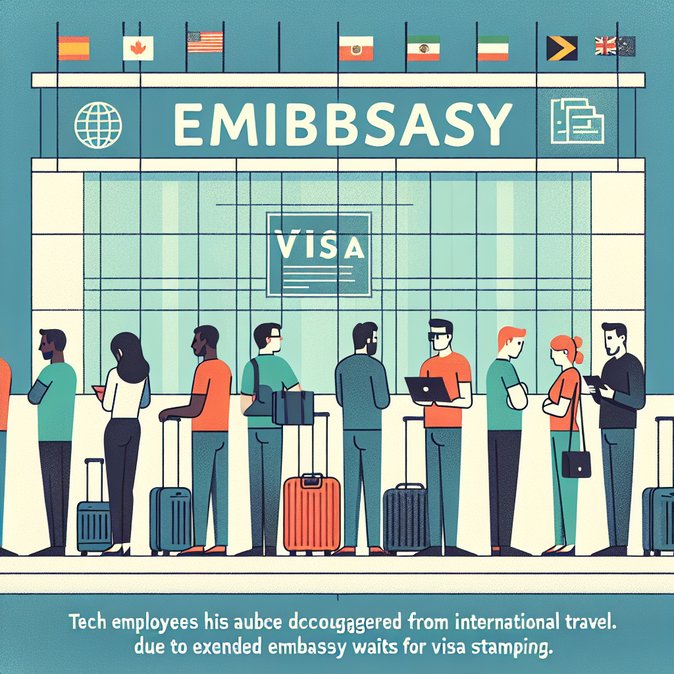
Alphabet and Apple have issued internal advisories telling employees on US work and study visas—many of whom are Chinese nationals—to postpone international trips over the Christmas-New-Year period because some American embassies now require up to 12 months to secure visa-stamping appointments. The alert, revealed by Business Insider and confirmed by Reuters on 21 December, follows the Biden Administration’s decision to intensify social-media vetting of H-1B, H-4, F, J and M visa applicants.
Impact on Chinese talent: Tech giants employ thousands of engineers who hold mainland Chinese passports and rely on the H-1B regime. If they travel home for Lunar New Year and cannot obtain timely consular interviews, they risk being stranded abroad and losing employment status. Immigration counsel Berry Appleman & Leiden says applicants at the US Consulate in Guangzhou face first-available slots in November 2026.
Business continuity: Both companies have set up contingency plans including remote-work accommodations and emergency L-1 transfers to Canadian offices. Smaller firms without such options may experience project delays. Human-resources departments are urging staff to renew visas via the State Department’s limited “drop-box” pilot or schedule appointments in third-country posts such as Singapore.
![US Visa-Stamping Backlog Prompts Google and Apple to Caution China-Born Staff Against Travel]()
For mobility teams that need a one-stop dashboard of consular wait times and up-to-the-minute rule changes, VisaHQ can streamline planning and document submission for Chinese passport holders and other foreign nationals alike. Its online platform (https://www.visahq.com/china/) provides real-time alerts, application checklists and courier support, helping employees secure appointments—or alternative travel documents—before they commit to flights home.
Policy backdrop: The United States reinstated a controversial US$100,000 H-1B petition fee earlier this year, and Congress has pressed for tighter screening of applicants with ties to China’s “strategic sectors”. The backlog highlights how geopolitics can disrupt talent mobility just as Chinese tech professionals begin travelling more freely post-pandemic.
Advice for mobility managers: Audit employee travel over the next six months, flag individuals whose visas need renewal, and explore in-country status changes or premium-processing upgrades. Consider briefing Chinese assignees on the risks of “visa run” strategies that might invalidate current status.
Impact on Chinese talent: Tech giants employ thousands of engineers who hold mainland Chinese passports and rely on the H-1B regime. If they travel home for Lunar New Year and cannot obtain timely consular interviews, they risk being stranded abroad and losing employment status. Immigration counsel Berry Appleman & Leiden says applicants at the US Consulate in Guangzhou face first-available slots in November 2026.
Business continuity: Both companies have set up contingency plans including remote-work accommodations and emergency L-1 transfers to Canadian offices. Smaller firms without such options may experience project delays. Human-resources departments are urging staff to renew visas via the State Department’s limited “drop-box” pilot or schedule appointments in third-country posts such as Singapore.

For mobility teams that need a one-stop dashboard of consular wait times and up-to-the-minute rule changes, VisaHQ can streamline planning and document submission for Chinese passport holders and other foreign nationals alike. Its online platform (https://www.visahq.com/china/) provides real-time alerts, application checklists and courier support, helping employees secure appointments—or alternative travel documents—before they commit to flights home.
Policy backdrop: The United States reinstated a controversial US$100,000 H-1B petition fee earlier this year, and Congress has pressed for tighter screening of applicants with ties to China’s “strategic sectors”. The backlog highlights how geopolitics can disrupt talent mobility just as Chinese tech professionals begin travelling more freely post-pandemic.
Advice for mobility managers: Audit employee travel over the next six months, flag individuals whose visas need renewal, and explore in-country status changes or premium-processing upgrades. Consider briefing Chinese assignees on the risks of “visa run” strategies that might invalidate current status.