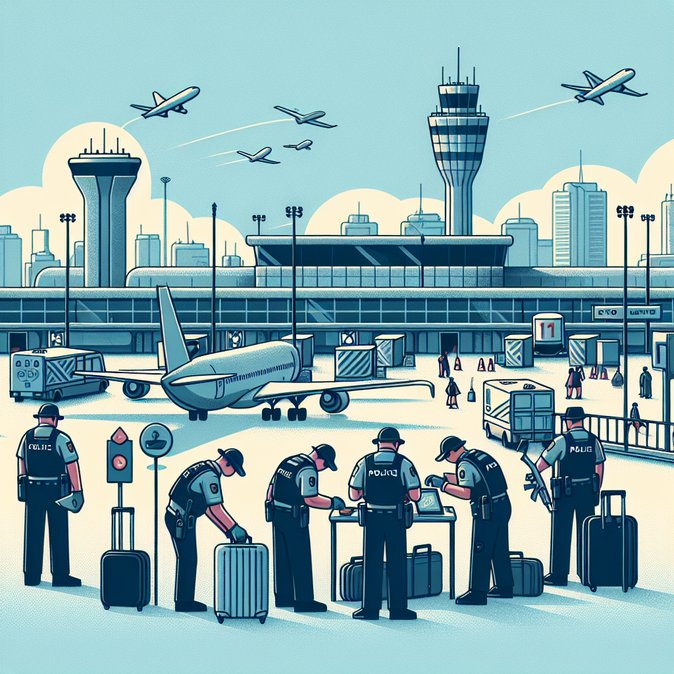
Brazil’s Federal Police (PF) mounted an intensive 24-hour operation at São Paulo/Guarulhos International Airport (GRU) between the evenings of 18 and 19 December, underlining the agency’s tougher holiday-season posture.
The first action saw migration agents enforce a Bahia-court warrant against a well-known businessman with R$4.2 million in unpaid labour debts. Officers confiscated his passport moments before boarding, a tactic courts increasingly deploy to force settlement before debtors can leave the country.
Hours later two Brazilian women transiting to Brussels via Madrid were caught with 10 kg of cocaine concealed in false-bottom suitcases. They face international-trafficking charges carrying sentences of up to 15 years. In a separate incident, a US national was arrested after X-ray scanners detected 16 kg of hashish in checked baggage.
![Federal Police blitz at São Paulo/GRU nets passport seizure and three drug couriers]()
PF statistics show drug seizures at GRU are up 27 % year-on-year, and holiday traffic peaks traditionally coincide with higher contraband attempts. The agency has surged personnel until 5 January under its “Operação Fim de Ano”, meaning longer queues and more intrusive baggage checks.
For travelers who need professional assistance ensuring that their paperwork is in perfect order before departure, VisaHQ offers comprehensive Brazilian visa and document services—including up-to-date guidance on police-clearance requirements and swift application handling. Details can be found at https://www.visahq.com/brazil/
For mobility programmes the implications are two-fold: travellers with outstanding Brazilian court orders risk last-minute passport holds, and all passengers should expect intensified scrutiny. Companies are advised to pre-screen employees for pending legal actions, instruct travellers to arrive at least three hours before departure, and carry work-permit receipts or invitation letters in hand luggage to avoid delays.
The first action saw migration agents enforce a Bahia-court warrant against a well-known businessman with R$4.2 million in unpaid labour debts. Officers confiscated his passport moments before boarding, a tactic courts increasingly deploy to force settlement before debtors can leave the country.
Hours later two Brazilian women transiting to Brussels via Madrid were caught with 10 kg of cocaine concealed in false-bottom suitcases. They face international-trafficking charges carrying sentences of up to 15 years. In a separate incident, a US national was arrested after X-ray scanners detected 16 kg of hashish in checked baggage.

PF statistics show drug seizures at GRU are up 27 % year-on-year, and holiday traffic peaks traditionally coincide with higher contraband attempts. The agency has surged personnel until 5 January under its “Operação Fim de Ano”, meaning longer queues and more intrusive baggage checks.
For travelers who need professional assistance ensuring that their paperwork is in perfect order before departure, VisaHQ offers comprehensive Brazilian visa and document services—including up-to-date guidance on police-clearance requirements and swift application handling. Details can be found at https://www.visahq.com/brazil/
For mobility programmes the implications are two-fold: travellers with outstanding Brazilian court orders risk last-minute passport holds, and all passengers should expect intensified scrutiny. Companies are advised to pre-screen employees for pending legal actions, instruct travellers to arrive at least three hours before departure, and carry work-permit receipts or invitation letters in hand luggage to avoid delays.