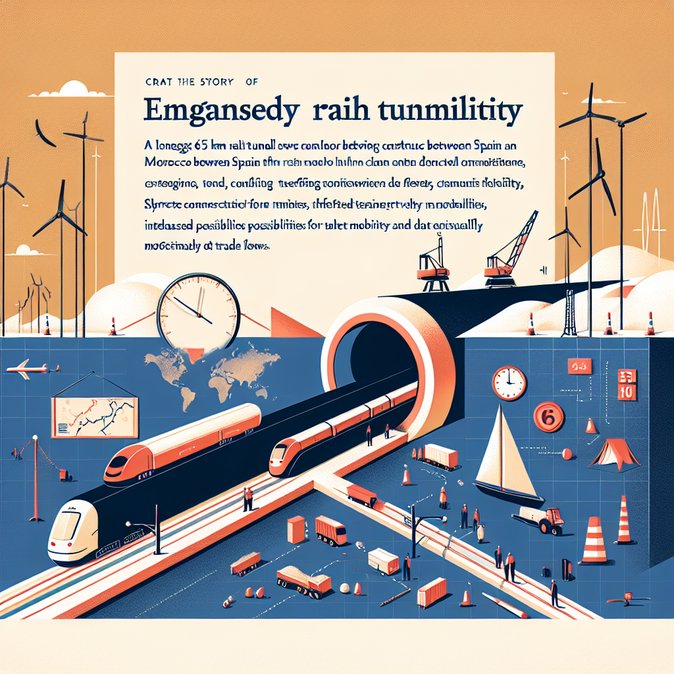
An independent report released at 04:40 CET on 19 December by engineering giant Herrenknecht has confirmed the technical viability of a 65-kilometre rail tunnel beneath the Strait of Gibraltar linking Spain and Morocco. The study, commissioned by Spain’s public developer SECEGSA, resets the project’s completion target to 2035-2040, ruling out earlier political hopes of an opening in time for the 2030 FIFA World Cup, which Spain, Portugal and Morocco will co-host.
The preferred design envisages twin single-track tubes plus a service gallery, reaching a maximum depth of 475 metres below sea level. The Spanish portal would be near Vejer de la Frontera in Cádiz province, connecting to the national high-speed network; the Moroccan portal would sit east of Tangier’s Al Boraq line.
From a global-mobility perspective, the tunnel promises a 30-minute rail trip between Europe and Africa, potentially transforming commuter patterns, near-shore outsourcing and weekend business hops. Logistics analysts predict that once operational the link could shift 13 % of current Spain–Morocco air passengers to rail and boost bilateral freight trade by €7 billion a year.
![Feasibility study clears path for €8.5 billion Spain-Morocco rail tunnel, but World Cup deadline scrapped]()
Travellers and companies mapping out future cross-strait movements can simplify their visa and travel-document needs through VisaHQ, which provides step-by-step online processing, real-time tracking and regulatory updates for Spain and other destinations. More information is available at https://www.visahq.com/spain/
The immediate next step is the drafting of a full preliminary design (APP07) by Spanish engineering firm Ineco, due August 2026, followed by a tender for an exploratory shaft in 2027. Financing, however, remains unresolved; Madrid is exploring a public-private partnership backed by EU TEN-T funds and Gulf sovereign wealth capital.
Corporate relocation teams with North-Africa footprints should watch the political dimension: Spain and Morocco intend to sign a bilateral mobility accord covering social-security portability and streamlined work-permit quotas ahead of construction. If ratified, this could ease expatriate assignments years before the first train runs.
The preferred design envisages twin single-track tubes plus a service gallery, reaching a maximum depth of 475 metres below sea level. The Spanish portal would be near Vejer de la Frontera in Cádiz province, connecting to the national high-speed network; the Moroccan portal would sit east of Tangier’s Al Boraq line.
From a global-mobility perspective, the tunnel promises a 30-minute rail trip between Europe and Africa, potentially transforming commuter patterns, near-shore outsourcing and weekend business hops. Logistics analysts predict that once operational the link could shift 13 % of current Spain–Morocco air passengers to rail and boost bilateral freight trade by €7 billion a year.

Travellers and companies mapping out future cross-strait movements can simplify their visa and travel-document needs through VisaHQ, which provides step-by-step online processing, real-time tracking and regulatory updates for Spain and other destinations. More information is available at https://www.visahq.com/spain/
The immediate next step is the drafting of a full preliminary design (APP07) by Spanish engineering firm Ineco, due August 2026, followed by a tender for an exploratory shaft in 2027. Financing, however, remains unresolved; Madrid is exploring a public-private partnership backed by EU TEN-T funds and Gulf sovereign wealth capital.
Corporate relocation teams with North-Africa footprints should watch the political dimension: Spain and Morocco intend to sign a bilateral mobility accord covering social-security portability and streamlined work-permit quotas ahead of construction. If ratified, this could ease expatriate assignments years before the first train runs.