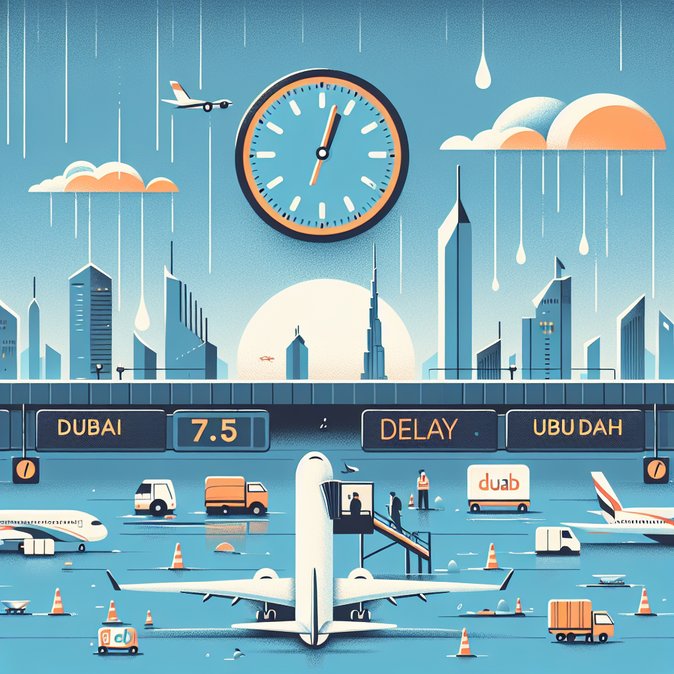
Emirates warned late on 18 December that a powerful winter storm moving across the Arabian Peninsula would disrupt operations at its Dubai hub—and by dawn on 19 December the world’s largest international airline had scrubbed or retimed dozens of flights. A travel-update posted on the carrier’s website lists 14 round-trip services cancelled for Friday, including popular regional shuttles to Kuwait, Bahrain, Muscat and Dammam as well as long-haul sectors to Frankfurt, Colombo, Malé, Peshawar and Incheon.
The disruption is being driven by an intense low-pressure system that has dumped more than 60 mm of rain on parts of Dubai in 24 hours—more than half the city’s annual average. Runway throughput at Dubai International (DXB) has been throttled, forcing Emirates to ground aircraft to protect network integrity. Airport authorities say further delays are likely as apron teams work around standing water and gusty cross-winds.
Operationally, the cancellations ripple far beyond the Gulf. Friday’s EK 043/044 rotation to Frankfurt, for example, would normally carry hundreds of trans-Atlantic and intra-EU transfer passengers who must now be re-routed. Cargo capacity is also affected: Emirates SkyCargo typically moves around 2,000 tonnes a day through DXB, much of it in belly-holds of passenger jets.
![Emirates cancels 14 routes as torrential rain lashes UAE]()
Travellers holding tickets for 18–19 December are being urged to monitor flight-status pages and ensure contact details are up to date so that automated re-booking messages reach them quickly. Emirates is waiving change fees for passengers whose itineraries are impacted by the weather event and says it will “re-protect” customers on the first available flights once conditions stabilise.
Should last-minute re-routing send travellers through countries where they lack entry clearance, VisaHQ can help. The platform processes express UAE visas and documentation for more than 200 other destinations, letting passengers and crew upload applications online and receive approvals rapidly—details are at https://www.visahq.com/united-arab-emirates/
For mobility managers the episode is a reminder that the UAE—despite its desert reputation—can experience flash flooding that paralyses surface access to DXB. Companies with time-critical crew changes, project mobilisations or perishable shipments should build weather contingencies into December timetables and keep hotel blocks on standby near Al-Maktoum International (DWC) in case diversions are triggered.
The disruption is being driven by an intense low-pressure system that has dumped more than 60 mm of rain on parts of Dubai in 24 hours—more than half the city’s annual average. Runway throughput at Dubai International (DXB) has been throttled, forcing Emirates to ground aircraft to protect network integrity. Airport authorities say further delays are likely as apron teams work around standing water and gusty cross-winds.
Operationally, the cancellations ripple far beyond the Gulf. Friday’s EK 043/044 rotation to Frankfurt, for example, would normally carry hundreds of trans-Atlantic and intra-EU transfer passengers who must now be re-routed. Cargo capacity is also affected: Emirates SkyCargo typically moves around 2,000 tonnes a day through DXB, much of it in belly-holds of passenger jets.

Travellers holding tickets for 18–19 December are being urged to monitor flight-status pages and ensure contact details are up to date so that automated re-booking messages reach them quickly. Emirates is waiving change fees for passengers whose itineraries are impacted by the weather event and says it will “re-protect” customers on the first available flights once conditions stabilise.
Should last-minute re-routing send travellers through countries where they lack entry clearance, VisaHQ can help. The platform processes express UAE visas and documentation for more than 200 other destinations, letting passengers and crew upload applications online and receive approvals rapidly—details are at https://www.visahq.com/united-arab-emirates/
For mobility managers the episode is a reminder that the UAE—despite its desert reputation—can experience flash flooding that paralyses surface access to DXB. Companies with time-critical crew changes, project mobilisations or perishable shipments should build weather contingencies into December timetables and keep hotel blocks on standby near Al-Maktoum International (DWC) in case diversions are triggered.