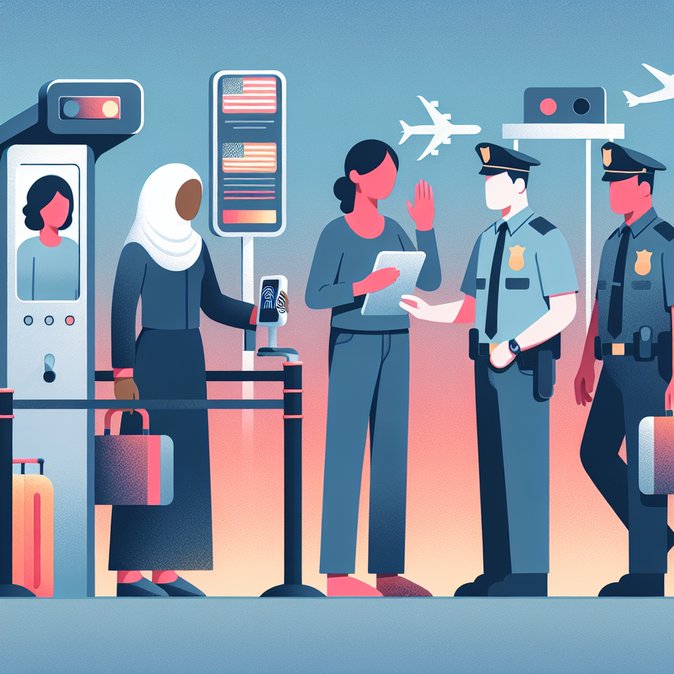
The U.S. Department of Homeland Security (DHS) published a final rule on December 17, 2025 requiring every non-U.S. citizen—including lawful permanent residents—to submit biometric data each time they enter or depart the United States, beginning December 26, 2025. Facial-recognition photographs will be collected at all airports, land crossings and seaports, with fingerprint and iris scans to be phased in later. Travelers who refuse will be denied boarding or entry, effectively making biometrics a condition of travel.
The mandate completes a decades-long congressional directive to create a comprehensive biometric entry-exit system. Pilot programs dating back to 2018 tested facial recognition at 70% of U.S. airports; DHS now says the technology is fast enough to cover the remaining ports without adding to wait times. Airlines and cruise operators must integrate their departure gates with CBP’s cloud-based Traveler Verification Service, while land borders will rely on mobile kiosks and handheld scanners.
If you’re still figuring out whether you need a visa, an ESTA or another document before encountering these new biometric checkpoints, VisaHQ can streamline the entire process. The company’s online portal (https://www.visahq.com/united-states/) offers real-time guidance on U.S. entry requirements, document checklists and appointment scheduling—tools that help both individual travelers and corporate mobility teams stay compliant as DHS rules evolve.
![DHS Sets Christmas Week Launch of Nationwide Biometric Entry-Exit for All Foreign Travelers]()
Privacy advocates, including the ACLU and multiple business-travel coalitions, warn that the rule’s broad scope—covering green-card holders and children as young as two—could normalize face surveillance and expose travelers to data breaches if the massive image database is hacked. DHS counters that images will be hashed and stored for no more than 14 days for most travelers, and says biometrics reduce impostor fraud and speed inspections by 30 seconds per passenger.
For multinational companies the immediate impact is operational: mobility managers must update travel policies, train staff on refusal risks, and ensure that employee-tracking systems can flag individuals whose biometrics were not successfully captured. Frequent travelers should allow extra time at departure gates until the new process stabilizes and verify that their departure record posts to their I-94 history.
Looking ahead, DHS has not ruled out expanding biometric requirements to domestic flights or adding DNA sampling for certain cases. Corporations should continue privacy-impact assessments and engage in public-comment rounds on future biometric expansions to safeguard employee data and business continuity.
The mandate completes a decades-long congressional directive to create a comprehensive biometric entry-exit system. Pilot programs dating back to 2018 tested facial recognition at 70% of U.S. airports; DHS now says the technology is fast enough to cover the remaining ports without adding to wait times. Airlines and cruise operators must integrate their departure gates with CBP’s cloud-based Traveler Verification Service, while land borders will rely on mobile kiosks and handheld scanners.
If you’re still figuring out whether you need a visa, an ESTA or another document before encountering these new biometric checkpoints, VisaHQ can streamline the entire process. The company’s online portal (https://www.visahq.com/united-states/) offers real-time guidance on U.S. entry requirements, document checklists and appointment scheduling—tools that help both individual travelers and corporate mobility teams stay compliant as DHS rules evolve.

Privacy advocates, including the ACLU and multiple business-travel coalitions, warn that the rule’s broad scope—covering green-card holders and children as young as two—could normalize face surveillance and expose travelers to data breaches if the massive image database is hacked. DHS counters that images will be hashed and stored for no more than 14 days for most travelers, and says biometrics reduce impostor fraud and speed inspections by 30 seconds per passenger.
For multinational companies the immediate impact is operational: mobility managers must update travel policies, train staff on refusal risks, and ensure that employee-tracking systems can flag individuals whose biometrics were not successfully captured. Frequent travelers should allow extra time at departure gates until the new process stabilizes and verify that their departure record posts to their I-94 history.
Looking ahead, DHS has not ruled out expanding biometric requirements to domestic flights or adding DNA sampling for certain cases. Corporations should continue privacy-impact assessments and engage in public-comment rounds on future biometric expansions to safeguard employee data and business continuity.