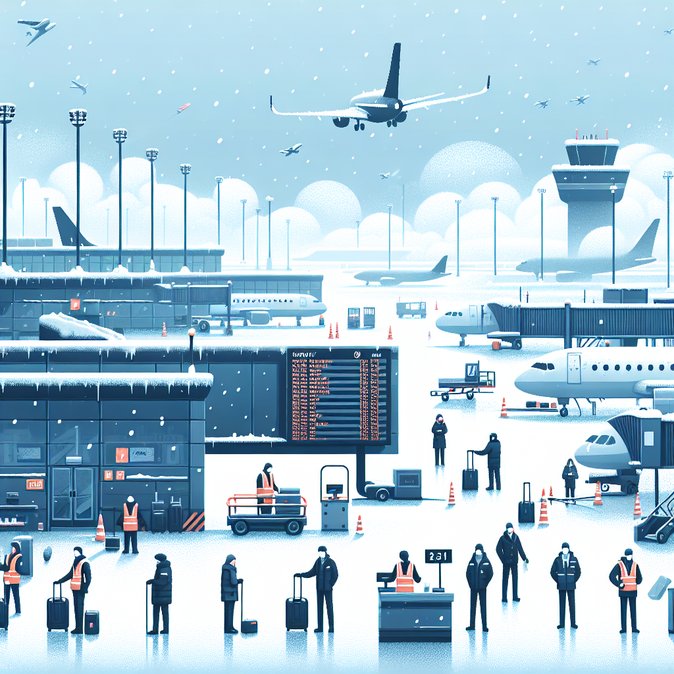
Business and leisure travellers passing through Geneva Cointrin Airport faced a grim start to the holiday-season rush on 18 December, after a powerful Atlantic low pressure system dumped driving rain and thick fog across north-western Europe. Air-traffic-control flow restrictions were imposed at day-break, forcing pilots to accept wider separation minima and triggering an immediate backlog of departures.
Under normal conditions Geneva’s tightly slot-controlled schedule leaves little slack; on Wednesday the combination of low visibility and cascading ground delays caused 66 outbound flights to miss their assigned windows and two to be cancelled outright. Swiss International Air Lines (SWISS) and easyJet, which together handle more than 60 % of Cointrin’s passenger volume, said crews were forced to wait for clearer approach minima into Paris, Zurich and London before pushing back. Crew duty-time limits then tipped a handful of rotations into last-minute cancellation territory.
Travel plans can unravel quickly when weather disruptions collide with tight schedules, and having the right travel documents in hand is one way to minimise stress. VisaHQ (https://www.visahq.com/switzerland/) streamlines the process of checking entry rules and securing visas for Switzerland and onward destinations, giving both corporate mobility teams and individual passengers a fast, reliable tool for last-minute itinerary changes or complex multi-country routings.
![Geneva winter storm and staffing crunch trigger 66 flight delays at Cointrin Airport]()
Airport operator Genève Aéroport acknowledged that pandemic-era labour cuts are still hampering resilience. Ground-handling subcontractors, many of whom lost experienced ramp agents in 2021-22, struggled to staff de-icing trucks and baggage belts fast enough to turn aircraft once weather restrictions eased. Travellers reported queues of up to 90 minutes at re-booking desks and secondary security re-screening when itineraries changed.
While the storm system is forecast to move east by 19 December, the airport warns further disruption is possible if temperatures drop and snow arrives. Corporate mobility managers are being advised to build generous connection buffers, check visa requirements should re-routes involve non-Schengen airports, and remind staff that EU air-passenger-rights rules entitle customers to compensation for delays exceeding three hours when attributable to the carrier.
Cointrin’s woes come as Zurich Airport continues to operate with 30 % of its security lanes closed for CT-scanner installation, compounding the risk of missed onward flights. Taken together, the twin bottlenecks underscore how weather shocks can quickly overwhelm Swiss aviation infrastructure still struggling to rebuild post-COVID staffing levels.
Under normal conditions Geneva’s tightly slot-controlled schedule leaves little slack; on Wednesday the combination of low visibility and cascading ground delays caused 66 outbound flights to miss their assigned windows and two to be cancelled outright. Swiss International Air Lines (SWISS) and easyJet, which together handle more than 60 % of Cointrin’s passenger volume, said crews were forced to wait for clearer approach minima into Paris, Zurich and London before pushing back. Crew duty-time limits then tipped a handful of rotations into last-minute cancellation territory.
Travel plans can unravel quickly when weather disruptions collide with tight schedules, and having the right travel documents in hand is one way to minimise stress. VisaHQ (https://www.visahq.com/switzerland/) streamlines the process of checking entry rules and securing visas for Switzerland and onward destinations, giving both corporate mobility teams and individual passengers a fast, reliable tool for last-minute itinerary changes or complex multi-country routings.

Airport operator Genève Aéroport acknowledged that pandemic-era labour cuts are still hampering resilience. Ground-handling subcontractors, many of whom lost experienced ramp agents in 2021-22, struggled to staff de-icing trucks and baggage belts fast enough to turn aircraft once weather restrictions eased. Travellers reported queues of up to 90 minutes at re-booking desks and secondary security re-screening when itineraries changed.
While the storm system is forecast to move east by 19 December, the airport warns further disruption is possible if temperatures drop and snow arrives. Corporate mobility managers are being advised to build generous connection buffers, check visa requirements should re-routes involve non-Schengen airports, and remind staff that EU air-passenger-rights rules entitle customers to compensation for delays exceeding three hours when attributable to the carrier.
Cointrin’s woes come as Zurich Airport continues to operate with 30 % of its security lanes closed for CT-scanner installation, compounding the risk of missed onward flights. Taken together, the twin bottlenecks underscore how weather shocks can quickly overwhelm Swiss aviation infrastructure still struggling to rebuild post-COVID staffing levels.