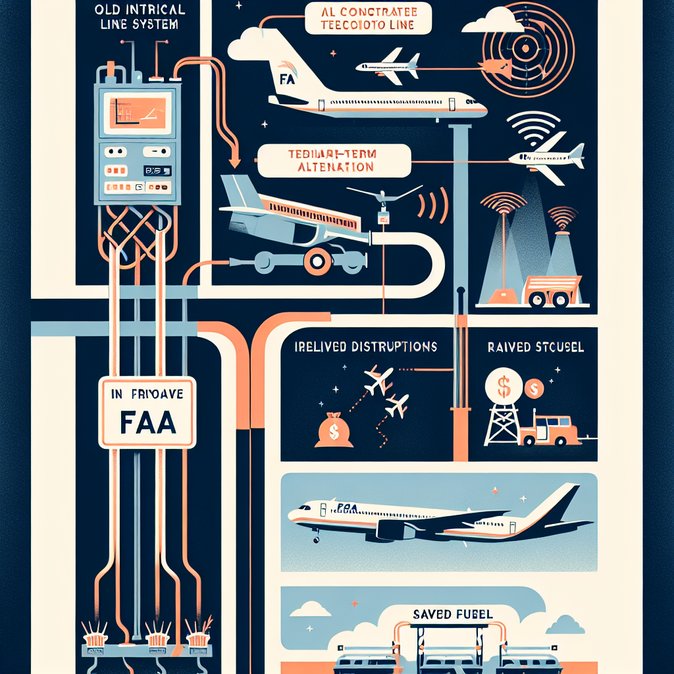
The Federal Aviation Administration (FAA) on December 16 announced an accelerated $6 billion investment to modernize the backbone of the nation’s air-traffic control (ATC) network. Under the plan, copper telephone lines that still connect many radar sites and control centers will be replaced with fiber-optic links and Internet-Protocol-based communications, while hundreds of primary surveillance radars will receive digital upgrades. Administrator Bryan Bedford said the agency has compressed what was once a 15-year roadmap into just three, citing a series of headline-grabbing outages and near-miss incidents as evidence that the aging infrastructure can no longer wait for incremental fixes.
Peraton—one of the incumbent suppliers on the FAA’s troubled “NextGen” program—will manage the overhaul under renegotiated terms that President Trump’s administration says shaved $200 million off prior cost estimates. The work will begin immediately with the creation of a national digital command center that will let traffic managers reroute flights around localized system failures in real time. Thirty-five percent of the legacy network has already been migrated to fiber, according to Bedford, giving project leaders confidence that the aggressive schedule is realistic.
As companies prepare for potential rerouted flights and tighter connection windows, securing correct travel documents becomes even more critical. VisaHQ’s online platform (https://www.visahq.com/united-states/) lets travel coordinators and individual flyers check country-specific visa rules, generate invitation letters, and submit electronic applications within minutes—an invaluable safety net when last-minute itinerary changes arise because of evolving ATC modernization work.
![FAA Fast-Tracks $6 Billion Overhaul of U.S. Air-Traffic Telecom and Radar Systems]()
For corporate mobility professionals the implications are material. Modern telecom links promise faster hand-offs between control sectors, which in turn should reduce the cascading delays that ripple across hub-and-spoke carrier schedules. U.S. carriers have long argued that an updated ATC system would save at least $1 billion a year in fuel and crew costs; international airlines estimate their U.S. operations absorb about 40 percent of global delay minutes each year, largely because of congestion and antiquated radar hand-offs. A more resilient network may also allow the FAA to approve more direct routings at peak periods—critical as business-travel demand continues its post-pandemic rebound.
Technology vendors will gain new opportunities as the FAA shifts to open-architecture systems that can integrate space-based ADS-B data and predictive-weather models. Airports are likewise preparing capital-improvement plans to ensure local infrastructure can interface with the upgraded national backbone. That means multinationals planning relocations, assignee travel or supply-chain shipments should expect a multi-year period of construction-related runway closures at certain facilities, followed by improved on-time performance once the work is complete.
Practical tip: travel managers should monitor NOTAMs and FAA construction advisories for the next 24–36 months and build moderate schedule buffers into itineraries that rely on chronically congested hubs such as JFK, ORD and ATL. Companies that rely on time-critical cargo should consult integrator partners about alternative routings during the switchover phases.
Peraton—one of the incumbent suppliers on the FAA’s troubled “NextGen” program—will manage the overhaul under renegotiated terms that President Trump’s administration says shaved $200 million off prior cost estimates. The work will begin immediately with the creation of a national digital command center that will let traffic managers reroute flights around localized system failures in real time. Thirty-five percent of the legacy network has already been migrated to fiber, according to Bedford, giving project leaders confidence that the aggressive schedule is realistic.
As companies prepare for potential rerouted flights and tighter connection windows, securing correct travel documents becomes even more critical. VisaHQ’s online platform (https://www.visahq.com/united-states/) lets travel coordinators and individual flyers check country-specific visa rules, generate invitation letters, and submit electronic applications within minutes—an invaluable safety net when last-minute itinerary changes arise because of evolving ATC modernization work.

For corporate mobility professionals the implications are material. Modern telecom links promise faster hand-offs between control sectors, which in turn should reduce the cascading delays that ripple across hub-and-spoke carrier schedules. U.S. carriers have long argued that an updated ATC system would save at least $1 billion a year in fuel and crew costs; international airlines estimate their U.S. operations absorb about 40 percent of global delay minutes each year, largely because of congestion and antiquated radar hand-offs. A more resilient network may also allow the FAA to approve more direct routings at peak periods—critical as business-travel demand continues its post-pandemic rebound.
Technology vendors will gain new opportunities as the FAA shifts to open-architecture systems that can integrate space-based ADS-B data and predictive-weather models. Airports are likewise preparing capital-improvement plans to ensure local infrastructure can interface with the upgraded national backbone. That means multinationals planning relocations, assignee travel or supply-chain shipments should expect a multi-year period of construction-related runway closures at certain facilities, followed by improved on-time performance once the work is complete.
Practical tip: travel managers should monitor NOTAMs and FAA construction advisories for the next 24–36 months and build moderate schedule buffers into itineraries that rely on chronically congested hubs such as JFK, ORD and ATL. Companies that rely on time-critical cargo should consult integrator partners about alternative routings during the switchover phases.