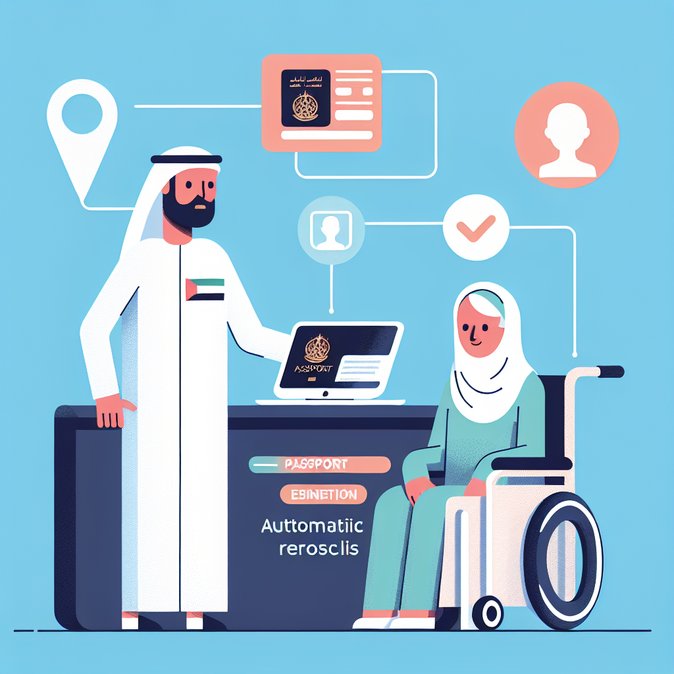
The Federal Authority for Identity, Citizenship, Customs and Port Security (ICP) has switched on an automated renewal system that will spare thousands of Emirati senior citizens and people of determination the need to file applications, pay fees or visit service centres when their passports or Emirates ID cards expire. Under the new “Taqdeer Package”, ICP’s database continuously monitors expiry dates; documents approaching renewal are re-issued, printed and courier-delivered to the beneficiary’s home before the old ones lapse.
The initiative was unveiled on 16 December and forms part of the UAE’s Zero Government Bureaucracy (ZGB) programme, which aims to eliminate redundant steps across 2,000 public-service journeys by 2026. For the target group, ICP says the process map has shrunk from three touch-points to zero, cutting average processing time from five days to 24 hours and removing biometric re-capture where the previous photo is still valid.
Meanwhile, organisations and individuals who want an additional safety net as these processes evolve can lean on VisaHQ’s UAE specialists. The platform’s tailored dashboard (https://www.visahq.com/united-arab-emirates/) monitors passport and ID validity, issues renewal reminders, and offers concierge visa services—ensuring travellers stay compliant even when documents are re-issued automatically.
![UAE rolls out ‘Taqdeer’ package to auto-renew passports and Emirates IDs for seniors and people of determination]()
For corporate mobility managers the move is significant because it confirms the UAE’s shift toward proactive, data-driven public services that reduce friction for all travellers. ICP officials hinted that the same auto-renewal logic could be extended to high-volume categories such as Golden Visa holders once the pilot proves stable. Organisations employing Emiratis will therefore need to update internal compliance calendars to reflect that employees may receive new ID numbers or document versions without warning.
Practical implications include the need for HR and global-mobility teams to ensure payroll, health-insurance and travel-booking systems can ingest automatically issued ID numbers. Employers should also brief travel-desk staff that some Emirati passengers may arrive at airports with freshly issued documents whose chip data has not yet propagated to airline departure-control systems, possibly triggering manual verification.
Ultimately, the package underlines how the UAE is leveraging digital identity to keep pace with its ageing population and to reinforce its reputation as a friction-free base for regional headquarters and international assignments.
The initiative was unveiled on 16 December and forms part of the UAE’s Zero Government Bureaucracy (ZGB) programme, which aims to eliminate redundant steps across 2,000 public-service journeys by 2026. For the target group, ICP says the process map has shrunk from three touch-points to zero, cutting average processing time from five days to 24 hours and removing biometric re-capture where the previous photo is still valid.
Meanwhile, organisations and individuals who want an additional safety net as these processes evolve can lean on VisaHQ’s UAE specialists. The platform’s tailored dashboard (https://www.visahq.com/united-arab-emirates/) monitors passport and ID validity, issues renewal reminders, and offers concierge visa services—ensuring travellers stay compliant even when documents are re-issued automatically.

For corporate mobility managers the move is significant because it confirms the UAE’s shift toward proactive, data-driven public services that reduce friction for all travellers. ICP officials hinted that the same auto-renewal logic could be extended to high-volume categories such as Golden Visa holders once the pilot proves stable. Organisations employing Emiratis will therefore need to update internal compliance calendars to reflect that employees may receive new ID numbers or document versions without warning.
Practical implications include the need for HR and global-mobility teams to ensure payroll, health-insurance and travel-booking systems can ingest automatically issued ID numbers. Employers should also brief travel-desk staff that some Emirati passengers may arrive at airports with freshly issued documents whose chip data has not yet propagated to airline departure-control systems, possibly triggering manual verification.
Ultimately, the package underlines how the UAE is leveraging digital identity to keep pace with its ageing population and to reinforce its reputation as a friction-free base for regional headquarters and international assignments.