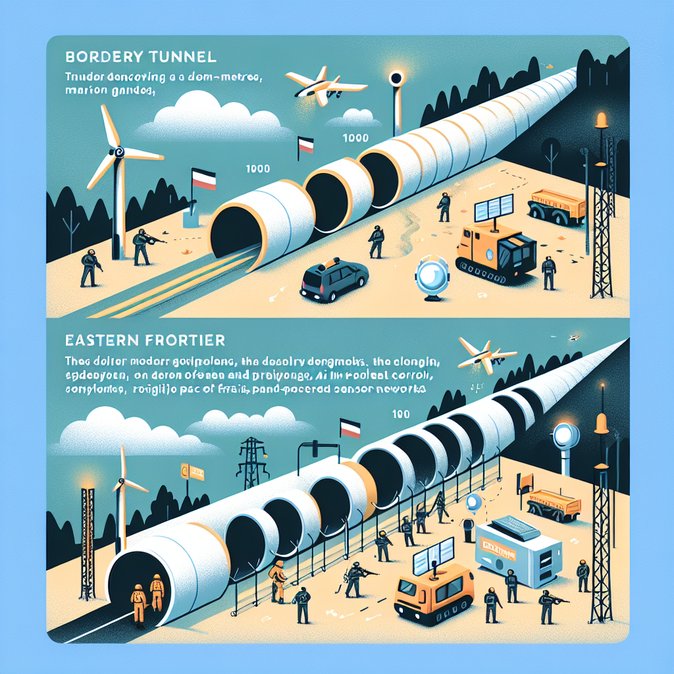
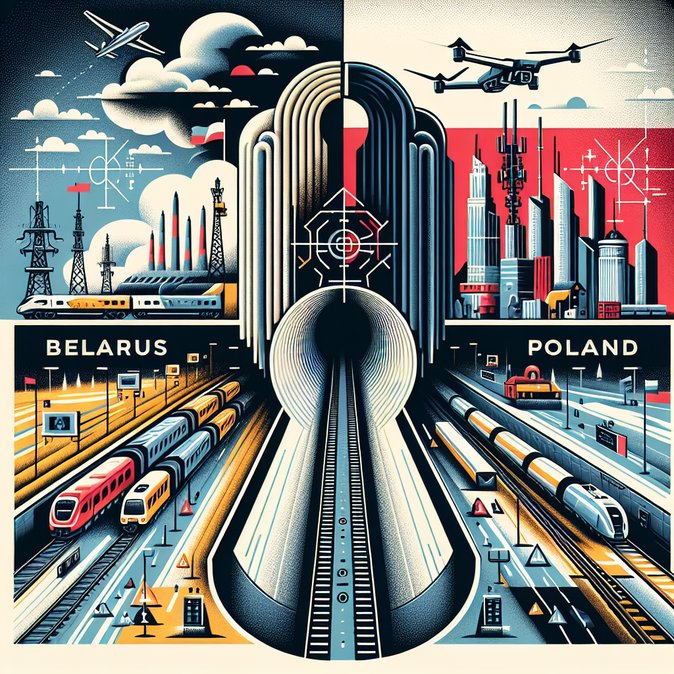
Poland’s Border Guard confirmed over the weekend that a 1.5-metre-high tunnel running beneath an embankment near Narewka, Podlaskie province, was used to move at least 180 migrants from Belarus into Polish territory. Integrated vibration sensors installed along the 180-kilometre steel fence triggered an alert in the early hours of 13 December, allowing rapid-response units to surround the exit point and detain 130 people within minutes. Two suspected facilitators—a Polish national and a Lithuanian driver—were also arrested with getaway vans loaded with blankets and mobile phones.
The discovery marks the fourth illicit passageway found in 2025, confirming that smuggling networks are literally going underground as physical barriers and thermal cameras make surface crossings increasingly difficult. Warsaw reacted quickly: the Ministry of Interior earmarked €18 million in emergency funds to deploy ground-penetrating radar, AI-enabled acoustic arrays and additional heat-seeking drones along the most densely forested sections of the Belarus frontier. A mobile command centre will be stationed in Hajnówka to coordinate data feeds from the new sensors and existing camera towers.
![Poland Uncovers Smuggling Tunnel on Belarus Border, Accelerates High-Tech Surveillance Roll-out]()
If you or your staff need to enter Poland for business, transit or humanitarian work, VisaHQ can simplify the paperwork at a time when border controls are tightening. Through its Poland portal (https://www.visahq.com/poland/) the service provides real-time visa requirements, digital application tools and status tracking, helping travellers stay compliant and avoid disruptions caused by sudden policy shifts.
For corporate security and mobility managers the incident is more than a border-control story. Logistic corridors such as S8 (Białystok–Warsaw) and rail lines carrying container traffic from the Małaszewicze dry port remain vulnerable to temporary closures each time large migrant groups are intercepted. Companies moving time-critical shipments or rotational staff through the region should build extra transit buffers and keep watch for ad-hoc military roadblocks while the search for the remaining migrants continues.
Human-rights NGOs have already warned of worsening humanitarian conditions as winter temperatures drop below freezing; the government insists that detained individuals will have access to asylum procedures but will be held in guarded centres pending background checks. The episode underscores the growing interplay between mobility policy and security strategy on the EU’s eastern flank, raising the likelihood of stricter document checks for legitimate travellers in the months ahead.
The discovery marks the fourth illicit passageway found in 2025, confirming that smuggling networks are literally going underground as physical barriers and thermal cameras make surface crossings increasingly difficult. Warsaw reacted quickly: the Ministry of Interior earmarked €18 million in emergency funds to deploy ground-penetrating radar, AI-enabled acoustic arrays and additional heat-seeking drones along the most densely forested sections of the Belarus frontier. A mobile command centre will be stationed in Hajnówka to coordinate data feeds from the new sensors and existing camera towers.
If you or your staff need to enter Poland for business, transit or humanitarian work, VisaHQ can simplify the paperwork at a time when border controls are tightening. Through its Poland portal (https://www.visahq.com/poland/) the service provides real-time visa requirements, digital application tools and status tracking, helping travellers stay compliant and avoid disruptions caused by sudden policy shifts.
For corporate security and mobility managers the incident is more than a border-control story. Logistic corridors such as S8 (Białystok–Warsaw) and rail lines carrying container traffic from the Małaszewicze dry port remain vulnerable to temporary closures each time large migrant groups are intercepted. Companies moving time-critical shipments or rotational staff through the region should build extra transit buffers and keep watch for ad-hoc military roadblocks while the search for the remaining migrants continues.
Human-rights NGOs have already warned of worsening humanitarian conditions as winter temperatures drop below freezing; the government insists that detained individuals will have access to asylum procedures but will be held in guarded centres pending background checks. The episode underscores the growing interplay between mobility policy and security strategy on the EU’s eastern flank, raising the likelihood of stricter document checks for legitimate travellers in the months ahead.