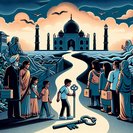
Facing critical shortages across its provincial health systems, Canada on 9 December unveiled a dedicated immigration stream that grants internationally trained physicians permanent residency in as little as six months. The pathway simplifies credential recognition and waives the usual requirement that applicants secure a provincial nomination before filing.
Indian doctors are expected to be among the largest beneficiaries; they already form the second-largest cohort of International Medical Graduates (IMGs) in Canada after the Philippines. According to Immigration, Refugees and Citizenship Canada (IRCC), IMGs make up 26 % of Canada’s practising doctors but 39 % of those in rural or underserved areas.
For doctors and family members mapping out the paperwork journey, VisaHQ can help gather the necessary police clearances, passport renewals and dependent visa documents, offering step-by-step guidance and real-time tracking through its India portal: https://www.visahq.com/india/
![Canada launches fast-track permanent-residency pathway for foreign doctors—Indian physicians poised to benefit]()
Under the new rules, physicians who have completed at least one year of paid clinical work in Canada on a work permit—often under the Rural Northern Immigration Pilot or temporary labour agreements—can file for expedited permanent residency along with their immediate family. Spouses receive open work permits, a key draw for dual-career households.
Indian healthcare recruiters say the scheme will intensify competition for talent at a time when New Delhi is trying to stem ‘medical brain drain’. Nevertheless, mobility specialists point out that many Indian doctors choose Canada for its postgraduate training pathways and clearer citizenship prospects compared with the U.S. H-1B system.
Hospitals in Ontario and British Columbia have already begun advertising roles that come with “PR-fast-track eligibility,” and webinar sign-ups from India jumped 240 % within 24 hours of the announcement.
Indian doctors are expected to be among the largest beneficiaries; they already form the second-largest cohort of International Medical Graduates (IMGs) in Canada after the Philippines. According to Immigration, Refugees and Citizenship Canada (IRCC), IMGs make up 26 % of Canada’s practising doctors but 39 % of those in rural or underserved areas.
For doctors and family members mapping out the paperwork journey, VisaHQ can help gather the necessary police clearances, passport renewals and dependent visa documents, offering step-by-step guidance and real-time tracking through its India portal: https://www.visahq.com/india/

Under the new rules, physicians who have completed at least one year of paid clinical work in Canada on a work permit—often under the Rural Northern Immigration Pilot or temporary labour agreements—can file for expedited permanent residency along with their immediate family. Spouses receive open work permits, a key draw for dual-career households.
Indian healthcare recruiters say the scheme will intensify competition for talent at a time when New Delhi is trying to stem ‘medical brain drain’. Nevertheless, mobility specialists point out that many Indian doctors choose Canada for its postgraduate training pathways and clearer citizenship prospects compared with the U.S. H-1B system.
Hospitals in Ontario and British Columbia have already begun advertising roles that come with “PR-fast-track eligibility,” and webinar sign-ups from India jumped 240 % within 24 hours of the announcement.