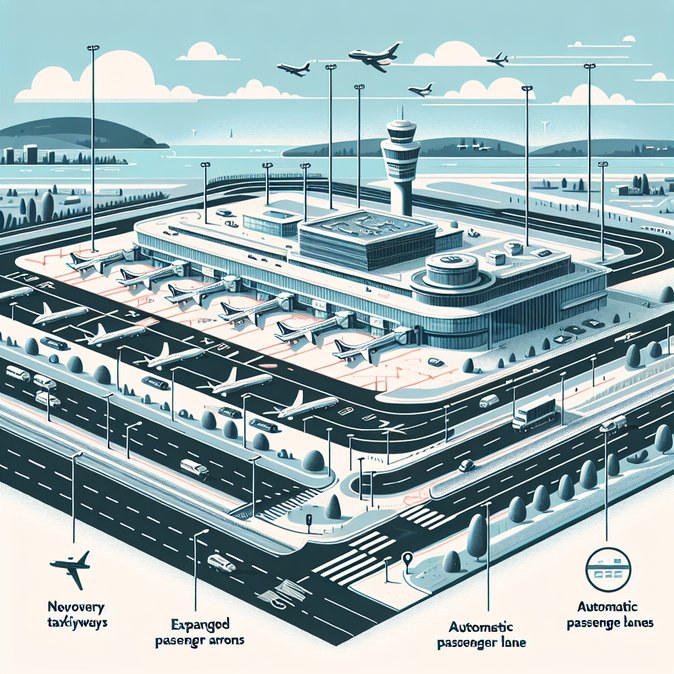
Commercial flights returned to Wrocław’s Nicolaus Copernicus Airport at 00:01 on 5 December, ending a 40-day shutdown that forced airlines to divert passengers through Katowice and Kraków. Contractors used the closure to install a rapid-exit taxiway, widen aprons, strengthen pavements for heavier military and cargo jets, and roll out self-service boarding-pass gates.
Airport management says the upgraded infrastructure will double the number of aircraft movements per hour and trim taxi-times by two minutes—an important gain on the high-frequency Warsaw–Wrocław shuttle favoured by corporate travellers. A sixth security lane and automated e-gates are expected to lift peak-hour throughput to 2,000 passengers.
![Wrocław Airport reopens after 40-day overhaul, promising faster business links]()
LOT, Ryanair and Wizz Air have reinstated their schedules, while Ryanair used the downtime to perform heavy maintenance on its based fleet. Rail operator PKP Intercity reported a 12 percent jump in bookings during the closure; those passengers are now expected to flow back to air.
Travel-management companies are advising clients to reconfirm flight numbers and build modest buffer times over the first 48 hours while air-traffic controllers fine-tune approach procedures. The airport’s reopening also boosts regional mobility for U.S. forces stationed at nearby Powidz, for whom Wrocław is a logistics hub.
The expansion aligns with Poland’s broader strategy of upgrading provincial airports to relieve pressure on Warsaw and spread foreign investment across the country’s dynamic western regions.
Airport management says the upgraded infrastructure will double the number of aircraft movements per hour and trim taxi-times by two minutes—an important gain on the high-frequency Warsaw–Wrocław shuttle favoured by corporate travellers. A sixth security lane and automated e-gates are expected to lift peak-hour throughput to 2,000 passengers.

LOT, Ryanair and Wizz Air have reinstated their schedules, while Ryanair used the downtime to perform heavy maintenance on its based fleet. Rail operator PKP Intercity reported a 12 percent jump in bookings during the closure; those passengers are now expected to flow back to air.
Travel-management companies are advising clients to reconfirm flight numbers and build modest buffer times over the first 48 hours while air-traffic controllers fine-tune approach procedures. The airport’s reopening also boosts regional mobility for U.S. forces stationed at nearby Powidz, for whom Wrocław is a logistics hub.
The expansion aligns with Poland’s broader strategy of upgrading provincial airports to relieve pressure on Warsaw and spread foreign investment across the country’s dynamic western regions.