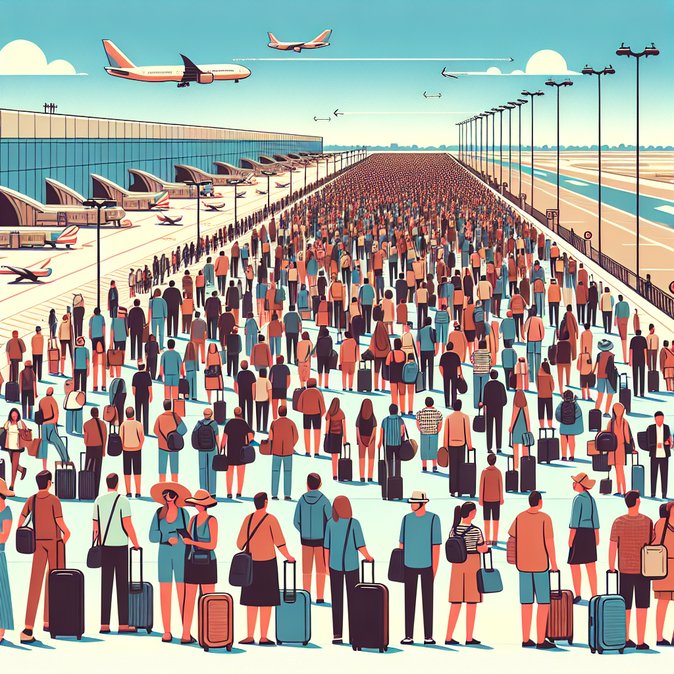
France’s two busiest gateways—Paris-Charles-de-Gaulle and Paris-Orly—have formally requested that the European Commission postpone the final, all-passenger activation of the Schengen Entry/Exit System (EES) until after the peak summer season. The Aéroports de Paris (ADP) group told French media that, although 300 self-service registration kiosks are already in place and another 120 are on order, the biometric border-control scheme is still creating queues of two to three hours at airports that have rolled it out more aggressively, such as Amsterdam Schiphol and Frankfurt. (connexionfrance.com)
Under the current timetable, airlines and airports must register 100 % of third-country nationals at Schengen borders from April 2026. ADP warns that passenger volumes in July and August are forecast to break pre-Covid records and that adding a 30- to 90-second biometric capture for every non-EU traveller risks “congestion we cannot physically absorb”. Similar pleas have been made by Portuguese and Dutch hubs after Lisbon registered seven-hour waits earlier this month.
Airport managers emphasise that they support the security objectives of EES and ETIAS but want “a gradual approach” that keeps staffing and automation in balance with traffic peaks. They argue that a summer grace period would allow more border-force recruitment, fine-tuning of kiosks, and a public-information campaign so travellers arrive prepared.
![Paris-area airports ask EU to postpone full Entry/Exit System rollout until after summer 2026]()
Amid this uncertainty, VisaHQ’s France portal (https://www.visahq.com/france/) can streamline trip planning by providing real-time EES and ETIAS updates, customised document checklists, and application support for travellers of all nationalities, helping corporates and individuals avoid unnecessary delays.
For global-mobility managers the stakes are high: longer queues translate into missed connections, higher chauffeur costs, and employee fatigue on short-notice assignments. Companies with frequent non-EU travellers are being advised to pad itineraries, purchase fast-track services where available, and brief assignees on the need to pre-register in airline apps as soon as the functionality goes live.
The Commission is expected to review the request in March. If it refuses, French airports say they may invoke the Schengen Borders Code article that allows member states to suspend parts of EES temporarily in the event of ‘serious operational difficulties’.
Under the current timetable, airlines and airports must register 100 % of third-country nationals at Schengen borders from April 2026. ADP warns that passenger volumes in July and August are forecast to break pre-Covid records and that adding a 30- to 90-second biometric capture for every non-EU traveller risks “congestion we cannot physically absorb”. Similar pleas have been made by Portuguese and Dutch hubs after Lisbon registered seven-hour waits earlier this month.
Airport managers emphasise that they support the security objectives of EES and ETIAS but want “a gradual approach” that keeps staffing and automation in balance with traffic peaks. They argue that a summer grace period would allow more border-force recruitment, fine-tuning of kiosks, and a public-information campaign so travellers arrive prepared.
Amid this uncertainty, VisaHQ’s France portal (https://www.visahq.com/france/) can streamline trip planning by providing real-time EES and ETIAS updates, customised document checklists, and application support for travellers of all nationalities, helping corporates and individuals avoid unnecessary delays.
For global-mobility managers the stakes are high: longer queues translate into missed connections, higher chauffeur costs, and employee fatigue on short-notice assignments. Companies with frequent non-EU travellers are being advised to pad itineraries, purchase fast-track services where available, and brief assignees on the need to pre-register in airline apps as soon as the functionality goes live.
The Commission is expected to review the request in March. If it refuses, French airports say they may invoke the Schengen Borders Code article that allows member states to suspend parts of EES temporarily in the event of ‘serious operational difficulties’.