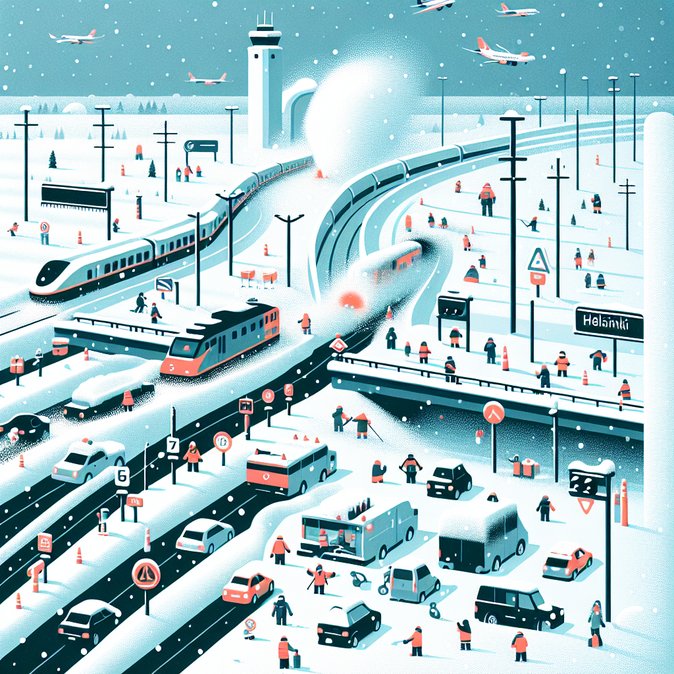
The first weekend of Finland’s winter school holidays has been hit by a fast-moving Arctic low-pressure front that dumped 20–40 cm of snow over large parts of the country overnight, forcing the Finnish Transport and Communications Agency (Traficom) and the Finnish Meteorological Institute to issue rare, nationwide Level 2 road-weather warnings on 22 February 2026. The heaviest bands swept south-east from North Karelia through Savonia into central Häme, severely reducing visibility on the E75 and Route 5 corridors that carry much of the seasonal leisure traffic to Lapland ski resorts.
Police reported dozens of minor collisions before noon and advised motorists to postpone non-essential journeys or equip vehicles with snow chains—still uncommon outside Lapland—before venturing north. VR, Finland’s state rail operator, said drifting snow caused point failures on the Riihimäki–Lahti line, delaying several InterCity services to Kuopio and Joensuu by up to 90 minutes. Finavia, meanwhile, confirmed that runway-clearing operations at Helsinki-Vantaa stretched departure queues, although no flights were cancelled outright thanks to rapid turnaround of de-icing crews.
For mobility managers the timing is awkward: many expatriate families use the week-long talviloma to renew Schengen residence permits abroad or to make exploratory home-leave trips.
![Heavy snowfall snarls winter-holiday traffic across Finland, prompting travel safety alerts]()
If sudden weather disruptions force a change of travel plans, VisaHQ’s Finland portal (https://www.visahq.com/finland/) can coordinate expedited visa or permit processing, organise courier pick-ups and monitor consulate capacity in real time, helping travellers and HR teams stay on schedule despite snow-related delays.
Employers should therefore anticipate return-to-work delays and remind staff that airlines will not compensate missed connections caused by road-weather disruption. Companies running shuttle buses from Helsinki to regional plants in Jyväskylä, Mikkeli and Kuopio have already activated contingency plans, adding driver rest stops and authorising overnight accommodation if journeys exceed statutory EU driving-time limits.
Looking ahead, the Finnish Meteorological Institute expects temperatures to plunge to –25 °C in eastern lake districts tonight, which could turn packed snow into hard ice, complicating tomorrow’s morning commute in the capital region. Traficom has asked haulage companies to stagger long-distance lorry departures to prevent jack-knife incidents on inclines. The agency also reminded foreign drivers unfamiliar with Nordic conditions that exceeding the 80 km/h advisory limit in a Level 2 warning may invalidate insurance cover.
While Finland’s transport infrastructure is famously resilient, the episode is a reminder that climate change is amplifying both sudden thaws and extreme snowfall events, increasing volatility for domestic mobility. Employers with regular winter assignees should consider adding weather-triggered remote-work clauses to assignment letters and ensure that emergency contact trees are tested before each holiday peak.
Police reported dozens of minor collisions before noon and advised motorists to postpone non-essential journeys or equip vehicles with snow chains—still uncommon outside Lapland—before venturing north. VR, Finland’s state rail operator, said drifting snow caused point failures on the Riihimäki–Lahti line, delaying several InterCity services to Kuopio and Joensuu by up to 90 minutes. Finavia, meanwhile, confirmed that runway-clearing operations at Helsinki-Vantaa stretched departure queues, although no flights were cancelled outright thanks to rapid turnaround of de-icing crews.
For mobility managers the timing is awkward: many expatriate families use the week-long talviloma to renew Schengen residence permits abroad or to make exploratory home-leave trips.

If sudden weather disruptions force a change of travel plans, VisaHQ’s Finland portal (https://www.visahq.com/finland/) can coordinate expedited visa or permit processing, organise courier pick-ups and monitor consulate capacity in real time, helping travellers and HR teams stay on schedule despite snow-related delays.
Employers should therefore anticipate return-to-work delays and remind staff that airlines will not compensate missed connections caused by road-weather disruption. Companies running shuttle buses from Helsinki to regional plants in Jyväskylä, Mikkeli and Kuopio have already activated contingency plans, adding driver rest stops and authorising overnight accommodation if journeys exceed statutory EU driving-time limits.
Looking ahead, the Finnish Meteorological Institute expects temperatures to plunge to –25 °C in eastern lake districts tonight, which could turn packed snow into hard ice, complicating tomorrow’s morning commute in the capital region. Traficom has asked haulage companies to stagger long-distance lorry departures to prevent jack-knife incidents on inclines. The agency also reminded foreign drivers unfamiliar with Nordic conditions that exceeding the 80 km/h advisory limit in a Level 2 warning may invalidate insurance cover.
While Finland’s transport infrastructure is famously resilient, the episode is a reminder that climate change is amplifying both sudden thaws and extreme snowfall events, increasing volatility for domestic mobility. Employers with regular winter assignees should consider adding weather-triggered remote-work clauses to assignment letters and ensure that emergency contact trees are tested before each holiday peak.