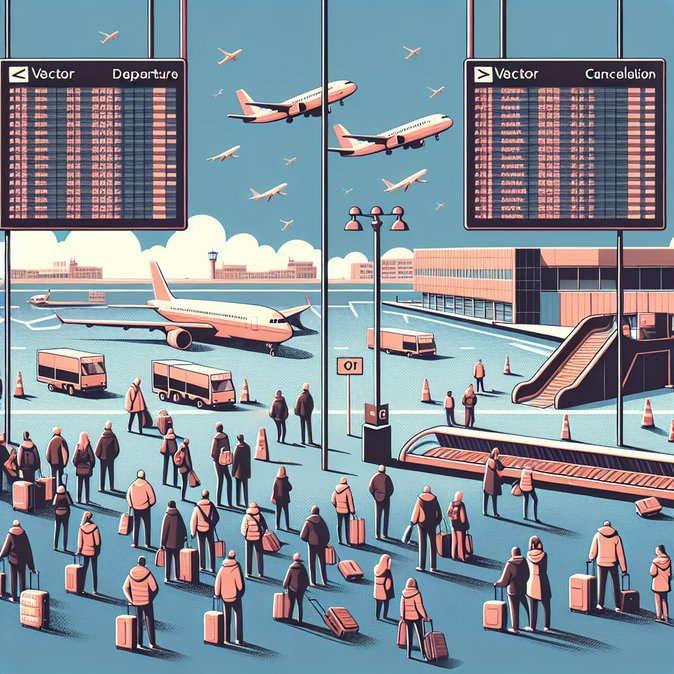
Brussels Airport Company (BAC) issued an extraordinary advisory on Sunday, 22 February, telling passengers to expect “a virtually complete halt of all outbound flights” on Tuesday, 12 March, when Belgium’s three main trade-union federations will stage a 24-hour nationwide strike. The airport says security screening, baggage handling, catering and even air-traffic services are likely to be understaffed, making normal departures impossible. Arriving aircraft may still land, but BAC cautions that immigration and baggage processing will be “extremely slow”. (euroweeklynews.com)
The walk-out is not limited to aviation workers: public-sector employees, rail staff and many private-sector union members have pledged to join. Airlines using Brussels Airport (BRU) have already begun waiving change-fees for tickets dated 11-13 March, and carriers including Brussels Airlines and Ryanair are preparing provisional ferry flights to position aircraft abroad overnight on 11 March so that schedules can resume quickly on 13 March. Travel-management companies are advising corporate clients to reroute executives through Amsterdam Schiphol, Paris-CDG or Frankfurt, warning that seat availability on those dates is shrinking fast. (euroweeklynews.com)
![Brussels Airport warns travellers of near-total shutdown during 12 March general strike]()
For international passengers scrambling to re-book through neighboring countries, making sure travel documents are valid for every potential transit point is essential. VisaHQ can help by instantly checking Schengen visa requirements and arranging expedited processing when time is tight; its Belgium page (https://www.visahq.com/belgium/) also outlines entry rules for nearby hubs like Amsterdam, Paris or Frankfurt, giving travelers one less thing to worry about during the disruption.
Belgium has a long tradition of coordinated general strikes, but BRU’s management says the timing—just before the busy Easter-holiday period—raises the stakes for airlines and exporters. Cargo operators fear missed “cool-chain” connections for pharmaceuticals and perishables; logistics groups estimate that a 24-hour ground-stop could delay up to 4,000 tonnes of freight. European business-travel association GBTA Europe says the strike underscores the importance of contingency planning and flexible ticketing for companies with regional headquarters in Brussels. (euroweeklynews.com)
Under EU Regulation 261/2004, passengers whose flights are cancelled by strikes that are not within an airline’s control are entitled to rerouting or refunds but not to additional cash compensation. Belgian consumer group Test-Achats is urging travellers to keep records of re-booking costs, noting that some travel-insurance policies do reimburse hotel nights or re-ticketing fees incurred because of industrial action. (euroweeklynews.com)
The walk-out is not limited to aviation workers: public-sector employees, rail staff and many private-sector union members have pledged to join. Airlines using Brussels Airport (BRU) have already begun waiving change-fees for tickets dated 11-13 March, and carriers including Brussels Airlines and Ryanair are preparing provisional ferry flights to position aircraft abroad overnight on 11 March so that schedules can resume quickly on 13 March. Travel-management companies are advising corporate clients to reroute executives through Amsterdam Schiphol, Paris-CDG or Frankfurt, warning that seat availability on those dates is shrinking fast. (euroweeklynews.com)

For international passengers scrambling to re-book through neighboring countries, making sure travel documents are valid for every potential transit point is essential. VisaHQ can help by instantly checking Schengen visa requirements and arranging expedited processing when time is tight; its Belgium page (https://www.visahq.com/belgium/) also outlines entry rules for nearby hubs like Amsterdam, Paris or Frankfurt, giving travelers one less thing to worry about during the disruption.
Belgium has a long tradition of coordinated general strikes, but BRU’s management says the timing—just before the busy Easter-holiday period—raises the stakes for airlines and exporters. Cargo operators fear missed “cool-chain” connections for pharmaceuticals and perishables; logistics groups estimate that a 24-hour ground-stop could delay up to 4,000 tonnes of freight. European business-travel association GBTA Europe says the strike underscores the importance of contingency planning and flexible ticketing for companies with regional headquarters in Brussels. (euroweeklynews.com)
Under EU Regulation 261/2004, passengers whose flights are cancelled by strikes that are not within an airline’s control are entitled to rerouting or refunds but not to additional cash compensation. Belgian consumer group Test-Achats is urging travellers to keep records of re-booking costs, noting that some travel-insurance policies do reimburse hotel nights or re-ticketing fees incurred because of industrial action. (euroweeklynews.com)